
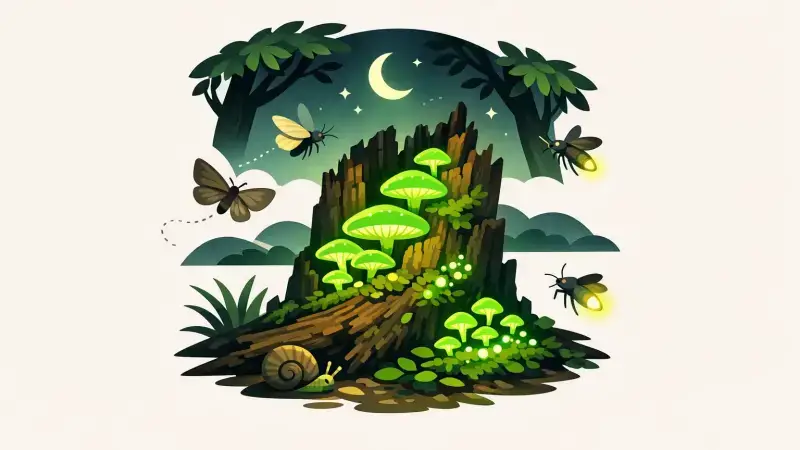
Seeing a tree glow at night
People sometimes report a greenish glow coming from dead wood, not from the sky or an animal, but from the log itself. It isn’t one single place or one famous incident. It’s been noticed in temperate forests in Japan, in parts of the eastern United States, and across Europe. The light comes from fungi living inside damp, decaying wood. As the fungus breaks down the wood for food, a chemical reaction in its cells releases visible light. The wood looks like it has been “painted” with dim light because the glow is spread through the fungal threads running under the surface.
Which fungi do this, and where the light comes from
Several species can produce this glow. A well-known group is the “jack-o’-lantern” mushrooms (Omphalotus species), and another is the honey mushroom group (Armillaria species), where the glowing can come from the mycelium more than the cap you’d notice in daylight. In Japan, the mushroom Mycena chlorophos is often mentioned for strong bioluminescence, though what you see in the field depends on moisture, temperature, and the stage of growth. The light is not heat. It’s a biochemical process involving a molecule called luciferin and an enzyme called luciferase, plus oxygen, producing photons with very little wasted energy.
Why glow at all when you’re a fungus
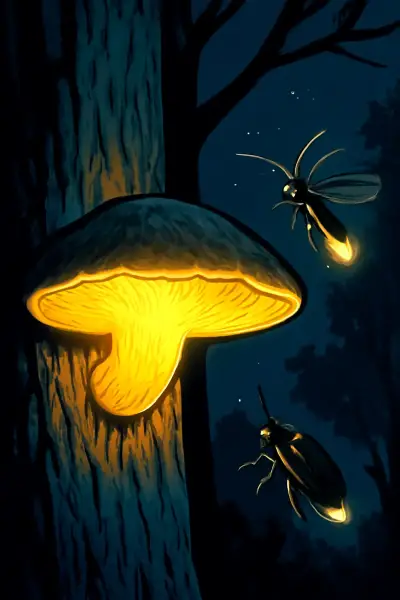
For fungi, glowing is expensive enough that it likely has a payoff, but that payoff isn’t always the same across species. One leading idea is that light can help attract night-active insects that then move spores around. That makes the most sense for species that glow near spore-producing structures, or in habitats where wind dispersal is limited under dense canopy. Another idea is that the glow is a side effect of metabolism, tied to managing reactive oxygen compounds created during wood decay. The evidence isn’t uniform. Some glowing fungi don’t seem to benefit from insect traffic in obvious ways, which suggests there may be more than one reason, or that the effect depends on local ecology.
How insects get involved
Insects don’t need to “understand” the light for it to matter. Many flies, beetles, and gnats are drawn to faint points of contrast at night, especially in dark, cluttered forest understories where landmarks are limited. If a glowing patch sits on a log that also smells like decay and fermentation, it becomes a combined signal: a visual cue plus an odor cue. That’s a detail people often overlook. The glow alone isn’t the whole message. Fungi release volatile compounds as they digest wood, and insects can follow those smells even before the light is visible to a human eye. When insects land, they can pick up spores on legs and bodies, or they can disturb the surface and help spores shed into moving air.
What you’re actually looking at on a glowing log
The brightest-looking areas are often not mushroom caps at all, but mycelium in the wood or under bark. That matters because it changes where the “signal” sits: spread along cracks, knots, or the underside of a fallen branch where humidity stays high. The light can look steady, but at the cellular level it can vary with oxygen access and the fungus’s metabolic pace. A log that glows one night may not glow the next if it dries out, gets colder, or if the fungus shifts resources into growth rather than light production. When people say a forest “lit up,” it’s usually a few scattered pieces of wood, each glowing faintly. Your eyes notice it only after you’ve been in the dark long enough for night vision to kick in.
If you liked this, you might also enjoy: