

On warm nights when cicadas are out, the sound can tighten into a steady pulse, like the insects are keeping time together. It isn’t just because they can hear each other through the air. In places like the eastern U.S. during periodical cicada emergences (for example, Brood X in 2021), the ground itself can carry the rhythm. Plants, soil, and anything attached to them vibrate when cicadas call. Those vibrations travel as tiny tremors. Nearby cicadas can pick them up through their legs and body, and that “feel” can help their chorus line up.
How a chorus gets started
A cicada chorus often begins messy. A few males call, others answer, and the overall noise swells. As density increases, timing starts to matter. When many individuals call at once, each caller has a better chance of being heard over the crowd. If calls are scattered, they blur together and individual patterns get lost.
This is why chorusing tends to drift toward synchrony. Not perfect, not always stable, and it varies by species. But the pressure is simple: a shared beat is louder and cleaner than the same number of callers spread out randomly.
Vibrations are information, not just noise
Cicadas are built to make airborne sound, but they also live on vibrating structures. A calling male makes a branch shake a little. Leaves and stems transmit that vibration into other connected parts of the plant, and sometimes into nearby plants through contact points or dense vegetation. The ground can also conduct low-frequency components, especially when the source is close and the surface is continuous enough.
One detail people overlook is how much of a cicada’s body is already “wired” to feel motion. Their feet are gripping bark. Their legs are in constant contact with a surface. Even without turning toward a sound, they are sitting on a sensor. That means a chorus can coordinate through shared vibration cues, not only through directional hearing in air.
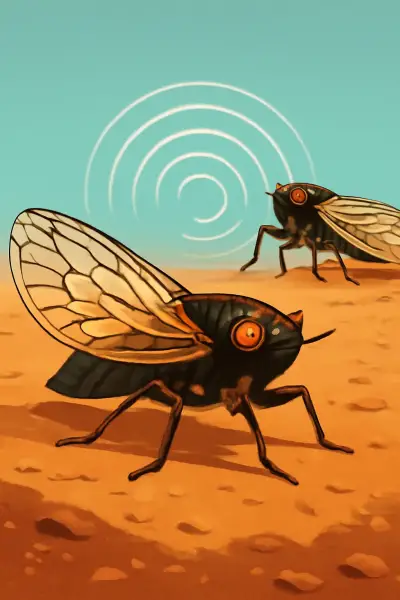
What “listening to the ground” looks like for an insect
Insects don’t need ears shaped like ours to detect rhythm. They can sense mechanical vibrations through receptors in their legs and body joints. A repeating tremor can act like a timing signal. If a cicada is slightly off-beat, it can shift its next call earlier or later to match the strongest, most consistent pulse it detects.
This isn’t mind-reading or group planning. It’s closer to reflexive timing. The animal is responding to a pattern in its environment. When many individuals do the same small adjustment, the group can snap into a shared cadence.
Why plants and soil can beat the air
Airborne sound spreads widely, but it also bounces, scatters, and overlaps. In a dense chorus, the air can become a jumble of similar frequencies. Vibrations in a branch or trunk can be cleaner at short range. They also arrive with less ambiguity about “when” a neighbor called, because the mechanical pulse can be sharp and repeatable.
A concrete situation where this matters: a cluster of males spaced along the same small tree. Each call makes that tree quiver. Even if wind or traffic adds background noise to the air, the shared plant still carries a local beat that everyone on it can detect. Ground conduction can extend that cue beyond a single plant, but how far it travels is unclear and depends on soil type, moisture, and how connected the surfaces are.
What synchrony changes for the cicadas around it
Once a chorus becomes synchronized, it changes the listening problem for everyone nearby. Females that are trying to locate a mate can use timing differences and call structure to pick out individuals. Predators that home in on sound also face a different scene: a unified burst can be overwhelming, and it can be harder to target one caller in the middle of a timed wave.
Synchrony also creates a moving edge. The loudest, most coordinated part of a chorus can shift as groups adjust and new individuals join. From a sidewalk under street trees, it can sound like the pulse is “traveling,” but a lot of that motion is just local clusters aligning and then slipping out of phase as the mix of callers changes.
Related reads
If you liked this, you might also enjoy: