

A pig in the dock
It feels like a joke until you look at the paperwork. In 1386, in Falaise in Normandy, a sow was formally tried and sentenced after killing a child. There were court officials, a recorded judgment, and a public execution. That wasn’t a one-off oddity, either. Medieval and early modern Europe saw a scatter of animal trials in different places, with different rules. The basic mechanism was simple: a community treated harm as an offense against public order, and the local court responded with the same tools it used on humans—charges, testimony, and punishment—because that was how authority showed itself.
What courts thought they were doing
These cases usually landed in the same kinds of courts that handled assaults, theft, and disorder. A loose or aggressive pig could be treated as a danger that demanded a visible response. The “trial” also marked jurisdiction. A lord’s court or a town court was saying, plainly, that it had the power to declare a wrong and impose a remedy. That matters in a world where law was local, overlapping, and constantly negotiated.
There was also a moral logic at work. Wrongdoing wasn’t only about inner intention. It was also about the disturbance caused. A child killed in a lane or a courtyard was not an abstract tragedy. It was a breach in the peace, and peace was something courts claimed to restore.
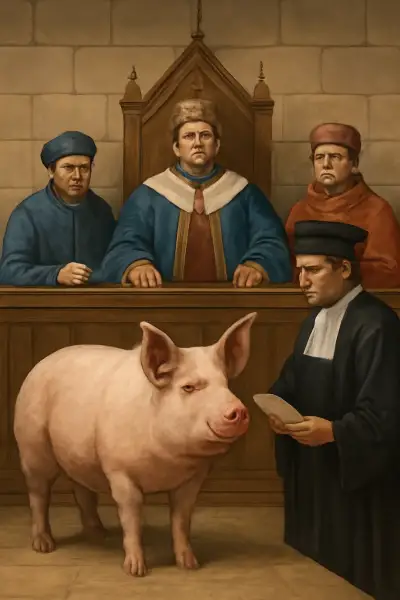
How an animal trial could look in practice
In the Falaise case, surviving accounts describe a formal procession-like punishment. The sow was dressed in a way meant to mirror human penalty, then executed publicly. That detail often gets overlooked because it sounds theatrical, but it matches the wider habit of making punishment legible at a glance. People did not need to read the sentence. They needed to see it.
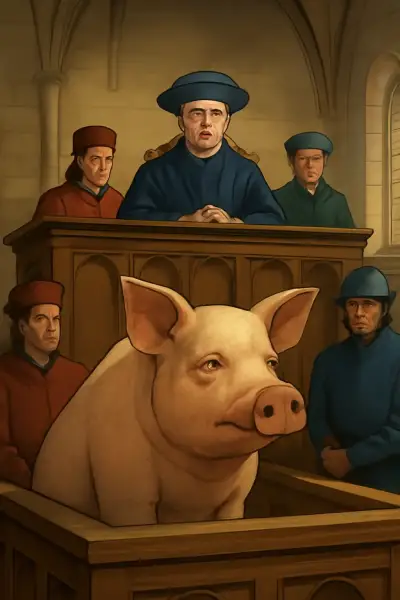
Elsewhere, records suggest courts called witnesses, described wounds, and noted time and place, much as they did in other violent incidents. The animal’s owner might appear too, sometimes facing separate penalties for negligence or for allowing a known danger to roam. In other words, the spectacle did not always replace responsibility. It could sit alongside it.
Why pigs show up so often
Pigs were everywhere in medieval towns and villages. They ate scraps, wandered streets, and mixed closely with people. That closeness is the unglamorous reason they appear in the stories. A horse could injure someone, but it was usually controlled. A pig was more likely to be loose, underfed, and opportunistic, especially around infants and small children.
They were also economically important. A dead pig meant lost value, and a court-ordered execution made that loss official. It converted a private problem into a public act. Even when everyone knew an animal could not “intend” murder, the community still had to decide whether the pig stayed, was destroyed quietly, or was punished in a way that made the decision feel final.
Not all animal cases were the same kind of case
It helps to separate two different traditions that often get blurred together. Individual animals accused of harming people tended to be handled in secular courts, like the sow in Falaise. But swarms and infestations—rats, locusts, weevils—sometimes show up in a different setting, tied to church courts and religious procedure. Those proceedings could look like legal argument too, but the aim was not to execute a single creature. It was to command a nuisance to leave or to mark communal suffering in a formal way.
That split is part of why the surviving examples can feel inconsistent. One record reads like criminal law. Another reads like ritual and petition. The common thread is not that medieval people were confused about animals. It’s that courts and churches were among the few institutions equipped to turn fear, anger, and loss into an ordered public response.
Related reads
If you liked this, you might also enjoy: