

How a face ends up on a latte
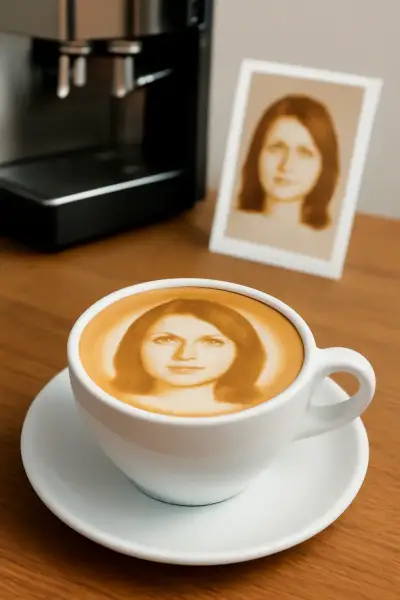
People don’t usually expect coffee to look back at them. But some cafés can take a quick photo and “print” it onto latte foam using edible ink. It isn’t one single famous place. Variations have shown up in different cities and countries, including Ripple Maker machines used in cafés and events in the US and parts of Europe, and older food-printing setups seen in Japan. The basic mechanism is straightforward: a tablet or kiosk captures an image, software converts it into a high-contrast pattern, and a small printer head sprays tiny droplets of food-safe coloring onto the foam’s surface.
The machine is a tiny inkjet printer
Most systems work like inkjet printing, just with edible “ink” and a very soft “paper.” Inside the device there’s a cartridge or reservoir with food-grade coloring (often based on vegetable extracts). A moving print head lays down dots in passes, building the image line by line. The printer doesn’t sink color into the drink much. It sits on top of the micro-bubbles in the foam, which is why the foam has to be stable and fairly even.
That stability is the part people overlook. Not all foam behaves the same. Milk texture depends on fat, protein, temperature, and how it was steamed. If the foam is too wet, the dots bleed and faces turn into smudges. If it’s too dry and bubbly, the printer lands color on peaks and craters, and fine details disappear. The best results usually come from very smooth microfoam, the kind baristas aim for in latte art.
What the software does to your photo
A phone selfie isn’t automatically printable on foam. The system usually crops tightly to the face, boosts contrast, and reduces the image to a limited set of tones. Some machines lean toward a single-color look, like sepia or dark brown, because it reads better on a white foam background. If the photo has harsh shadows or a busy background, the algorithm often simplifies it. That’s why hair and eyebrows tend to show up clearly while subtle skin shading gets lost.
The print area is small, too. Many cups only give the machine a few inches across, and the foam itself is moving slowly as it settles. So the software prioritizes features that survive tiny dot patterns: eyes, mouth, strong outlines. It also tends to rotate and center faces automatically, which can look slightly “off” if the original photo had an angle. None of this is artistic judgment. It’s the practical job of making a recognizable face from a low-resolution spray of edible dye.
What you see in the café
The setup is often near the pickup counter, because timing matters. Foam starts to break down as soon as it’s poured. In a typical scene, someone taps a screen, chooses a photo or a preset image, and the barista slides the cup under a hood. The printer head moves for a few seconds. Then the cup comes out with a crisp portrait or logo floating on top, usually darker than cocoa dusting but lighter than actual chocolate syrup.
One situational detail that’s easy to miss is how sensitive the image is to vibration and tilt. If the cup is bumped while printing, the dot pattern shifts and the face gets a faint double outline. If the cup is carried at an angle right after printing, the foam surface slumps, and the printed features stretch slightly. That’s why cafés sometimes serve these drinks with a little extra foam height, even if the drink style wouldn’t normally call for it.
Why it feels personal, even when it’s automated
There’s a small jolt in seeing a familiar face on something you’re about to drink. The novelty lands because it looks like customization, not decoration. It’s also fast. Traditional latte art requires skill and time, and it changes with every pour. A printer repeats the same output on demand, which makes it useful for promotions, corporate events, and cafés that want consistent visuals across shifts.
At the same time, it stays slightly unpredictable because the “canvas” is foam. Temperature, milk type, and even the wait between steaming and printing can change the result. So you end up with a strange mix: a digital image that should be identical every time, sitting on a surface that never is.
Related reads
- How moss chooses the perfect sidewalk crack to colonize
- The pig put on trial before a medieval French court
- How cicadas synchronize by listening to the ground
- Why names get stuck on the tip of your tongue
- Why some amputees still feel a missing limb
- The fungus that lights up trees and calls insects at night
If you liked this, you might also enjoy: