

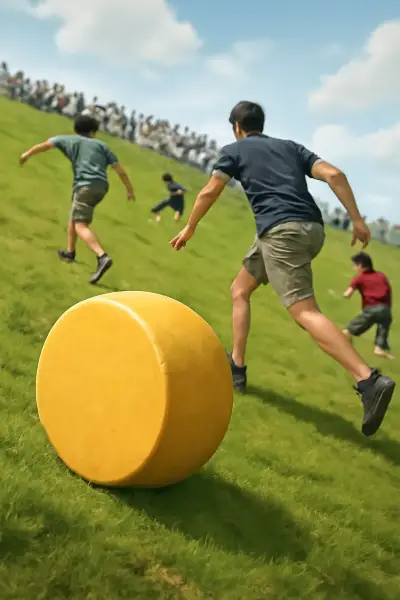
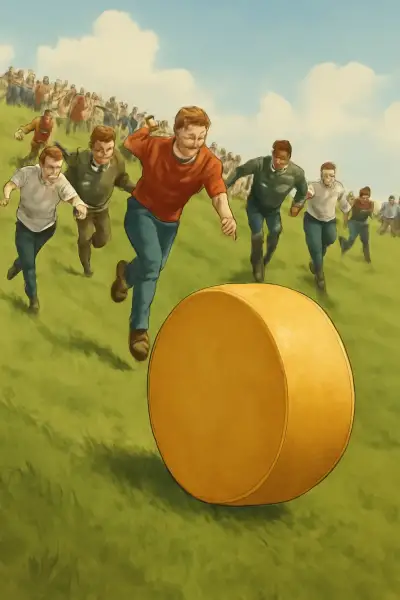
It’s hard to picture on a normal day: a wheel of cheese rolling downhill fast enough that grown adults can’t keep up, and yet they still try. On Cooper’s Hill near Brockworth in Gloucestershire, England, that’s the whole mechanism. Someone sends a round of cheese off the top. A pack of runners launches after it. The slope is so steep that “running” quickly turns into tumbling, sliding, and bouncing, with the cheese long gone ahead. The point isn’t to catch it. It’s to be first over the finish line at the bottom, even if you arrive sideways.
What actually happens on the hill
The start is simple and loud. People gather along a narrow track with ropes and stewards trying to keep a corridor open. A master of ceremonies typically holds up the cheese, then sends it rolling. Once it’s moving, the runners go. The hill’s uneven ground does the rest. Ankles twist. People lose footing immediately. A few manage short bursts of upright sprinting, but most end up in a chain of controlled falls.
A detail people overlook is how quickly the cheese becomes irrelevant. A Double Gloucester-style wheel can hit high speeds on that gradient, and nobody is realistically “chasing” it in the literal sense after the first seconds. What’s being chased is position in the pack, because the finish is about who crosses the bottom first, not who reaches the cheese.
Why a cheese wheel, and why this place
There are origin stories, but they aren’t fully nailed down. You’ll hear claims about old spring rituals, grazing rights, or community boundary markers. Some accounts suggest it’s tied to older hillside celebrations rather than a single documented “first year.” What’s clear is that it became a local tradition strongly associated with Cooper’s Hill, and it stayed sticky because it’s dramatic, legible, and easy to explain in one sentence to anyone passing through.
The cheese itself fits the logic of spectacle. It’s heavy enough to roll with authority, familiar enough to feel like a joke you can take seriously, and round enough to behave like a runaway object. Organizers have sometimes used a foam replica for safety in certain years, though what’s used can vary. The act is the same either way: release something that cannot be negotiated with, then watch humans attempt to negotiate with gravity.
Rules, prizes, and the problem of “official”
From the outside, it can look like a formal sporting event. Up close, it’s more complicated. The gathering has a long history of being community-run, and there have been years where local authorities discouraged it or tried to limit it because of injuries and crowd control. That creates a blurry edge between “officially organized” and “it happened anyway,” depending on the year and who stepped up to manage the day.
The prize is traditionally the cheese, but the social prize is bigger. Winners get names remembered, at least locally, and repeat competitors become familiar faces. There are often multiple races, including separate runs that can include women’s events and children’s events, though the exact lineup can change. The rules stay minimal: start after the cheese, get down the hill, cross first.
What the body is up against
The hill isn’t a track. It’s a steep, bumpy grass slope with ruts, patches of loose footing, and a fall line that pulls people into each other. Once a runner goes down, staying down can be safer than fighting to stand, because legs and arms become moving obstacles for everyone behind. That’s why so many descents turn into rolling rather than running. It’s not cowardice. It’s biomechanics and self-preservation in real time.
At the bottom, volunteer medics and staff are part of the scene. Stretcher carries aren’t rare. Neither are quick checks for head hits and shoulder injuries. A surprising part is how fast the pack can disperse after a crash. People stand up, brush grass off, and limp away smiling, while the next race gets lined up above them.
How a local stunt became a global reference point
Cooper’s Hill is the famous case, but it also sparked copies and cousin events elsewhere because the idea is so portable: pick a slope, pick something that rolls, add a start line. You can find cheese-rolling races and similar downhill chases in other parts of the UK and in places like the US and Canada, sometimes as novelty festival programming rather than a long local tradition. They rarely match the steepness or the crowd intensity of Brockworth, and that difference matters.
What stays consistent is the social setup. Spectators get a clear view of effort, failure, and a winner decided in seconds. Competitors get a moment that’s hard to fake. A rolling wheel of cheese is funny, but the commitment around it is very real, and it doesn’t take long on that hillside to see which part is doing the work.
Related reads
- How a beetle’s dramatic death pose fools both birds and ants
- Why mangrove roots trap carbon and hold back storm surge
- Antique toys discovered hidden inside a house wall
- Why a yawn from someone else makes you yawn too
- The mailbox that spat out letters decades later
- Why names get stuck on the tip of your tongue
If you liked this, you might also enjoy: