
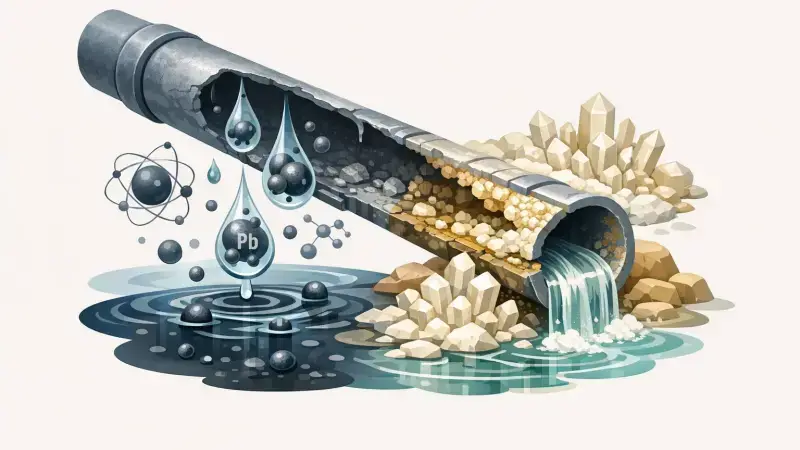
Lead pipes didn’t just move water
People tend to picture a pipe as a neutral tube. Ancient lead plumbing wasn’t. It acted like a slow chemical reactor. There isn’t one single “lead pipe story,” because different waters behave differently. But you can see the pattern in Roman aqueduct-fed cities, in Herculaneum’s preserved plumbing, and in modern crises like Flint, Michigan. The core mechanism is simple: as water sits and flows, it can dissolve a little lead, or it can build a crust that locks lead away. Which one happens depends on the water’s chemistry and on what changes over time.
A specific detail people overlook is the “first draw.” Water that has been motionless inside a lead service line or fixture for hours can pick up far more dissolved metal than water taken after the system has been running. That small timing detail is one reason lead exposure can look erratic, even when the plumbing is the same.
How ancient water changed once it touched lead
When lead meets water, the surface immediately starts transforming. A thin layer of lead oxide and hydroxide forms, and then other minerals can join in. If the water carries carbonate (common in limestone regions), lead carbonate scales such as cerussite (PbCO₃) can develop. If the water contains sulfate, lead sulfate minerals can appear. These layers matter because they control what the water “sees.” The bulk pipe might be lead, but the water is often interacting with a mineral film.
That film doesn’t just protect the pipe. It also changes the water chemistry a little. It can consume or release ions near the surface, and it can shift pH right at the metal-water boundary. The effect is localized, but it influences how much lead stays dissolved. It’s one reason two neighborhoods with similar pipes can have different lead levels if the source water or the treatment history is different.
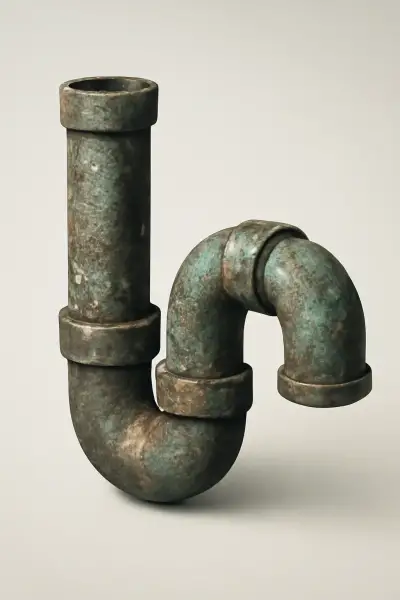
Scale: the protective crust people assume is always there
Corrosion science treats scale as a living history of the water. It builds layer by layer, and it can be stable for years. In some conditions, scale behaves like a cap that blocks lead from dissolving. In other conditions, it behaves like a sponge that can release lead particles when it breaks. Lead can show up as dissolved ions, but also as tiny bits of mineral scale or metal. Those particles can spike measurements and exposure in a way that feels random because it depends on disturbance.
Disturbance can be physical, like a repair, a change in flow, or vibration. It can also be chemical. A shift in disinfectant, a change in chloride-to-sulfate ratio, or a change in alkalinity can destabilize old scale. That’s why “old pipes” aren’t a single risk level. The risk depends on what kind of crust formed, and whether the current water keeps that crust intact.
What modern corrosion science says about sudden lead problems
Modern systems don’t usually rely on luck. They often use corrosion control to encourage stable scales, commonly by managing pH and alkalinity and, in many places, adding orthophosphate so low-solubility lead phosphate minerals can form. The point isn’t to make lead disappear. It’s to make the pipe surface less willing to give it up. This is also why a water source change is such a high-stakes event. New water can have a different mineral balance and can “ask” the pipe to equilibrate again.
Flint is an example people bring up because the shift in water chemistry was followed by corrosion problems and elevated lead in some homes. The details of any one case can be complicated, but the corrosion principle is straightforward: if water becomes more corrosive to the existing scale, the system can move from “mostly locked up” lead to “newly mobile” lead quickly. Once scale is damaged, it can take a long time to rebuild because it’s not just a coating. It’s a mineral ecosystem shaped by the exact water chemistry.
Ancient plumbing leaves chemical fingerprints
Archaeologists and geochemists can sometimes read old water conditions from pipe interiors, because different waters leave different deposits. Carbonate-rich waters tend to leave thick carbonate scale, which can reduce metal release by acting as a barrier. But scale thickness alone doesn’t guarantee safety. Porosity, cracking, and the presence of mixed minerals matter. A layered deposit can trap lead and then shed it as particles later, especially if the deposit gets brittle.
Even without perfect records, the basic constraint is clear: water chemistry and pipe material co-evolve. Ancient lead plumbing changed the water it carried, and the water changed the plumbing in return. Corrosion science mostly formalizes that back-and-forth with measurements and models, but the underlying story is the same one that played out in Roman streets and still plays out under modern ones.
Related reads
- The festival where people chase a rolling wheel of cheese
- How a beetle’s dramatic death pose fools both birds and ants
- Why mangrove roots trap carbon and hold back storm surge
- Antique toys discovered hidden inside a house wall
- Why a yawn from someone else makes you yawn too
- The mailbox that spat out letters decades later
If you liked this, you might also enjoy: