

A weird rule that isn’t one clear law
People hear this story and picture a Victorian lawbook that says, plainly, you can’t die inside the Palace of Westminster. It’s not that tidy. The idea comes from how Parliament’s buildings were treated for centuries, and from a knot of privileges, procedures, and property rules that could turn an ordinary death into an administrative headache. The place most versions point to is the Houses of Parliament in London, especially the House of Commons and the House of Lords, where the Crown’s interests and Parliament’s autonomy historically overlapped in awkward ways.
The “illegal” part is best understood as a folk summary. It compresses several real pressures into a single punchline: if someone died in the wrong part of the estate, the wrong people might have to get involved, and the wrong legal consequences could follow. That’s the core mechanism people are reacting to, even when the wording gets exaggerated over time.
Royal precincts, coroners, and a messy jurisdiction
Historically, certain royal palaces and their “precincts” had special legal status. Westminster began as a royal palace long before it was a modern parliament building, and that heritage matters. Deaths trigger formal processes: a coroner, an inquest in some circumstances, documentation, and questions about where and under whose authority the death occurred. If the location is treated as a royal site, the machinery of state can shift in subtle ways, because the Crown’s household and courts used to have their own lanes.
One overlooked detail is that the modern “Palace of Westminster” is not just a debating chamber. It’s a complex with offices, committee rooms, ceremonial spaces like Westminster Hall, and a web of control over access and policing. When jurisdiction is split—between parliamentary authorities, local authorities, and national ones—people tend to simplify it as “they didn’t want a death there,” because that’s easier to repeat than “the inquest and custody chain could become unclear.”
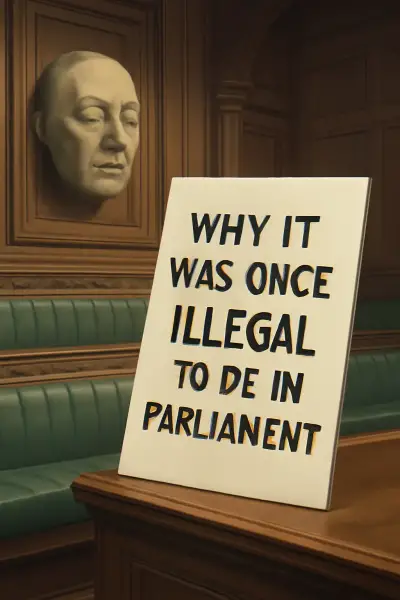
Why anyone would want to avoid a death in the first place
One common explanation ties the story to ceremonial burial rights. The idea goes like this: if someone died in a royal palace, they might be eligible for a state-funded funeral or for burial arrangements connected to the Crown. That specific claim varies in how it’s told, and it’s hard to pin down as a single rule that would automatically apply to any random visitor. But the underlying anxiety is plausible: public institutions worry about precedents, and deaths can create financial and ceremonial obligations when they happen “on the state’s doorstep.”
There’s also a less glamorous reason. Parliament runs on schedule and control. A death inside the estate is a major operational event: security lockdowns, investigations, press attention, and a long paper trail. Even if no one is “charged” with anything, the institution inherits a problem that doesn’t fit neatly into party politics or procedure. That institutional discomfort is exactly the sort of thing that gets retold as a prohibition.
What “illegal” would even mean inside Parliament
It’s tempting to treat this as a simple criminal ban, but that’s not how it would work. You can’t meaningfully prosecute someone for dying. The more realistic legal friction points are about what follows: who has authority to enter, who can compel witnesses, where records are kept, and how an inquest is convened. Parliament has long asserted its own privileges, including control over its internal proceedings and spaces, and that can collide with ordinary law enforcement routines.
That’s why the story survives even without a neat statute to quote. It’s describing a conflict between two systems that both think they’re in charge. People often miss that Parliament is not just a workplace; it’s a constitutional arena with its own officers, rules of access, and security. A death is the moment when outside authorities normally take over, and inside authorities tend to resist being “managed” on their own ground.
How the legend sticks to real moments
Situationally, it’s easy to see how the idea would spread. Imagine someone collapsing in Westminster Hall during a busy day: tourists nearby, police responding, parliamentary staff trying to keep routes clear, and officials making quick calls about what can happen where. Even if everything is handled properly, observers will notice the choreography and the sensitivity around the location. The human brain converts that into a rule, because “they’re not allowed to die here” sounds like an explanation for the unusual tightness of control.
The part that usually gets overlooked is that these stories don’t need to be true as written to be anchored in something real. They persist because Parliament’s spaces carry layers of old status, and because the consequences of a death there are never just medical. They are procedural, political, and symbolic all at once, which makes any awkwardness feel like a prohibition even when it isn’t one.
Related reads
- The sponge that grows glass skeletons on the ocean floor
- Vending machines that sell live crabs
- How lead pipes changed ancient water chemistry—and modern corrosion science explains why
- The festival where people chase a rolling wheel of cheese
- How a beetle’s dramatic death pose fools both birds and ants
- Why mangrove roots trap carbon and hold back storm surge
If you liked this, you might also enjoy: