
Seeing a jellyfish go backward
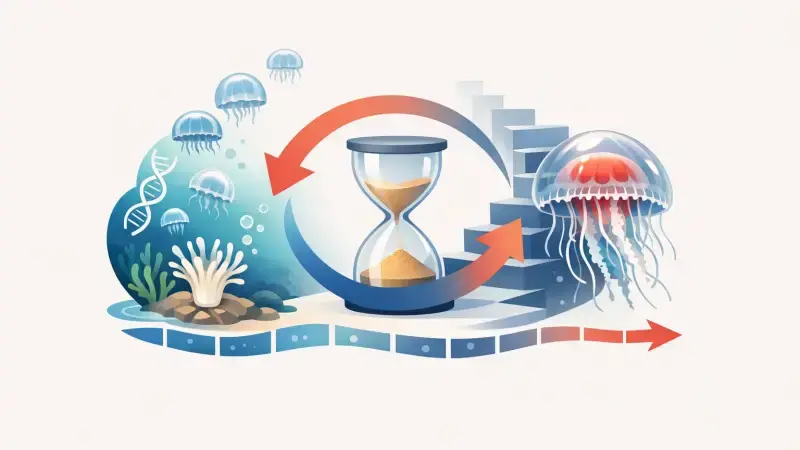
Most animals get older in one direction. With the so‑called “immortal jellyfish,” time can appear to run the other way. It isn’t one famous event in one place. It’s a species, Turritopsis dohrnii, reported from parts of the Mediterranean Sea and also observed in places like Japan. The core trick is not magic and not true invincibility. When stressed—by things like injury, hunger, or sudden changes in the water—its body can revert from an adult medusa back into an earlier, attached polyp stage. That reversal relies on cells switching jobs instead of staying locked into one role.
Its normal life cycle, in plain terms
Jellyfish like this usually move through a set of stages. The tiny, drifting larva settles and becomes a polyp, which is more like a small stalk attached to a surface. Polyps can clone themselves and make more polyps. Later, they produce free‑swimming medusae—the classic jellyfish form with a bell and tentacles that reproduces sexually.
The odd part is that the adult medusa doesn’t have to stay an adult. Under the right kind of stress, it can collapse into a blob of tissue, attach to a surface, and reorganize into polyp structures again. Instead of dying at the end of the medusa stage, it re-enters the earlier part of its life cycle.
The cellular trick: transdifferentiation
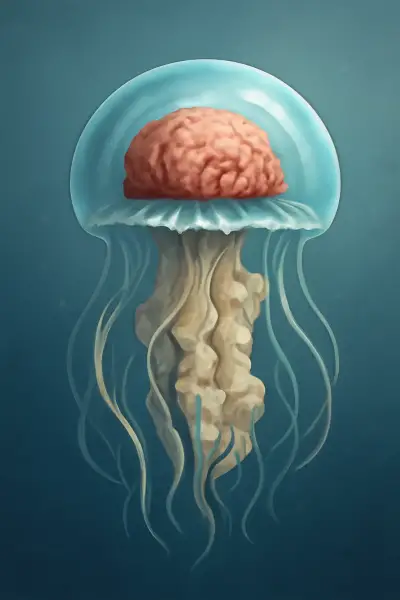
In most animals, cells specialize and then mostly stick with that specialty. Muscle cells stay muscle. Nerve cells stay nerve. Turritopsis dohrnii can do something closer to a reshuffle. A mature cell type can convert into a different mature cell type without going back to an all-purpose stem cell state first. Researchers describe this as transdifferentiation.
That matters because “aging” is partly about cells losing flexibility. If tissues can be rebuilt with the right cell types in the right places, the organism can restore a younger body plan. One specific detail people overlook is that the jellyfish doesn’t just shrink. It reorganizes its whole layout—bell tissue, tentacle tissue, and the structures used for reproduction—into the architecture needed for a polyp colony. That is a developmental restart, not a simple rewind of the same body.
What sets off the reversal
The trigger tends to be stress, but the exact threshold varies and isn’t always predictable. In lab and field observations, things like physical damage, starvation, or abrupt shifts in temperature and salinity have been associated with the change. A concrete scenario is a medusa that gets injured—say, tentacles damaged during a rough interaction with other planktonic predators—and then fails to keep swimming normally. Instead of continuing toward death, it can settle, attach, and start the reorganization process.
It’s also not guaranteed. Some individuals die. Some revert. And even a successful reversal doesn’t mean a single jellyfish is destined to live forever in the wild. Predators, disease, and simple bad luck can still end the cycle before it restarts.
Why “immortal” is a slippery word here
People hear “immortal” and imagine a creature that can’t die. That’s not what’s happening. The species can repeatedly reset its life stage, which is closer to escaping one kind of death—age-related decline tied to the medusa phase—than escaping death altogether. It’s more accurate to think of it as potentially indefinite cycling, not guaranteed endless survival.
There’s another subtle point: the reversal is a whole-body change, but the organism still carries its history in a biological sense. Damage, mutations, and accumulated problems can still matter. Scientists are interested because the process shows that adult animal cells can be more plastic than expected. It also raises practical questions that are still unclear, like how often this happens in natural conditions compared to lab setups, and what limits the number of times a single lineage can pull it off.
Related reads
- The 9th-century pope who put a rival corpse on trial in the Cadaver Synod
- Why the first second after you look feels frozen
- Why it was once illegal to die in Parliament
- The sponge that grows glass skeletons on the ocean floor
- Vending machines that sell live crabs
- How lead pipes changed ancient water chemistry—and modern corrosion science explains why
If you liked this, you might also enjoy: