

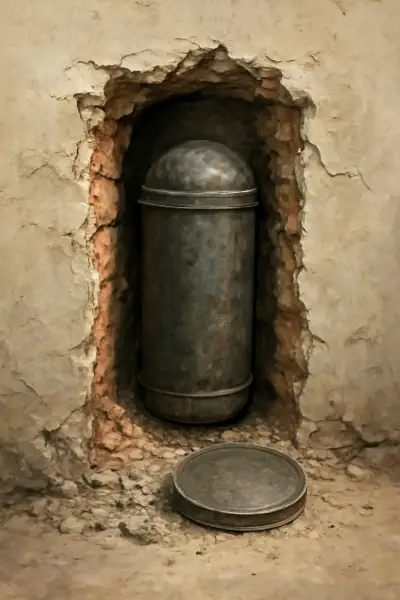
People renovate old buildings and assume the walls are just walls. Then a stud bay opens up and there’s a small bundle sitting where insulation should be. Sometimes it’s a tin, sometimes a glass jar, sometimes folded paper wrapped in cloth. This isn’t one single famous incident. It happens in lots of places, and the details vary. In 2017, for example, a Victorian-era time capsule was found in the wall of the Massachusetts State House in Boston during repairs. Other finds turn up during routine work in ordinary houses, and they don’t come with a headline. The core mechanism is simple: the wall stays sealed for decades, and someone’s private “save this” moment survives.
How a wall becomes a hiding place
Walls are convenient because they are predictable. Renovations happen. Wiring gets updated. Plaster cracks. A baseboard comes off. Someone can tuck a package behind lath-and-plaster, under a stair stringer, or into a cavity near a chimney breast and expect it to be ignored for a long time.
The overlooked detail is that “inside the wall” rarely means randomly stuffed into insulation. Older buildings have voids that act like shelves: behind window casings, above door headers, or in dead space beside a brick flue. Those spots stay dry and undisturbed. That affects what survives, and what turns to mush.
What people actually leave behind
The contents usually aren’t grand. They’re domestic. Letters, receipts, small photographs, a child’s drawing, a ration book, a prayer card, a dance ticket, a union card, a newspaper clipping used as padding. When newspapers appear, they can be misleading. They often mark the day the wall was closed, not the day the items were “meant” to be found.
It’s common to see practical bundling choices that say as much as the paper itself. Greaseproof paper, cloth scraps, or a tobacco tin are not “romantic.” They’re moisture control. A glass jar with a metal lid can trap humidity and still rust from the inside. A plain envelope can outperform a fancy container if it sat in a stable, dry cavity.
How a vanished life shows up in fragments
A life can “vanish” without drama. People move. Names change through marriage. Tenants leave no forwarding address. Records get lost, or never existed beyond a landlord’s notebook. A wall cache can bring back a person who doesn’t appear in family stories, because they were a lodger, a live-in worker, or someone who stayed only a season.
The strongest clues tend to be boring ones. A return address on a bill. A workplace name on a pay stub. A school form with a partial date. Even handwriting can point to a specific kind of life: careful block letters that look like someone trained for clerical work, or phonetic spelling that hints at interrupted schooling. It’s not always possible to tie it to one person. Sometimes the bundle is a mix left by more than one occupant over time.
Why these finds are hard to interpret
Context gets scrambled the moment the wall is opened. Items slide down cavities. Dust gets disturbed. A contractor may set everything into a box without noting where each piece was sitting. That matters because placement can be the whole story. A letter tucked behind a window frame reads differently than a stash pushed deep under floorboards.
There’s also the issue of intent. Some caches are deliberate time capsules. Others are concealment. People hid valuables during eviction fears, domestic conflict, or theft. Some hid objects for superstitious reasons, like shoes or written charms placed in walls in parts of Europe and North America. Without documentation, it can be unclear whether the “capsule” was meant to be found, or simply meant to stay safe.
What tends to happen after the discovery
The first response is usually practical: can it be handled without falling apart? Paper that looks fine can shatter at a fold line. Photographs can stick to glass or to each other. The smell can be a clue too, because mold or smoke residue tells you about where it sat and what the building went through.
Then comes the awkward part: ownership and meaning. A few items are clearly personal, like letters addressed to a specific person. Others belong to the building’s history, like dated newspapers used as insulation. In a public building, material sometimes ends up cataloged, as with the Massachusetts State House capsule. In a private house, it may stay with whoever opened the wall, even if it points to someone whose life is otherwise gone from the neighborhood and the records.
Related reads
If you liked this, you might also enjoy: