
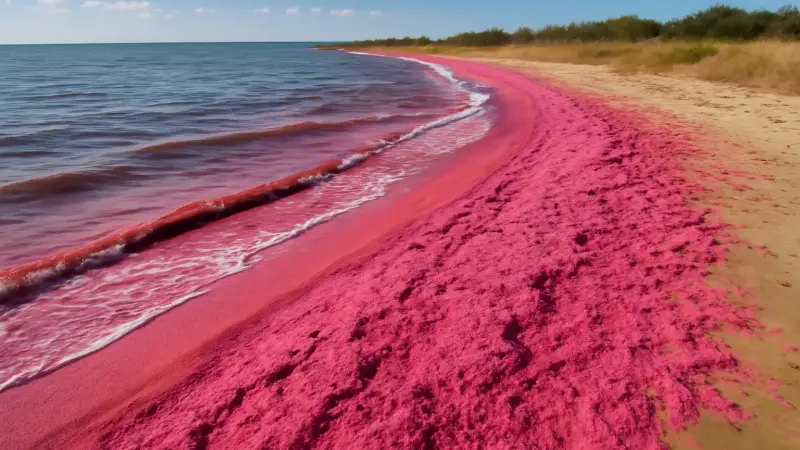
You walk down to the water expecting tan sand and gray rocks, and instead the whole edge looks like someone spilled paint. This isn’t one single famous shoreline event. It shows up in lots of places when the timing is right, including parts of Western Australia, the Persian Gulf, and some salt ponds and lagoons around the Mediterranean. The color usually comes from microscopic life that makes strong pigments, then piles up where waves, wind, and evaporation concentrate it. It can be algae, but it’s often a mix that includes salt‑loving microbes. The “bloom” is less like a tidy layer spreading evenly and more like a bright band forming where conditions trap cells and their pigments.
What “pink algae” usually is
People call it pink algae because that’s the easiest label, and sometimes it really is algae. A well-known culprit in salty water is Dunaliella salina, a tiny green alga that can look red or pink when it loads up on beta‑carotene. But the shoreline color can also come from halophilic (salt‑loving) archaea, which produce red pigments and can dominate in very salty brines. In real life it’s often a community, not a single species, and which group “wins” depends on salinity, temperature, nutrients, and how fast the water is being refreshed.
One overlooked detail is that the pink you see is not always a sign of explosive growth at that exact spot. The cells can bloom in the water body or in a nearby pond, then get pushed and stranded along the edge. Pigments are stubborn. Even when cells die, colored compounds can linger on wet sand, shells, and foam.
Why the bloom turns pink instead of staying green
Many of these organisms can photosynthesize, so you might expect a green tint. The pink shows up when stress pushes them to make protective pigments. High salt, strong sun, and warm, shallow water are a common combination. In Dunaliella, beta‑carotene can build up inside the cell and act like a shield against intense light and the reactive molecules that form under stress. In salt‑loving archaea, different red pigments serve a similar purpose while also helping capture light in briny conditions.
Salinity is a big lever because it changes who can survive. As evaporation concentrates salt, many competitors drop out. The survivors tend to be the ones with these vivid pigments. That’s why bright pink water is often linked to hypersaline lagoons, salt flats, and managed salt ponds, where salinity can climb far beyond normal seawater.
How a bright pink band forms along the shoreline
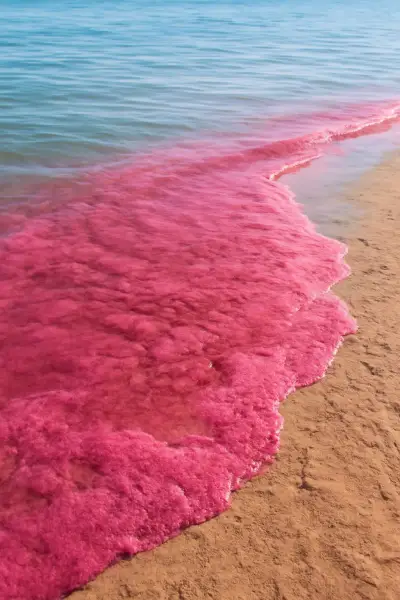
The shoreline color is about physics as much as biology. Waves and wind push floating cells and surface foam toward the edge. In shallow water, tiny particles and microbes can get trapped in a thin, warm layer near the surface. Then the swash zone concentrates everything. Each wave leaves behind a little more material, and evaporation removes water faster than it removes pigment.
That’s why the most vivid color is often a narrow strip: the place where water repeatedly arrives and retreats. It can look like the whole beach changed overnight, but it’s frequently a relocation and concentration effect. Even the direction the beach faces matters, because wind-driven surface drift can pile cells on one side of a lagoon and leave the other side almost normal-looking.
The conditions that let it happen
These blooms tend to show up when water exchange is limited. A semi-enclosed bay, a coastal lagoon separated by a sandbar, or a salt pond with controlled flow can hold water long enough for salinity and temperature to climb. Nutrients also play a role, but not always in the same direction. Some pink systems happen in nutrient-poor, high-salt water where only specialists cope. Others get a boost from runoff or bird guano that adds nitrogen and phosphorus.
Temperature and sunlight set the pace. Warm, clear, shallow water accelerates growth and also increases stress from light exposure, which encourages pigment production. The timing varies by region. In places like Western Australia, calm hot periods can line up with stagnant conditions in lagoons and salt lakes, and that’s when the bright colors are most likely to stand out.
What it is not, and why it can look alarming
Pink shorelines are easy to confuse with chemical spills or dyed water, because the color can be unnaturally uniform. But natural pigment blooms usually come with patterns: streaks that follow wind lines, a colored foam edge, or a band that matches the highest reach of recent waves. Another common mix-up is with “red tide.” Some red tides involve toxin-producing algae in normal salinity seawater, while many bright pink shoreline events are tied to hypersaline conditions and different organisms entirely.
It can also look like the sand itself turned pink. Sometimes it really did, temporarily. Pigments and tiny cells can stick to grains, to salt crystals, and to the biofilm that coats rocks right at the waterline. That thin, slippery film is easy to miss unless you’re looking closely, and it can hold color long after the water nearby has cleared.
Related reads
- When people reportedly burst into flame with no visible fire
- Why mornings can leave you foggy for minutes after waking
- A corpse, a forged identity and the ruse that duped WWII intelligence
- A time capsule hidden in a wall that revealed a vanished life
- The city that once outlawed chewing gum
- Why some octopuses stack stones to build dens
If you liked this, you might also enjoy: