

That sudden itch that arrived from nowhere
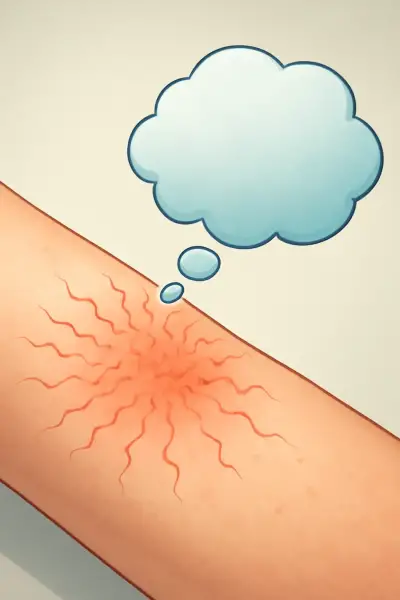
Someone says “lice” in a classroom and a few people start scratching. A friend mentions bed bugs after a hotel stay in New York, and your scalp feels busy for the next minute. This isn’t one single story tied to one place or year. It shows up anywhere humans swap sensory details: a London tube seat, a camping trip in Australia, a group chat about poison ivy. The core mechanism is straightforward. The brain doesn’t wait for proof before preparing the body. When it hears or sees “itch,” it predicts itch, turns up attention to the skin, and small normal sensations get promoted into something urgent.
Your brain treats “itch” like a threat cue
Itch is protective. It’s the nervous system’s way of pushing you to remove something that might be on the body: an insect, a plant irritant, a fiber, a chemical. Because it can matter, the brain is tuned to detect patterns that suggest itch even before the skin sends a strong signal. Hearing a vivid description, seeing someone scratch, or noticing a suspicious speck can shift the brain into a higher-alert mode. That shift changes what you notice. The tiny brush of fabric, a dry patch you ignored earlier, or a stray hair on the neck stops being background noise and becomes “that spot.”
A lot of people assume itch is always a direct message from the skin. Often it is. But when imagination triggers it, the message is more like an interpretation. The sensory input may be weak, ambiguous, or even absent. The brain fills in the missing certainty, because the cost of a false alarm is small compared with the cost of missing a real irritant.

Itch is contagious because attention is contagious
Watching someone scratch is unusually effective. Part of that is plain learning. You’ve spent a lifetime linking the sight of scratching with the idea that something is on the skin. There’s also automatic mirroring in human behavior. People copy each other’s actions without meaning to, especially in small repetitive movements. When you see the action, your own body representation gets nudged. The result can be a matching urge, even if your skin isn’t dealing with the same thing.
One overlooked detail is timing. The urge often lands a beat after the cue, not instantly. That delay matters because it makes the itch feel “self-generated,” like it came from inside your skin rather than from what you just saw or heard. By the time the sensation blooms, the triggering moment is already gone, so the mind searches for a local cause and finds one: a seam, a tag, a tiny bump.
Expectation can change the signals coming from your skin
Imagined itch isn’t only “in your head” in the dismissive sense. Expectation can alter real bodily signals. When the nervous system ramps up monitoring, it also changes how the skin is regulated. Stress and anticipation can shift sweating, temperature, and blood flow by small amounts. Those changes can make skin feel prickly or tight. They can also increase awareness of dryness. That’s why an itch episode can cluster around places with lots of touch and friction—scalp, collar line, waistband—even when nothing is actually there.
People also forget that skin is noisy. Nerves in the skin constantly report pressure, movement, and chemical changes. Most of that is filtered out. The “invisible itch” happens when the filter gets relaxed. A weak tickle signal that would normally be ignored is allowed through, then interpreted through the new expectation: itch.
Words, images, and uncertainty make it stronger
Not all triggers are equal. Vivid, concrete details tend to provoke stronger reactions than abstract talk. “Something crawling in your hair” is different from “skin irritation.” So are images: close-up photos of mites, rashes, or fleas can set off itching in people who are completely fine. Uncertainty also matters. If the situation is unclear—an unexplained bite, a rumor of an outbreak, a used couch brought home from the street—the brain has less to anchor to. It leans harder on possibility, and possibility is enough to recruit the scratch response.
A concrete example is the moment someone in a shared space notices a bug and can’t identify it. It might be nothing. It might be a problem. While the identification is pending, people tend to scan their own skin more intensely and interpret normal sensations as evidence. That scanning is quiet and fast. It can happen while the person is still talking, before anyone has moved an inch.
Why it can linger after the thought has passed
Once scratching starts, it supplies fresh input. Scratching irritates nerve endings and can release inflammatory chemicals in the skin, which can create more itch. It also teaches the brain that the spot mattered. So the original imagined trigger can fade, but the body now has a real signal to keep paying attention to. That’s why a brief mention of bed bugs can turn into five minutes of checking and rubbing, even after the conversation has moved on.
It also explains why the itch sometimes “moves.” Attention shifts, clothing shifts, and the brain keeps searching for a source. The skin keeps providing little ambiguous sensations, and the mind keeps sorting them into the same category until something more interesting takes over.
Related reads
- How underground rivers trigger sudden sinkholes in flat landscapes
- The algae that turns shorelines bright pink and how its bloom works
- When people reportedly burst into flame with no visible fire
- Why mornings can leave you foggy for minutes after waking
- A corpse, a forged identity and the ruse that duped WWII intelligence
- A time capsule hidden in a wall that revealed a vanished life
If you liked this, you might also enjoy: