
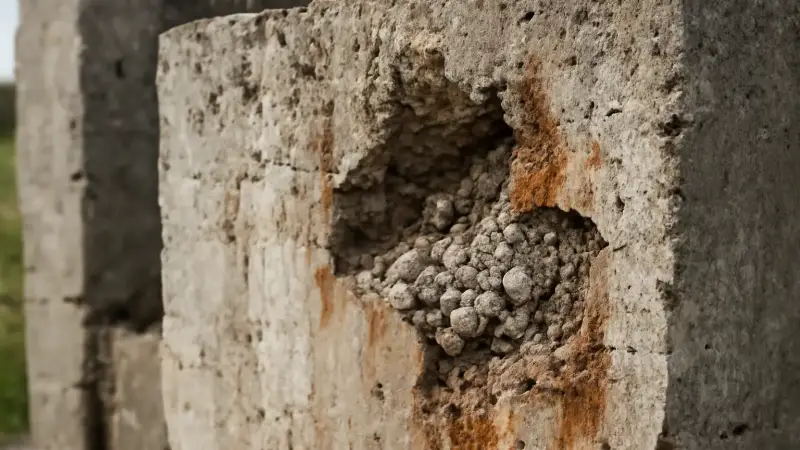
Concrete feels like the end of a story. Pour it, let it set, bury something underneath, and it should stay put. But it doesn’t always. This isn’t one single incident, and it shows up in very different places—sewer tunnels in Hamburg, wastewater systems in Los Angeles, and parts of the London Underground have all dealt with biologically driven concrete damage. The basic mechanism is simple. Certain microbes don’t “eat” concrete like food. They change the chemistry around it. They generate acids and other reactive compounds that dissolve the cement binder, opening paths through what looks like solid stone so they can reach minerals and trace nutrients trapped inside.
Concrete is a mineral buffet held together by chemistry
Most concrete is aggregates (sand and gravel) glued together by hydrated cement paste. That paste is full of calcium-bearing minerals. It’s also extremely alkaline when new. Fresh concrete can sit around pH 12–13, which is hostile to most life. Over time, though, air and water push it toward less extreme conditions. Carbon dioxide reacts with calcium hydroxide in the paste, a process called carbonation, and the surface can become less protective.
The overlooked detail is the thin water film. Even “dry” concrete usually has a microscopically thin layer of moisture in pores and along surfaces, especially underground or in humid infrastructure. That film is where ions move. It’s also where microbial byproducts dissolve, diffuse, and start attacking the binder. Without that water layer, the chemistry slows to a crawl.
Microbes don’t need to chew it, they just need to acidify it
Microbes are good at turning one chemical into another to harvest energy. In buried or wet concrete, the big troublemakers are often sulfur-cycling microbes, because sulfur chemistry can swing from harmless to very corrosive. In wastewater systems, anaerobic microbes in sludge can reduce sulfate to hydrogen sulfide gas. That gas drifts upward into the moist air space above the waterline, where oxygen is available.
On those damp concrete surfaces, different microbes can oxidize the hydrogen sulfide into sulfuric acid. That acid reacts aggressively with calcium-rich cement phases. The cement paste softens, loses mass, and can convert into crumbly minerals like gypsum. The aggregates might still be there, but the “glue” is gone, so the surface starts to pit and flake.
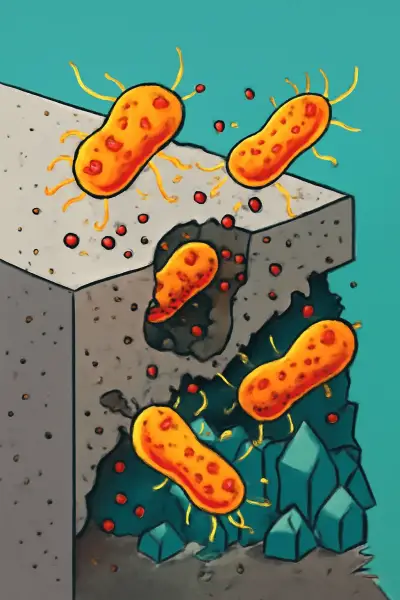
Why buried minerals matter to a microbe
Concrete contains trace metals and nutrients that can be limiting in some environments: iron, manganese, magnesium, even tiny amounts of phosphate depending on the mix and what water has carried in. Microbes don’t necessarily “want” the concrete. They want electron donors and acceptors, and they need cofactors for enzymes. If the surrounding soil or water is nutrient-poor, the cement matrix becomes one of the few accessible reservoirs.
As acids dissolve the paste, new surfaces and pores open up. That increases the surface area dramatically. It also creates gradients—pH, oxygen, sulfide, moisture—that different microbes can occupy. Once that layered ecosystem forms, it can keep running even if the original conditions fluctuate, because the concrete itself has become part of the chemical buffering and the transport network.
The damage is often worst where air meets water
One reason people get surprised is that the most severe corrosion in sewers and similar structures often isn’t deep underwater. It’s above the flow line, in the crown of a pipe or tunnel. That zone gets humidity, condensation, and intermittent wetting, plus oxygen from the air. It’s perfect for acid production on the surface. The submerged parts may stay more chemically stable because oxygen is limited and acids get diluted or washed away.
This is also why the pattern can look patchy. Small differences in airflow, temperature, or where droplets form can decide where microbial films establish. A hairline crack can become a preferred channel because it holds moisture longer and traps gases. From the outside it can look like “random” deterioration, but it follows the microclimate of the structure.
It’s not just sulfuric acid, and the timeline varies
Sulfur-driven corrosion gets the attention because it can be fast and dramatic, but other microbial routes exist. Nitrifying microbes can produce nitric acid in some settings. Organic acids from biofilms can locally dissolve calcium phases. And microbes don’t have to make acid to change concrete: some processes shift redox conditions and mobilize metals, which can alter how minerals form and dissolve in pore water.
How quickly any of this happens is unclear without knowing the exact environment. Temperature, humidity, water chemistry, oxygen, and concrete mix design all matter. A dense, well-cured concrete in dry soil may show little biologically driven change for a long time. A warm, humid sewer crown with steady hydrogen sulfide can degrade much faster, because the microbial chemistry is constantly replenished right at the surface.
Related reads
- Why volcanic ash plumes often produce spectacular lightning bolts
- How your brain filters out half of a crowded conversation
- When Victorian Parliament fled as the Thames reeked across London
- Why awkward silences feel physically uncomfortable
- How a beetle survives being frozen by turning its blood into antifreeze
- A town that kept changing clocks so shops never opened the same hour
If you liked this, you might also enjoy: