

How a mouse ends up inside a returned book
People think of library returns as clean and simple. A book leaves a building, it comes back, it goes on the shelf. But this isn’t one single famous incident with a known date. It’s the kind of odd report that pops up in different places when libraries share stories. You’ll hear it from public branches in the U.S., small community libraries in the U.K., or rural libraries in Australia. The mechanism is usually plain. The book spends time in a garage, shed, car, or storage box. A mouse finds the warm, dark pocket between covers and pages and treats it like shelter. Then the book gets dropped in a slot and the surprise stays hidden for hours.
What makes a library book a good hiding place
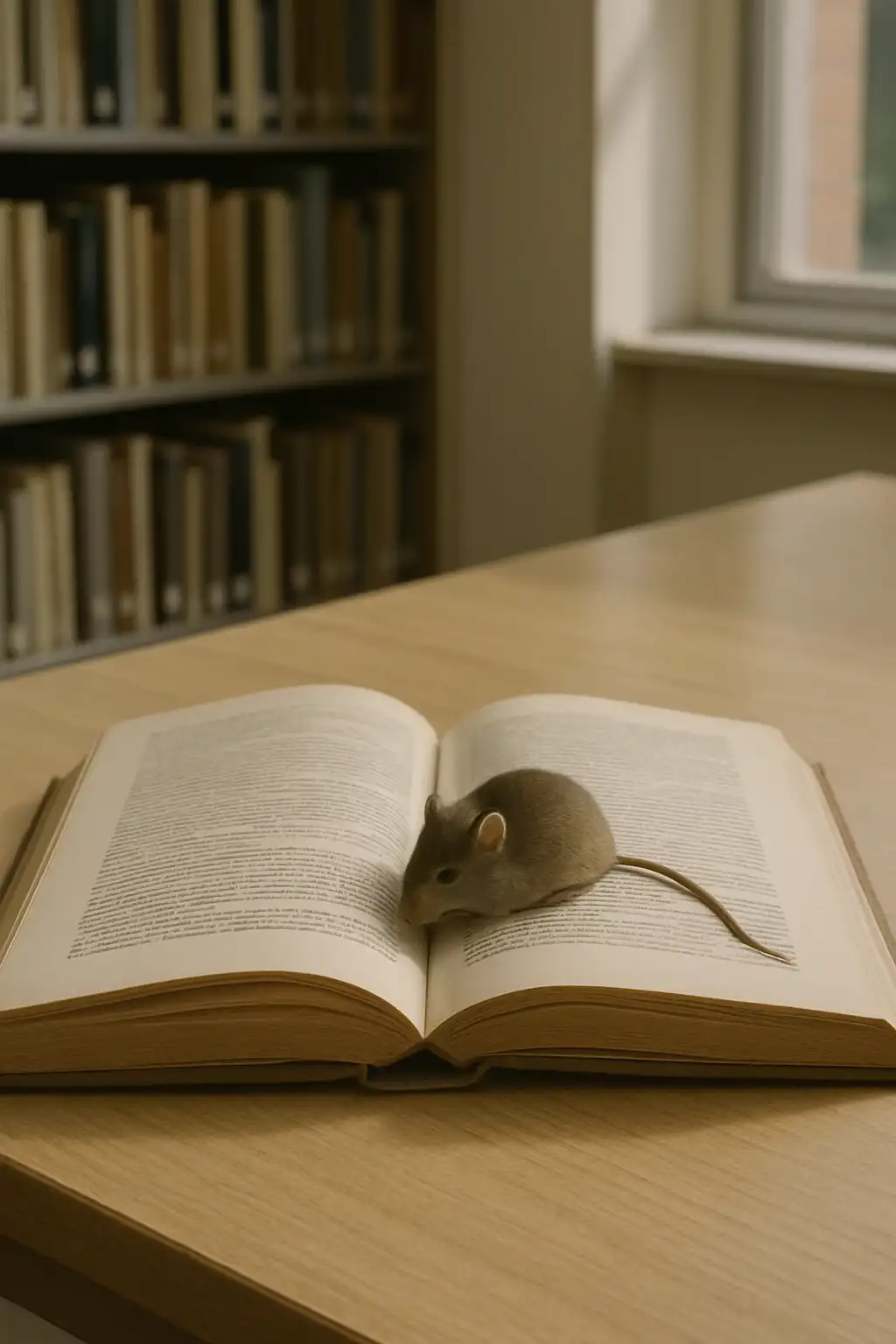
A closed book has a few things mice like. It’s enclosed. It holds heat longer than you’d expect. And it smells like paper and glue, which can be attractive as nesting material even if the mouse doesn’t “eat” the book. Hardcovers are especially good at this because the boards keep their shape and create a firmer cavity along the gutter. Paperbacks can work too, but they collapse more easily, so the mouse tends to tuck into the space where a bent cover makes a small tent.
The overlooked detail is how little space a mouse needs. An adult house mouse can squeeze through a gap about the width of a pencil. If a book’s pages are warped from humidity, or the cover is slightly peeled away from the spine, it can form a gap that looks trivial to a person but reads as an entrance to a mouse. That tiny defect is often already there before the book ever leaves the library.
Where the mouse comes from in ordinary life
Most of these situations start away from the library. Books get set down where people don’t think much about rodents: a laundry room shelf, a basement stack, a porch box, or the trunk of a car. Garages are a common setting because they combine clutter, shelter, and food smells. A tote bag with snacks, a bird-seed bucket nearby, or pet food stored in the same area can make the whole corner “active” for mice. The book is just an object that happens to have a fold and a protected seam.
Sometimes the mouse isn’t trying to live in the book at all. It may be fleeing a cat, light, or noise and ducks into the nearest crevice. If the book is returned quickly afterward, that creates the strange version of the story where the animal is still alive when it arrives. Other times, the book sits long enough that the result is droppings, shredded edges, or the smell people notice only when the book is opened.
How it stays hidden during the return
Return systems help this happen. Many libraries use exterior book drops that empty into a bin or rolling cart. Those bins are deep and dark, and the workroom may not be visited immediately, especially overnight or on weekends. A book can also land spine-down or face-down in a stack, which keeps the pages pressed shut. If a mouse is wedged into the hinge area, it can remain invisible unless someone fans the pages or checks the inside cover.
Another easy-to-miss factor is sound. A mouse doesn’t always scratch in an obvious way, especially if it’s stressed or trying not to move. Libraries can be noisy in back areas too, with fans, carts, and doors. So even if there is movement, it can blend in. People often picture a dramatic “rustling” moment, but plenty of books get handled in quick, practiced motions that don’t involve opening them until later.
What the library staff is dealing with afterward
Once the book is opened and the animal is discovered, the situation becomes about two different risks at the same time. One is the mouse itself, alive or dead. The other is contamination. Rodent droppings and urine can carry pathogens, and even a small amount can matter if it’s smeared onto hands, desks, or other books. That’s why the response is usually more cautious than people expect, even when the mouse looks “fine.” The book can’t simply be wiped and reshelved if there’s any sign it was used as a nest.
It also turns into a workflow problem. Anything the book touched in a bin may need to be checked for odor, spotting, or gnaw marks, and the drop area may be inspected for gaps. A single odd return can look like a one-off, but it forces staff to think about the path the book took: the drop slot, the cart, the sorting surface, and the shelf route. The whole chain is ordinary until one hidden passenger makes it visible.

Related reads
- How trees and fungi swap carbon and signals through underground networks
- When soldiers and farmers clashed with emus in 1932 Western Australia and the birds won
- Why hearing your name in a crowd grabs your attention
- How a small change in posture instantly shifts confidence
- The shiver from a song: what causes musical goosebumps
- When a group all remembers the same detail that never happened