
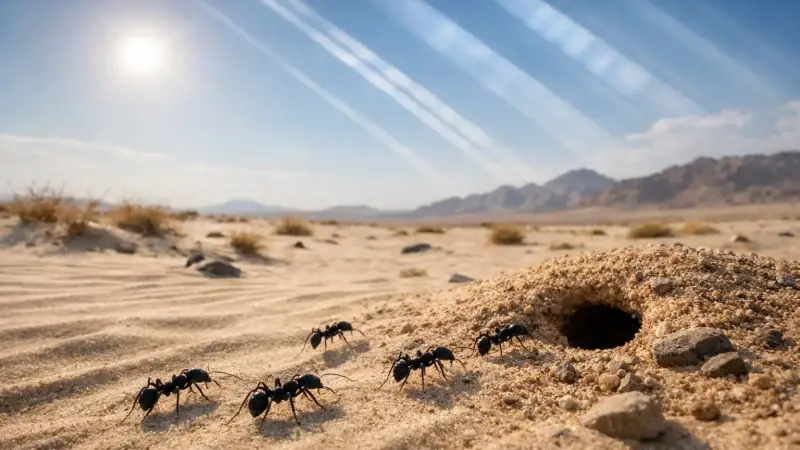
Seeing direction in a “blank” sky
In places where every horizon looks the same, some ants still make a clean, straight return to a nest hole you could lose in one step. This isn’t tied to one famous site. It shows up across deserts like the Sahara and the Namib, and in arid regions around the Mediterranean. Desert ants such as Cataglyphis can do it even when landmarks are sparse or shifting. A key part of the trick is that they don’t just see brightness. They read a pattern in skylight that most humans never notice: the direction of polarized light.
Polarized light sounds technical, but the basic idea is simple. Sunlight gets scattered by air molecules, and that scattering makes the light waves line up more in some directions than others. The result is a broad, invisible “compass pattern” spread across the sky. It’s still there when the sun is behind thin haze. It changes smoothly as the sun moves.
What polarization looks like to an ant
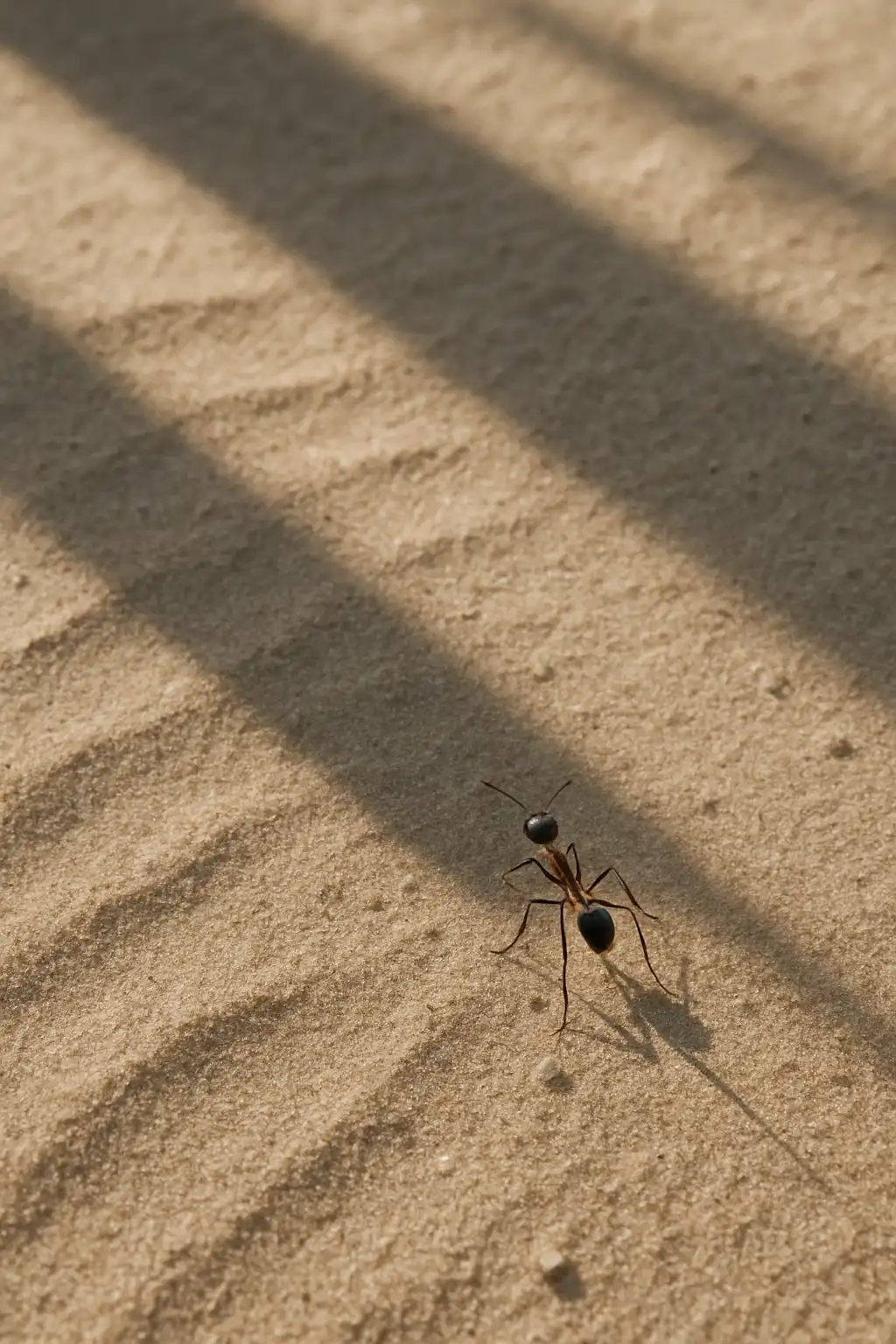
Ant eyes don’t measure polarization the way a lab instrument does. They do it with specialized photoreceptors in a narrow band of the compound eye called the dorsal rim area, aimed upward. Those receptors are tuned to ultraviolet light, because the polarization pattern is strongest and cleanest there. The receptors respond differently depending on the angle of polarization, so the ant can infer direction from a set of contrasts rather than from a single “arrow” in the sky.
One detail people usually overlook is how small this “sensor” is. It’s not the whole eye doing the heavy lifting. It’s a thin strip at the top edge, and it’s doing a very specific job: sampling the sky while the rest of the eye can stay busy with the ground. That division matters because an ant walking in heat and glare can’t afford to stare upward for long.
How the sky compass combines with step counting
Polarized light helps with heading, but it doesn’t solve the whole “find home” problem by itself. Desert ants are known for path integration. They keep a running estimate of how far they’ve walked and in what direction, then compute a direct return route. Distance is estimated partly by counting steps and partly by sensing motion across the retina as the ground moves underneath them. Heading comes from the sky compass, blended with other cues when available.
That combination explains a familiar field moment. An ant can wander in a messy search pattern while foraging, then pivot and head back on a straight line that seems too confident for such a small animal. The straightness is the math-like part: an internal “home vector” updated continuously. The sky’s polarization pattern anchors that vector so it doesn’t drift every time the ant turns.
When the system gets fooled
Researchers test the polarization compass by changing what the ant thinks the sky looks like. A classic approach is to hold a polarizing filter above the ant so the polarization angle is rotated. The ant often changes its chosen direction in a predictable way, as if its compass has been turned. This kind of experiment is useful because it isolates polarization from landmarks, smells, and the visible sun.
There are limits and messy edges. Thick cloud can weaken polarization cues, and nearby reflective surfaces can introduce misleading polarized reflections. The ant also has to keep the time of day straight. The polarization pattern rotates with the sun’s position, so the brain needs an internal clock-like correction or a way to cross-check against other cues. How much that correction depends on species and conditions can vary, and it isn’t always clear from the outside which cue is “winning” at any given moment.
What “home” means on open sand
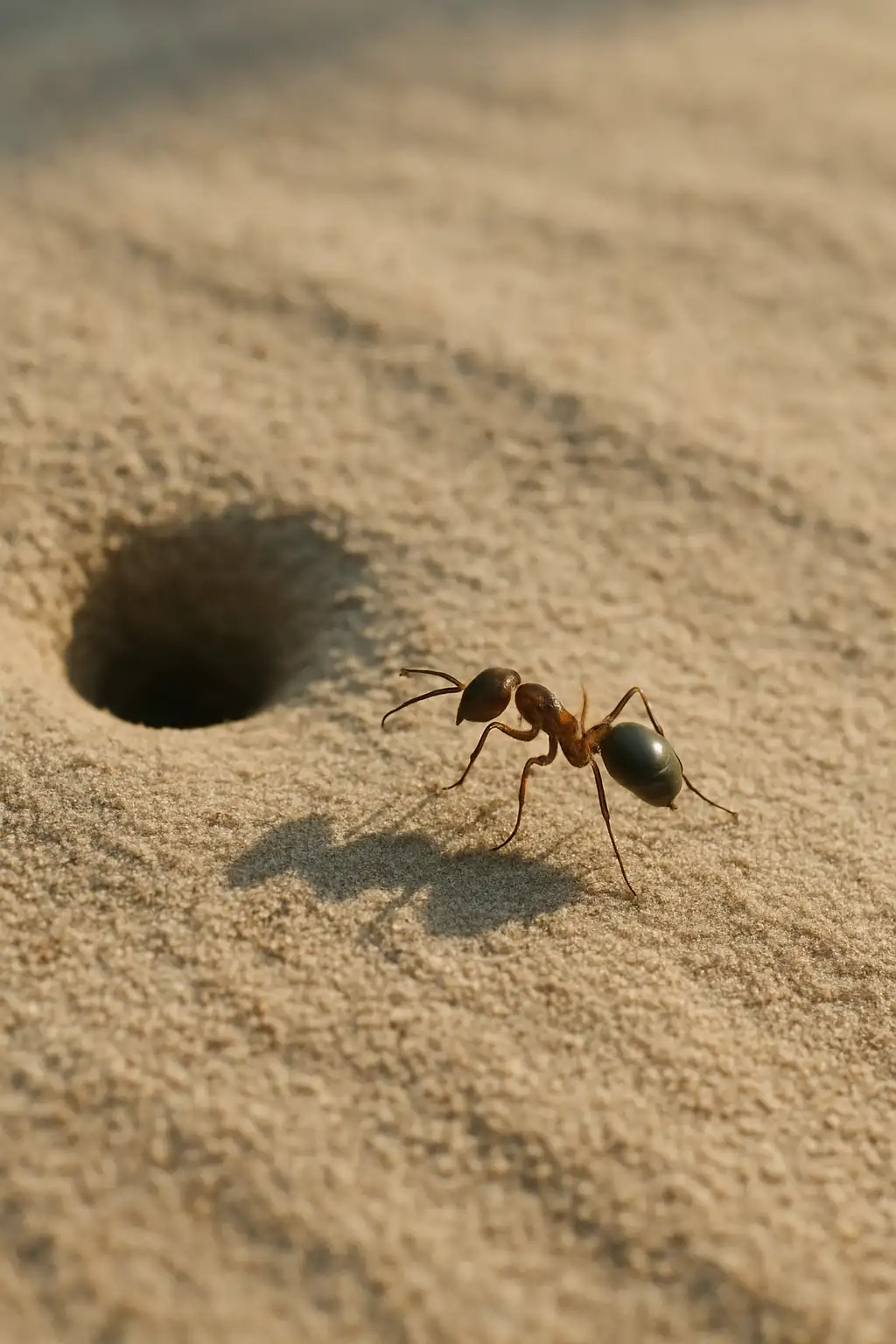
In the field, “home” can be a single nest entrance in a wide, hot plain, sometimes ringed by faint traffic marks or scattered debris that shifts after wind. A concrete example that observers often mention is an ant returning to a nest entrance only a few millimeters wide after walking tens of meters out to a dead insect. At close range, the behavior changes. The ant may stop relying on the long-distance vector and switch to a local search loop, tightening around where the entrance ought to be.
The final approach is where the systems overlap. The sky compass can bring the ant to the right neighborhood, but the last meter can depend on ground texture, subtle odor traces, and memorized visual snippets if there are stable objects. On an empty patch of sand, that means the ant can look “lost” for a few seconds even after an impressively straight return, because the internal map is good at direction and distance, not at pinpointing a hole that small.
Related reads
- A library book returned with a mouse still inside
- How trees and fungi swap carbon and signals through underground networks
- When soldiers and farmers clashed with emus in 1932 Western Australia and the birds won
- Why hearing your name in a crowd grabs your attention
- How a small change in posture instantly shifts confidence
- The shiver from a song: what causes musical goosebumps