
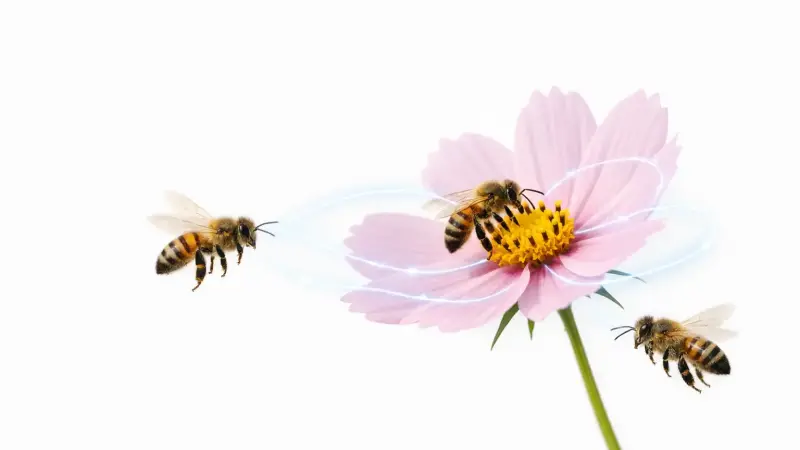
Watch a honeybee hesitate over a blossom and it can look like guesswork. But it isn’t only color and smell. This isn’t about one special field or one famous garden. It shows up wherever honeybees and flowers meet, from UK allotments to California orchards to Mediterranean scrub. A flower and the air around it carry tiny electric charges, and a bee can pick up the difference as it approaches. The charge shifts when another bee has just visited, or when the flower has been jostled. The bee’s body is basically a moving sensor, and the signal is fast enough to matter during a single hover.
Electric charge is already in the air
The air near the ground has an electric field most days, and it changes with weather. A flower is connected to the ground through its stem, so its surface charge tends to be different from a flying insect’s. A bee picks up positive charge as it flies, partly from friction with air and dust and partly from interacting with that background field. The numbers are small in human terms, but not to a small animal. That sets up a voltage difference between bee and flower even before the bee gets close.
What people usually overlook is how quickly that environment changes. Wind, humidity, and nearby vegetation can all shift local charge patterns. Even a passing cloud system can alter the background electric field, which is one reason measurements in labs don’t always match what happens outdoors minute to minute.
A bee doesn’t need to touch the flower

Bees can detect electric fields without making contact. Their body hairs and antennae can move slightly in response to electric forces, and those mechanical deflections can be picked up by sensory cells. It’s not like getting “shocked.” It’s more like feeling a tiny tug that depends on distance and orientation. That matters during a hover, when the bee is sampling a flower with its eyes and nose at the same time.
Electric sensing also behaves differently from smell. Scents linger and drift, but the electric field around a flower changes immediately when something charged comes close. That makes it a useful channel when the bee is deciding whether to land right now, not just which patch of flowers to head toward.
The signal can carry “recently visited” information
When a bee lands, it can change a flower’s charge. The bee is charged, the flower is coupled to ground, and the contact can shift the surface potential. After the bee leaves, the flower doesn’t necessarily snap back instantly. The electric “signature” can relax over time, and that time scale can overlap with how quickly nectar replenishes. So the field can act like a short-lived status flag that another bee can read as it approaches.
A concrete example is a busy fruit orchard during bloom, where blossoms get visited repeatedly within minutes. If one flower has just been handled, its electric field can be different from the neighboring flower that hasn’t been touched. The bee still uses scent and visual cues, but an electric difference is available before landing, when turning away is cheap.
Flowers aren’t passive in an electric landscape
A flower’s shape and materials affect the field around it. Petals, pollen, and the geometry of the blossom influence how charge is distributed and how strongly the field extends into the air. The stem’s connection to the plant and ground matters too, so the same species can present slightly different electric profiles depending on moisture in the soil and the plant’s condition.
There’s also a tight link to the immediate microclimate around the blossom. Humid air lets charge leak away faster than dry air, which can shrink the contrast between a “fresh” flower and one that was just visited. Wind can distort the field shape around petals, changing what a hovering bee experiences from one second to the next.
How this fits with the senses we already know
Bees don’t replace smell and color with electric sensing. They stack signals. Visual cues help from farther away. Scent helps when they’re close and when wind carries the odor plume. Electric cues are especially well-timed for the last moment: approach, hover, decide, land or leave. That timing makes it valuable even if the signal is subtle.
It also helps explain why a bee can seem picky at one flower and decisive at another that looks identical to us. Two blossoms can match in color and still differ in charge because one has just been visited, one is wetter, or the air has shifted. The bee is reading a layer of information that doesn’t show up in a photo.
Related reads
- The road that plays a song when your tires roll over it
- Tube worms farming bacteria: how vents host self-sustaining farms
- How desert ants use polarized light to find home
- A library book returned with a mouse still inside
- How trees and fungi swap carbon and signals through underground networks
- When soldiers and farmers clashed with emus in 1932 Western Australia and the birds won