

A very normal blank moment
You walk from the kitchen to the bedroom to grab something, cross the doorway, and it’s gone. You’re standing there with the light switch under your fingers, staring at a dresser, trying to reconstruct your own thought from ten seconds ago. This isn’t tied to one famous incident or one place. People describe it in offices in London, apartments in New York, and school hallways in Tokyo. The basic mechanism is simple: the brain doesn’t store “purpose” as a single file you carry around. It rebuilds it from cues. When the cues change fast—especially at a doorway—the rebuild can fail.
Doorways change what your brain is tracking
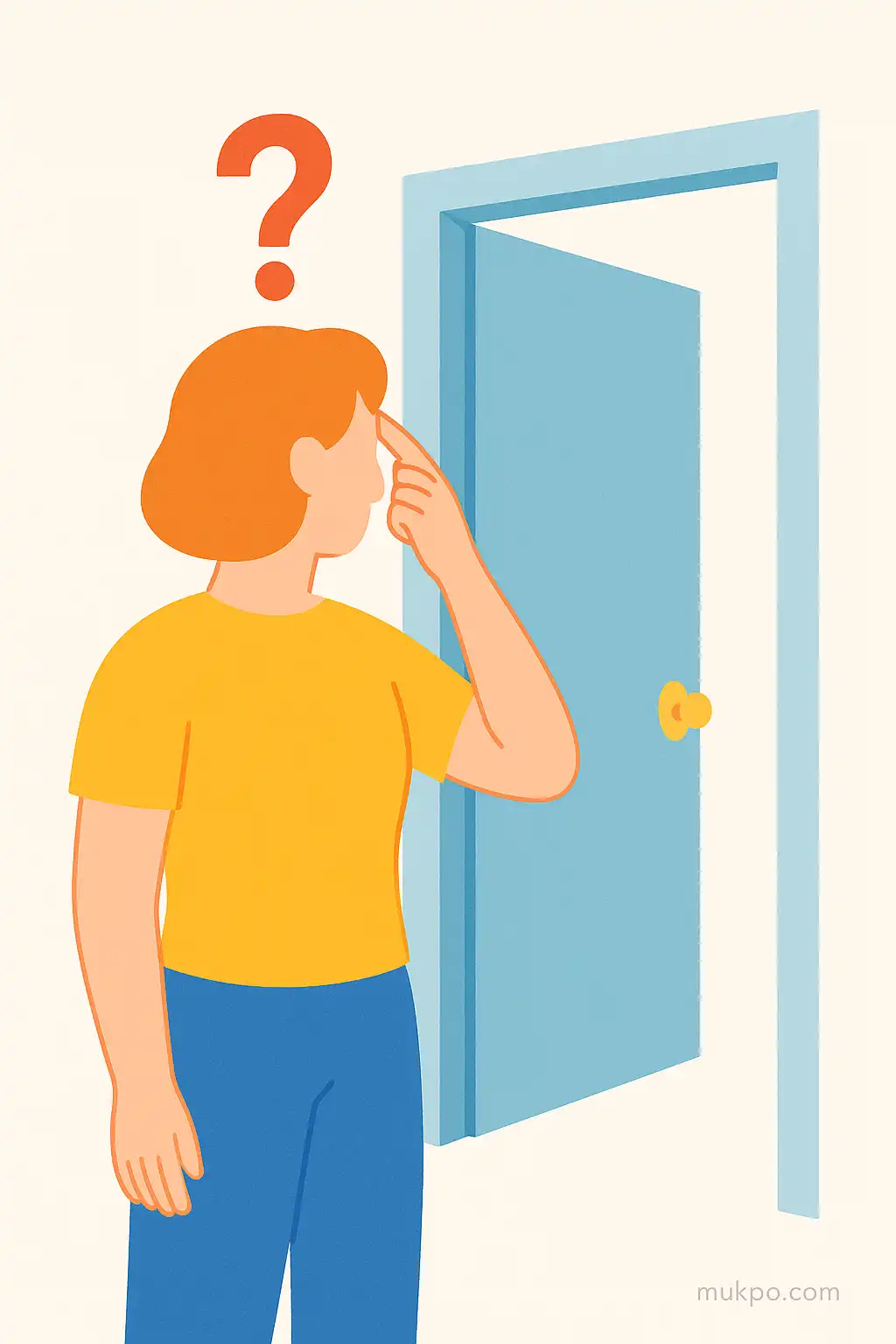
Rooms are not just physical spaces. They’re mental contexts. A doorway marks a boundary: different lighting, different sound, different smell, different set of objects. That shift matters because attention is limited and it’s constantly reallocated. Crossing a threshold forces a quick update. The brain starts sampling the new space for what’s relevant right now, and that can bump out the fragile, just-formed goal you were carrying.
A detail people overlook is how often the “purpose” is not fully decided before the walk begins. It’s common to start moving with a half-made intention. “Get the thing” without a vivid picture of which thing, where it is, and what you’ll do with it. That kind of goal relies heavily on environmental prompts. If the prompt isn’t waiting in the next room—because the room looks different than expected, or the object is hidden—the intention has nothing to latch onto.
Working memory drops pieces when it has to switch tasks
The thought you had in the previous room is usually being held in working memory. That system is fast and useful, but it’s not durable. It’s also doing more than one job. While walking, you’re balancing, navigating around furniture, listening for a sound, maybe keeping track of a conversation. Each of those can demand a slice of attention. When a new task shows up—like stepping around a laundry basket or noticing a notification sound—working memory can lose the original thread.
That’s why this can happen even when someone isn’t “distracted” in the usual sense. The distraction can be tiny and internal. A quick worry, a mental note, a shift from “I’m going to pick up my phone” to “I should answer that email later.” The switch itself is costly. The brain prioritizes what seems urgent in the new moment, and the old goal can be treated like it was already completed.
Your brain assumes continuity that isn’t there
A lot of daily action is driven by scripts. You’ve walked to the fridge a thousand times, so your body can start the sequence before your mind has pinned down the reason. The mind then tries to fill in the reason afterward. When the reason was vague, you get that odd feeling: movement without meaning. It’s not that the brain “forgot” a clear plan. It’s that the plan may never have been fully specified.
It’s also common for the intended action to be tied to a specific visual cue. Think of walking into a bedroom to get a charger because you pictured it next to the bed. If the charger isn’t there today, the cue doesn’t fire. The brain doesn’t always search broadly. It often waits for the expected trigger, and without it, the intention stays inaccessible even though the information is still somewhere in memory.
Emotion and urgency change retrieval
Stress, excitement, or low-level irritation can make this more likely. Not because emotion “erases” memory, but because it changes what gets priority. If you’re hurrying to leave and you’re scanning for keys, the brain is tuned to key-shaped cues and exit-related steps. A side intention—grab a jacket, refill water, take out trash—can drop out when the emotional urgency points attention in one direction.
Sleepiness and mental fatigue can play a similar role. The system that keeps track of goals has less stamina. The room change is the same, but the ability to reassemble the goal from context is weaker. That’s when someone can walk into the bathroom, see the sink, and only then remember they were there for toothpaste, not for their phone, and not for the towel they also needed.
Why it comes back when you return
People often report that the purpose pops back into mind when they walk back to the original room. That fits the cue idea. The earlier context still contains the sights, sounds, and object layout that were present when the intention formed. Those cues can reconstruct the goal quickly, like a partial password that suddenly completes itself when you see the right screen.
There’s also a timing piece that’s easy to miss. The goal can be delayed, not deleted. A few seconds of settling into the new room—eyes landing on familiar objects, background noise becoming predictable—can free up attention again. Sometimes the thought returns only after that “new room scan” finishes, which is why the blank feeling can last just long enough to feel ridiculous.
Related reads
- The elevator rule: why tiny strangers’ talk feels so awkward
- When it literally rained frogs and fish
- The town where the postman still delivers every letter by canoe
- Luggage that repeatedly showed up on flights to the wrong continent
- Microbes that breathe metals and reshape subterranean chemistry
- Coral skeletons as time capsules of ocean heat spikes