
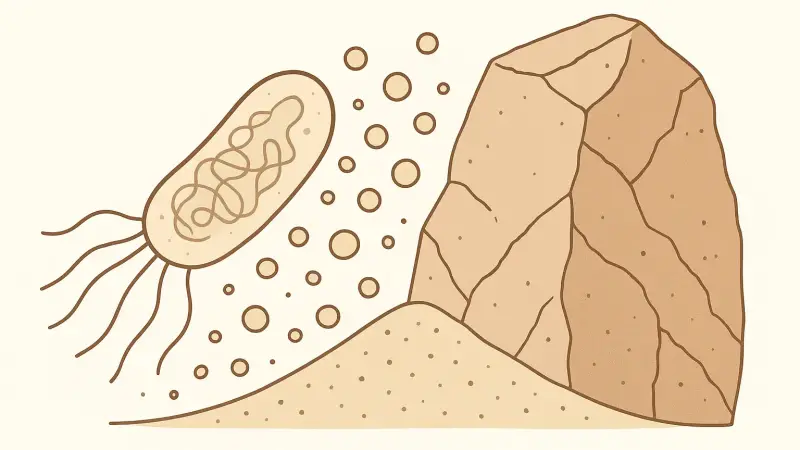
Sand usually stays loose
If you scoop up beach sand, it runs through your fingers. If you come back later, it is still sand. Yet there’s a well-studied lab trick where microbes make grains lock together like a weak natural rock. It isn’t tied to one famous place or event. You see it discussed in research and pilot projects from the Netherlands to the United States to Australia, often under the name microbially induced calcium carbonate precipitation. The core mechanism is simple: certain bacteria change the chemistry around them so that calcium carbonate forms and grows between grains, turning a pile of particles into something that holds its shape.
The bacterium people usually mean

When people talk about “the bacterium” that cements sand, they often mean Sporosarcina pasteurii (older papers may call it Bacillus pasteurii). It’s popular because it produces a lot of urease, an enzyme that breaks down urea quickly. That reaction pushes the local pH upward and creates carbonate in the pore water. If calcium is present, those ingredients can crystallize as calcium carbonate. The crystals don’t fill the whole space. They tend to show up at grain contacts and in tiny bridges, which is why a small amount can change strength a lot.
One overlooked detail is that the bacteria are not “gluing” grains in the way resin would. The bacteria mostly act as chemistry engines and nucleation surfaces. The cement is the mineral they help precipitate. How well it binds depends on grain size, pore space, and how evenly the fluids move through the sand. Even in controlled setups, the result can be patchy because flow finds the easiest channels first.
What has to be in the sand for it to work
The recipe sounds straightforward: sand plus bacteria plus urea plus a source of calcium. In practice, the sand’s environment decides almost everything. Temperature affects enzyme speed. Salinity can stress cells. Existing microbes can compete. And the pH can start too acidic for carbonate to form. Calcium also matters in a boring way that drives outcomes: where the calcium comes from and how fast it arrives changes what crystal forms, how big it gets, and whether it blocks pore spaces early.
Even the way the solution is delivered can flip the results. If reactants meet too quickly, calcium carbonate can precipitate near the injection point and seal the entrance. Then the rest of the sand stays loose. If they meet too slowly, crystals may form sparsely and never create enough bridges. That balance—reaction rate versus fluid transport—is often the real engineering problem, not the biology.
A concrete example people have tried
One of the commonly cited demonstrations is “bio-bricks,” where sand is packed into a mold and treated so it hardens into a block without firing like a clay brick. Variations of this have been explored at places like Delft University of Technology in the Netherlands, along with other research groups working on soil strengthening. The point isn’t that every block comes out identical. It’s that mineral bridges can form at room temperature, using a process that looks more like controlled groundwater chemistry than traditional cement mixing.
Another situational example is slope or dune stabilization. The idea is to strengthen the near-surface layer so wind or water has a harder time moving grains. Here, uniformity is the hard part. Natural sand deposits are layered. Water paths are irregular. A treated crust can end up strong in one patch and fragile a few feet away because the solution followed subtle differences in compaction and moisture.
The trade-offs that follow the chemistry
The urease route comes with baggage. Breaking down urea produces ammonium, and what happens to that nitrogen depends on the surrounding conditions. Sometimes it can be managed in closed systems. In open ground, it raises environmental questions that vary by site and regulation. There are also other microbial pathways people explore to precipitate carbonate without urea, but they can be slower or harder to control.
There’s also a subtle physical trade-off. Cementing sand can reduce permeability, because mineral growth narrows pores. That might be useful if the goal is to reduce seepage. It might be a problem if water needs to drain through. The same calcium carbonate that adds strength can quietly change how the ground breathes and moves water, and that side effect often matters as much as the headline “turns sand into rock.”

Related reads
- When fireflies flash together: the physics of synchronized light
- How desert varnish forms on sun-baked rocks
- Why hummingbird wings create tiny vortices that aid hovering
- A street whose lawns rearrange their stripes overnight
- How seawater ice traps air bubbles that record ancient storms
- A vending machine that always ejects a single antique spoon