
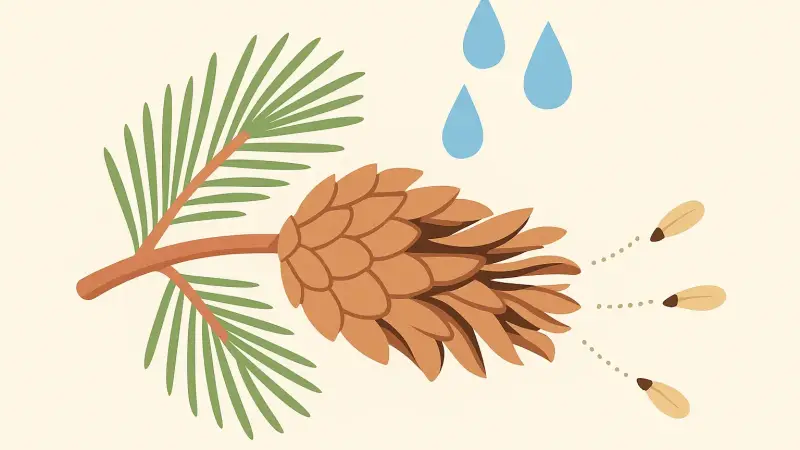
A pine cone looks dead until the air changes
Pick up a pine cone on a damp morning and it often feels tight and heavy, like it’s still holding itself shut. Come back after a dry afternoon and the same cone may look looser, with scales lifted and gaps you can see through. This isn’t one single place-dependent trick. It shows up across a lot of conifers, from Scots pine in Scotland to lodgepole pine in western North America to many Mediterranean pines that deal with long dry spells. The basic mechanism is simple. The cone’s scales move with humidity, and that movement controls when seeds can slip out and catch air.
The cone’s “hinges” are built from two kinds of tissue
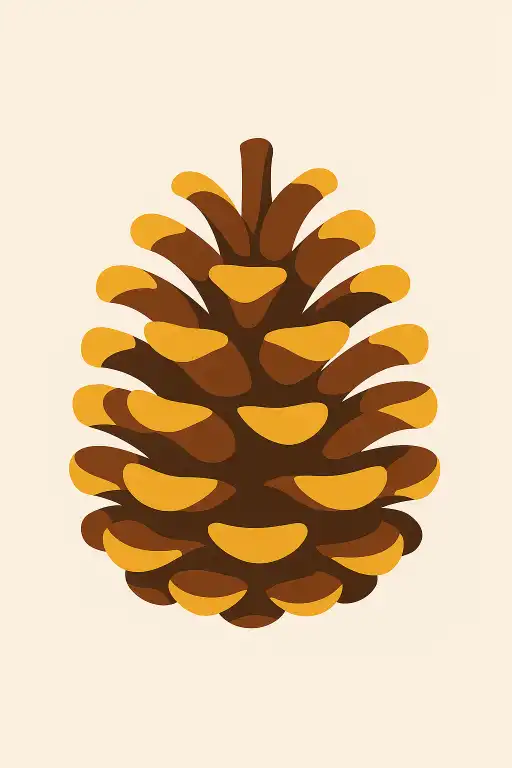
Each woody scale is not uniform. It’s a layered structure, and the layers don’t respond to moisture the same way. One layer swells more when it absorbs water. Another layer swells less and resists that change. When humidity rises, the swelling side forces the scale to bend inward and close. When humidity drops, that side shrinks back and the scale bends outward and opens. No nerves. No living muscles. It’s a passive material response baked into the cone as it forms.
A detail people tend to overlook is that the cone does not need to be “alive” to do this. Cones can keep opening and closing long after they’ve fallen from the tree because the movement is driven by the cell wall structure in the dead tissue. The same physical setup can cycle repeatedly as the air gets damp at night and dries during the day.
Humidity matters because wind and wet don’t cooperate
Seeds don’t just need to get out of the cone. They need the right exit conditions. Dry air is usually linked with better wind movement close to the ground and less clumping on seed surfaces. In damp conditions, thin papery wings can stick slightly, and seeds can cling inside the cone or fall with less lift. Closing in humidity also reduces the chance that a seed drops into wet litter where it can be pinned down by surface tension and decay faster.
There’s also timing. Many conifers release seeds over days or weeks, not all at once. A cone that opens only in dry spells spreads that release across multiple windy windows. That raises the odds that at least some seeds get carried away from the parent tree instead of landing in the same shaded patch.
It’s not the same as fire-triggered cones
People often lump all “cones that open later” into one category, but humidity-driven movement is different from serotiny. Serotinous cones are sealed with resin and tend to stay shut for years until heat—often from wildfire—softens that resin and allows the scales to separate. Humidity-responsive cones are already capable of moving with ordinary weather. They may still hang on the tree for a while, but the opening and closing is a daily materials cycle, not a once-per-lifetime release switch.
Some species can show a mix of behaviors depending on population and climate, and the exact degree of movement varies. The important point is that the humidity mechanism doesn’t require extreme heat. It works in the regular range of damp mornings, dry afternoons, and seasonal shifts.
Watching it happen explains the shape of the scales
If you watch a cone through a full day, the movement is not random. Scales tend to open from the outer parts first, changing airflow through the cone. That helps loosen seeds that are sitting deeper between scales. The “shingled” overlap is doing two jobs at once. It protects developing seeds from rain while they mature, and later it creates a controlled doorway that widens when the air is dry.
Even the stiffness of the scale matters. A cone that opened too easily in slight dryness would dump seeds in calm conditions. A cone that stayed too tight would hold seeds long past the best season. Humidity gives a built-in sensor that tracks the air the seed is about to fly through, because the same dryness that opens the scale usually also improves dispersal.
Related reads
- How deep-sea microbes turn methane into energy
- Why morning dew forms on some car hoods and not others
- The beetle that drinks fog as its water source
- The chemistry behind glass frogs’ see-through skin
- How wind vortexes carry maple seeds tens of kilometers
- The fossil tooth that changed what we know about mammal diets