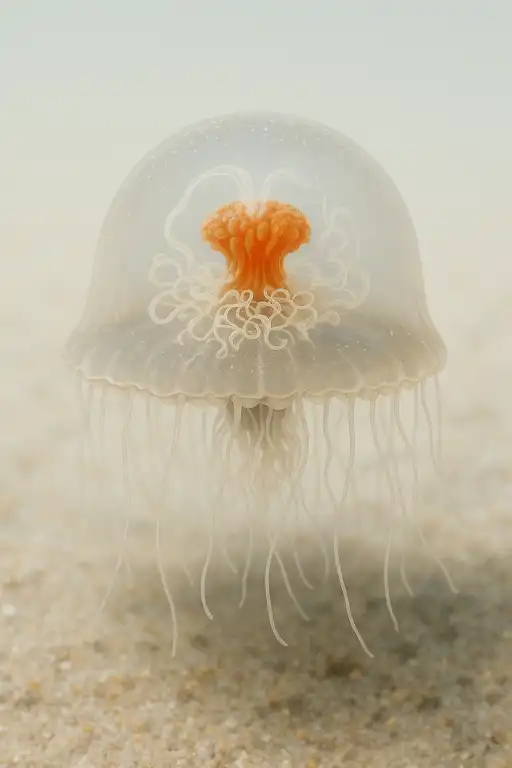
People usually think of a life cycle as a one-way street. Egg to larva. Juvenile to adult. For one small jellyfish, that expectation breaks. It’s not tied to one famous beach or a single “immortal jellyfish” event. It shows up in different parts of the world, including the Mediterranean Sea, Japan, and the Caribbean. The species most often linked to this trick is Turritopsis dohrnii. Under stress, it can reverse its development. An adult medusa can collapse into a blob of tissue and turn back into a polyp stage, then start producing new jellyfish again. The details vary by study and conditions, but the basic mechanism is real.
Which jellyfish does this, and where it turns up
The “reverse aging” story usually points to Turritopsis dohrnii, a tiny hydrozoan jellyfish. It’s easy to miss because the medusa stage is only a few millimeters across. Reports place related Turritopsis species in several oceans, and there’s some uncertainty because different species have been confused or reclassified over time. That matters, because not every lookalike has the same abilities, and some headlines blur the distinction.
Even when the species is identified correctly, you’re not looking at a creature that “chooses” immortality whenever it wants. It’s more like a survival detour that can happen under certain conditions. In the open sea, observing the full reversal directly is hard. In labs, where stressors can be controlled and watched closely, the transformation is easier to document.
The normal life cycle it’s messing with
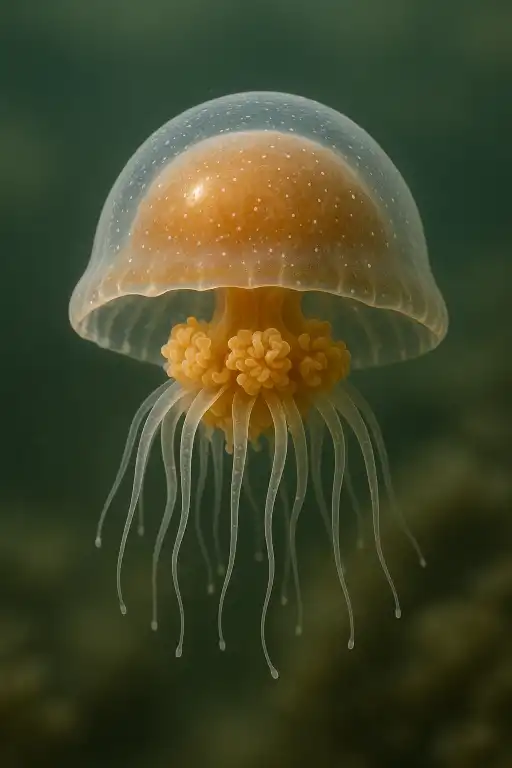
Hydrozoan jellyfish usually have two main body plans. There’s the polyp, which is attached to a surface and can bud off new individuals. And there’s the medusa, the familiar floating form that releases eggs or sperm into the water. The switch from polyp to medusa is considered a developmental step forward. Once you’re a medusa, you generally don’t go back.
One overlooked detail is how physically different these stages are. The polyp has a simple, tube-like body anchored to something solid. The medusa is built for swimming and dispersal. Reversing the cycle isn’t like shrinking. It means reorganizing the body plan, including structures that don’t even exist in the polyp stage.
How the reversal works in practice
When reversal happens, the medusa doesn’t quietly “age backward.” It often looks like it’s falling apart. The swimming bell can shrink and collapse. Tentacles can be reabsorbed. The animal settles and forms a cyst-like mass. From there, it can develop stolons and then polyps, which can later bud off new medusae. This process is usually described as transdifferentiation: one kind of specialized cell turning into another kind, rather than staying locked into its old job.
Stress tends to trigger it. Researchers have used things like physical damage, changes in temperature, or altered salinity in controlled settings to prompt the reversal. It’s not always successful. Sometimes the animal dies. Sometimes it stalls. When it works, though, the result isn’t the same individual “living forever” in a normal sense. It’s more like the body resets into a stage that can reproduce asexually, and the cycle can begin again.
What “immortal” does and doesn’t mean here
The popular label “immortal jellyfish” is catchy, but it hides the practical limits. Predators still eat them. Disease still happens. Starvation still happens. A jellyfish that can revert to a polyp can still be wiped out in a rough patch of ocean, or in a jar that isn’t kept stable. The trick mainly changes the odds of dying from developmental dead-ends, not the odds of dying from everything else.
It also doesn’t mean an unbroken, conscious lifespan. The medusa stage can regress into tissue that reorganizes into a polyp colony. Depending on how you define “the same individual,” it can feel more like a biological reboot than a single animal accumulating years. The boundaries get fuzzy because colonies, budding, and clonal reproduction are already normal parts of hydrozoan life.
Why biologists pay attention to it
Researchers care because it’s a rare, natural example of large-scale cellular reprogramming in an adult animal. Most animals can regenerate small parts. Some can regrow limbs. But reversing an entire life stage suggests unusually flexible control over cell identity. That puts attention on genes and pathways involved in development, repair, and stress response, because they’re being used in an extreme way.
There’s also an ecological angle that people overlook. A species that can drop back into a tough, attached stage may be better at surviving local disasters and recolonizing later, especially if polyps can hide on rocks, shells, docks, or ship hulls. That doesn’t guarantee it spreads everywhere, but it changes how persistence in an environment might work when conditions swing from good to bad and back again.