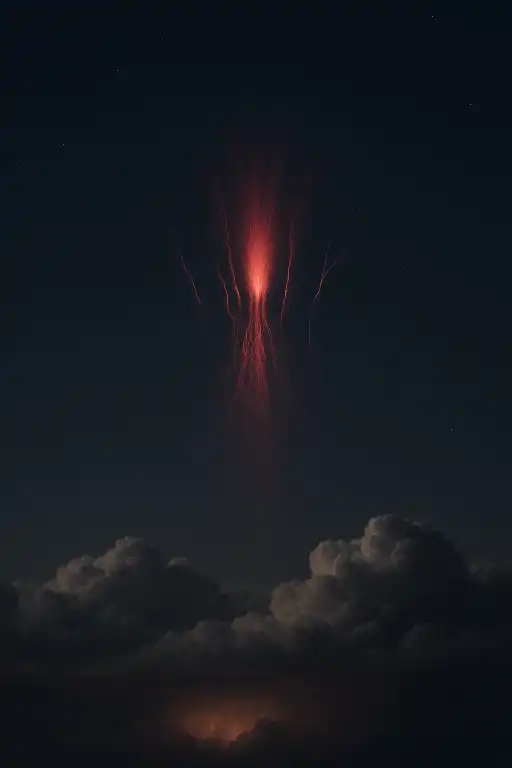

Why do “sprites” appear at all?
People expect lightning to stay inside the storm clouds, or to strike the ground. So it’s a surprise to learn that some storms also trigger brief red flashes high above them, in the thin air near the edge of space. This isn’t one single famous event. Sprites have been reported above storms in the U.S. Great Plains, over northern Italy, and near Japan’s coast. The basic mechanism is simple: a powerful lightning discharge inside the storm rearranges electric charge so abruptly that the electric field above the cloud spikes, and the upper atmosphere responds with its own kind of electrical breakdown.
That breakdown is not a “bolt” traveling upward like a normal strike. It’s more like the air itself suddenly becoming conductive in patches. The red color comes from excited nitrogen molecules, which are abundant up there and glow strongly in red when the right electrons slam into them.
The kind of lightning that tends to trigger them

Sprites are most often linked with strong positive cloud-to-ground lightning, the kind that moves a lot of charge in a single stroke. A big positive strike can leave the storm cloud with a different charge balance than it had a fraction of a second earlier. That sudden change matters more than the dramatic look of the bolt itself, because it’s the electric field above the cloud that “notices” first.
That field can briefly become intense enough to accelerate electrons in the rarefied air tens of kilometers above the storm. Once enough electrons start gaining energy, they collide with nitrogen and oxygen and create more charged particles. The process can cascade, and the upper atmosphere lights up in a pattern that can look like jellyfish shapes, columns, or tendrils depending on the details of the field.
Altitude changes the rules of a spark
The reason the flash happens so high up is that air density changes what it takes to make a discharge. Near the ground, air is dense and it takes a very strong local electric field to force a visible breakdown along a narrow channel. Higher up, there are fewer molecules per cubic meter. That makes it easier for electrons to travel farther between collisions, so a large-scale glow can form even when the field would not make a classic lightning channel at lower altitude.
One specific, overlooked detail is timing. The optical flash is extremely brief, often just a few milliseconds, and it can lag the parent lightning by a small fraction of a second. That delay is part of the clue that the storm isn’t “shooting” a thing upward. The upper atmosphere is responding after the cloud’s charge shift has already happened.
What shapes and colors are telling you
The red glow is mostly emissions from nitrogen in the upper atmosphere, where oxygen is less effective at quenching that light than it is lower down. The lower parts of a sprite can look slightly bluish or purplish in some recordings. That’s because different molecular transitions dominate at different altitudes and pressures, and cameras vary a lot in what wavelengths they capture well.
The branching structures are not random decoration. They track where the electric field is strong enough for “streamers,” thin filaments of ionization, to propagate. Small changes in the storm’s charge layout, the altitude of the charge layers, and even lingering ionization from earlier activity can change the pattern from one flash to the next, even above the same thunderstorm system.
Why they’re easy to miss from the ground
They sit above the storm top, often tens of kilometers up, so the viewing geometry matters. If you’re too close, the cloud anvil blocks the line of sight. If you’re too far, haze and distance wash out a millisecond flash. That’s why many clear observations come from aircraft, mountaintops, or dry, flat regions like the central United States where horizons are wide.
Another practical detail people miss is that sprites don’t necessarily correlate with the most frequent lightning. A storm that produces fewer but more charge-intensive strokes can be a better candidate than a storm flickering constantly. It’s the amount and configuration of charge moved, and how abruptly it changes the electric field above the cloud, that sets the upper atmosphere glowing.