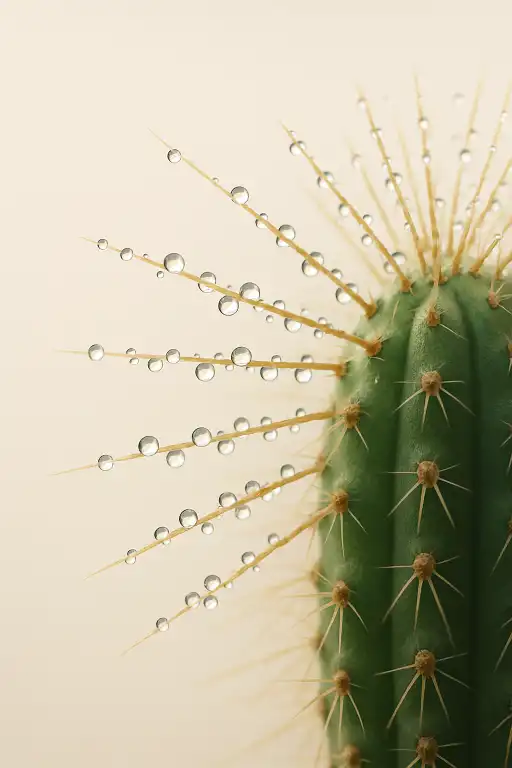
Watching a cactus drink air
Fog can feel like nothing. It just sits there, damp and weightless. But stand near a cactus on a foggy morning and the “nothing” starts turning into beads you can actually see. This isn’t one single place or event. It shows up in coastal deserts like the Atacama in Chile, the Namib near the Skeleton Coast in Namibia, and foggy stretches of Baja California in Mexico. The basic idea is simple: spines give fog droplets a place to collide, stick, merge, and then move. It looks like the plant is sweating. It isn’t. It’s turning passing mist into tiny, usable liquid water.
Why spines are good at catching fog

Fog is made of suspended droplets that are already liquid. They just need a surface to hit. Cactus spines work because they’re thin and numerous, so they intercept airflow without fully blocking it. When wind pushes fog past a spine, some droplets impact the spine and stay there instead of continuing on. A big, smooth cactus skin can catch droplets too, but it tends to shed them differently and it warms in the sun, which can evaporate them faster.
One overlooked detail is that spines are often covered in tiny grooves and bumps. Those microtextures change how easily water spreads. They can pin a droplet in place long enough for more droplets to join it. That matters because a single fog droplet is so small it would otherwise blow off again. A spine’s roughness helps build something heavy enough to move.
How the droplets grow and start to travel
Once a droplet sticks, it becomes a collector. The next droplets collide with it and merge, a process called coalescence. As the droplet grows, gravity begins to matter. So does vibration from wind. At some point the droplet stops being a static bead and becomes a moving one, sliding or rolling along the spine.
The direction it moves is not always random. Many cactus spines taper from thicker near the base to thinner at the tip. That shape creates a pressure difference across the droplet’s curved surface, which can nudge it along the spine. Surface tension is doing the steering. Whether the droplet goes toward the base or toward the tip can vary by spine shape, surface chemistry, and how the spine is angled.
Where that water actually ends up
Harvesting fog only helps if the water gets off the spine. Often it drips to the soil near the plant’s base, where shallow roots can catch it. Sometimes it runs onto the plant body itself and then down toward the ground. In a dense cluster of spines, one drip can strike another spine, break apart, and re-collect. That sounds inefficient, but it can spread water over a wider area under the plant.
There’s also a timing issue people miss. Fog events frequently happen at night or early morning, when the air is cooler and evaporation is slower. A bead that forms at dawn can survive long enough to drip. The same bead on a hot afternoon might vanish before it ever moves. So the cactus isn’t just shaped for collection. It benefits from the daily rhythm of temperature and humidity.
Why it works so well in real foggy deserts
In places like the Atacama and the Namib, fog can be more reliable than rain. The air is moist, but the sky may stay stubbornly dry. Cacti and other desert plants don’t “pull” water out of vapor the way a dehumidifier does. They take advantage of droplets that already exist, then use structure to make those droplets collide and combine.
It’s also not guaranteed. Wind speed, droplet size, and how salty the fog is can change how sticky water is on a surface. Some mornings a spine will bead up quickly. Other mornings it won’t, even if the air feels wet. The mechanism depends on a fragile chain of small events: impact, attachment, merging, and finally release.