

Watching the reef “snow”
On some nights, a reef can look calm right up until it suddenly turns into a slow-motion blizzard. That “snow” is eggs and sperm rising into the water at the same time. It isn’t one single place where this happens. It’s been documented on the Great Barrier Reef in Australia, on reefs in the Caribbean, and in parts of the Red Sea. The timing often clusters around particular moon phases, usually a few nights after a full moon, but the exact night can vary by species and location. Corals don’t “see” the moon like people do. They key off a stack of repeating cues that line up with it.
Why the moon is such a good calendar
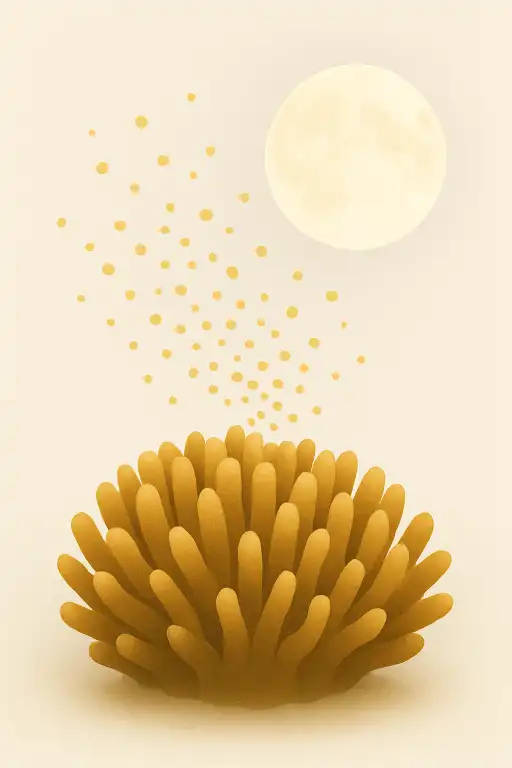
The moon is useful because it is reliable. A lunar cycle repeats with a predictable rhythm, and moonlight changes in a consistent way night to night. That matters on reefs, where conditions can swing with weather and currents. Moon phase also tends to correlate with tide patterns, which can change how water moves over the reef and how diluted the gametes become once they’re released.
Still, the moon is not acting alone. Most mass spawning events also sit inside a seasonal window. Water temperature and day length help set that window. Corals seem to use those slower signals to know what month it is, then use the lunar cycle to narrow down to the right week and night.
The cues corals actually respond to
Corals have light-sensitive chemistry, even without eyes. Moonlight intensity and the length of darkness can shift internal rhythms, similar in concept to biological clocks in other animals. Researchers also point to the abrupt change in light at sunset as a “final” cue. Many species release their bundles shortly after dusk, often within a tight window that can be measured in minutes.
A detail people tend to overlook is that a lot of reef-building corals don’t release loose eggs and sperm at first. They release buoyant bundles that look like tiny beads. Those bundles float up, then break apart at the surface. That short delay may help keep eggs and sperm concentrated together long enough for fertilization, instead of being immediately scattered by turbulence around the coral heads.
How millions of colonies synchronize without a leader
No single coral “starts” it. Synchrony comes from many colonies independently tracking the same environmental schedule. When temperature, day length, and the lunar phase all land in the right range, a lot of individuals reach readiness at once. Within that, there’s still variation. Different species on the same reef can spawn on different nights, and even the same species can split across two nearby nights.
There’s also a practical reason for the crowding. Fertilization happens outside the body, in open water. If only a few colonies spawned, sperm concentrations would drop fast and fertilization would fail. Releasing together swamps that dilution problem. It can also overload predators that eat gametes, simply because there’s too much food all at once for them to consume.
Why the “right” night can shift
Even when a reef is known for a particular moon phase, the exact timing is not fixed like a holiday. Local water temperature can run early or late. Cloud cover can change how much moonlight reaches the reef. Storms and unusual currents can disrupt the conditions that make surface fertilization workable. That’s part of why spawning is often described as happening “around” a full moon rather than on it.
In places like the Great Barrier Reef, observers have recorded mass spawning spread across multiple nights, and sometimes across different months, depending on which coral species are dominant and what the year’s conditions are like. The moon provides the backbone, but the reef still waits for the rest of the signals to line up before it lets go.
Related reads
- Why pumice rafts let plants and insects colonize distant islands
- Why raindrops make different sounds on metal and wood
- The orchid that mimics a female moth down to the scent molecules
- How electric eels prevent self-shock while stacking thousands of volts
- The bacterium in subway tiles that glows under blue light
- How electric fish create private radio channels underwater