
It’s not one event, and you’ve probably felt it
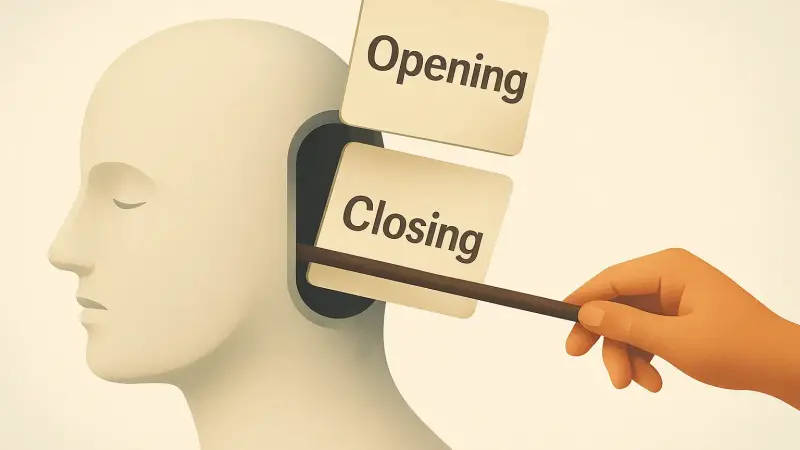
Think about a concert, a wedding, a job interview, or even a flight. People often remember the first minute and the last minute better than the middle. This isn’t tied to one famous incident or one place. It shows up at Wembley Stadium, in a courthouse hallway, and at a family dinner table. The basic mechanism is that the brain doesn’t store every moment evenly. It leans on boundaries. Beginnings and endings act like natural “bookends,” so attention sharpens there, and memory gets an easier handle to grab later.
There’s also a small detail people overlook: the first few seconds often include orientation work. You’re scanning faces, lighting, tone, rules, where to sit, what’s expected. That quick mental setup creates a richer bundle of cues than a typical minute later on, when everything has already settled.
Beginnings come with a spike in attention
At the start of an event, attention tends to narrow. The brain treats a new episode as potentially important, because it might contain threats, opportunities, or social information. That extra alertness means more details get encoded. Not just what happened, but what it felt like: the room temperature, the sound level, the first impression of someone’s voice.
This is part of why first impressions can feel sticky. The opening minutes contain high-contrast information: new faces, new stakes, and uncertainty. Uncertainty is a memory amplifier. When the brain can’t predict what comes next, it samples more aggressively. Once the pattern becomes familiar, attention relaxes, and fewer distinct markers get stored.
Endings get stored because they close the file
As something ends, the mind starts wrapping it up. People notice final cues: applause, goodbyes, the last question, the credits, the walk to the door. That closing process can strengthen memory because it forces a quick “what just happened?” pass. Even without meaning to, the brain compresses the experience into a simpler record, and the final moments sit right next to that compressed label.
Endings also tend to come with emotion and evaluation. Relief, satisfaction, disappointment, awkwardness. Those feelings tag the whole episode. A small late detail can color what’s remembered, like the last song at a set, or a final comment after a tense meeting. The middle can be longer and objectively richer, but it doesn’t always get the same tagging treatment.
The middle blurs because it’s repetitive and harder to index
Most events have a “cruise” phase. The structure is established, and the brain shifts from active sampling to maintenance. When minutes resemble each other, they compete in memory. It’s not that nothing is stored. It’s that later, there aren’t enough unique hooks to pull out one middle moment from another.
This is where time perception gets weird. The middle often feels long while you’re living it, because you’re tracking ongoing details. Later, it can feel short in hindsight, because the brain kept fewer distinct snapshots. The beginning and end have clearer boundaries, so they’re easier to retrieve, and that can make the middle seem like it vanished.
Memory of events also leans on peaks and the last moments
When people recall an experience, they don’t replay it like a recording. They rebuild it from a handful of standout points. Two that often dominate are the most intense moment and the final moments. Psychologists sometimes describe this as a “peak-end” pattern in evaluation and recall. It can show up in medical visits, theme parks, and performance reviews, where one high-stress moment and the wrap-up shape what people say the whole thing was like.
That doesn’t mean the middle is irrelevant. It shapes the peak and sets up the ending. But the way memory is accessed favors moments that are easy to label and locate. Beginnings announce themselves. Endings do too. The middle usually doesn’t, unless something interrupts it—an unexpected announcement, a sudden mistake, a surprising joke—anything that creates a new boundary inside the episode.

Related reads
- The town that renamed itself to win a radio contest
- Why laughter spreads through a crowd even when no one plans it
- A pond that spits out coins every few summers
- A warehouse full of undeliverable returns with no senders
- The pattern-hunting glitch that convinces us there’s meaning where there isn’t
- The necklace scandal that entangled Marie Antoinette and unraveled royal credibility in pre-Revolution Paris