
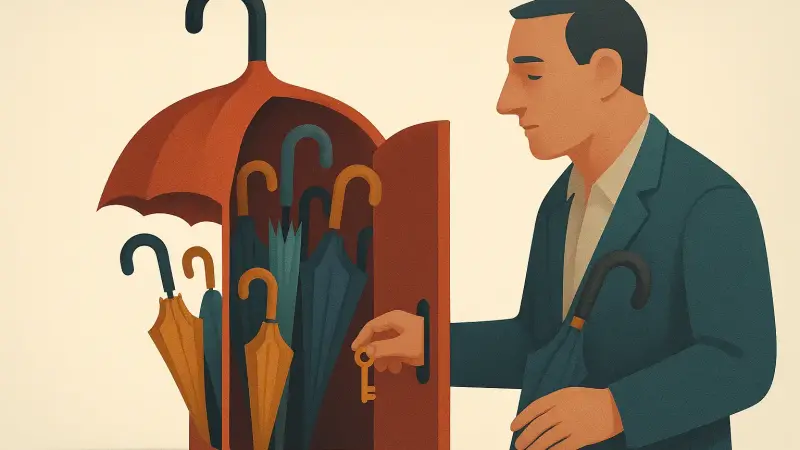
In any building with shared hallways, umbrellas pile up in the same places. By the mailboxes. In a stairwell corner. Hooked to a radiator “for now,” then forgotten. This isn’t one famous story tied to one city. You can hear versions of it in apartment blocks in London, New York, or Tokyo, where rain gear turns into anonymous clutter fast. The odd part is when a landlord doesn’t toss the pile. They keep it. Quietly. And months or even years later, they hand an umbrella back to someone who barely remembers losing it—because they noticed one small identifier that stuck to it longer than the owner did.
How umbrellas end up orphaned
Umbrellas get abandoned for boring reasons. A tenant comes home soaked, drops it near the entry, then grabs the groceries instead. Or it dries out, looks like every other black umbrella, and stops feeling like “theirs.” Buildings make this worse. Shared spaces blur ownership. People move out quickly. Keys change hands. When something small is left behind, it doesn’t feel worth the awkward email to everyone on the floor.
A lot of umbrellas also look interchangeable until you’re the person who lost one. Then you remember a crooked spoke, a scuffed handle, or a strap that never fastened right. Those details are real, but they’re private. Nobody else knows to look for them, so the umbrella becomes “unclaimed” even when its owner is still in the building.
Why a landlord would keep them

Some landlords keep lost items for the same reason they keep spare tiles or an extra light fixture in a closet. They like order, and they like having a quick fix when a tenant asks. An umbrella pile is messy, but it’s also useful. A sudden storm hits. A repair person shows up without rain gear. Someone’s kid forgets theirs on a school morning. The “lost and found” becomes an informal supply cabinet.
There’s also a quieter motive: avoiding conflict. Throwing away property can backfire. Even a cheap umbrella can become a complaint if the wrong person sees it in the bin. Keeping it costs almost nothing. A landlord already has storage spaces tenants rarely see—boiler rooms, utility closets, an under-stairs nook. The umbrella goes there and stops being an issue until a moment presents itself.
The small clues that make a reunion possible
Most umbrellas are anonymous until something tags them. A name written on the fabric. A luggage tag looped to the handle. A distinctive sticker from a café or a museum. A bent tip that catches the eye because the landlord has walked past it for months. The overlooked detail people miss is that umbrellas often carry microscopic paperwork: a dry-cleaning-style claim tag, a wrist strap with a monogram, or a company logo from a conference that places it in a specific time window.
When a landlord has handled enough move-outs and maintenance visits, they build a memory for objects. Not because they’re sentimental, but because objects repeat. The same brand of compact umbrella appears three times on one floor. One has a green elastic band. Another has a chipped wooden hook. If the landlord later sees a tenant carrying the “wrong” one, they can connect the mismatch without making a big show of it.
What “quietly” looks like in practice
The reunion often happens sideways. A tenant mentions they’re heading out and it looks like rain. The landlord reaches into a closet and says, almost casually, “Is this yours?” Or they leave it by a door with a note that doesn’t demand proof. Sometimes they wait for a confirming detail. The tenant smiles and says, “I thought I lost this when the elevator was broken,” or “That’s the one with the jammed button.” The landlord doesn’t need to interrogate anyone.
It’s also common for the timing to be accidental. A tenant returns after being away. A long-time resident moves back into a building they lived in years earlier. Or someone comes to pick up mail after a move-out. A landlord who kept a few labeled items can match them in minutes, but only if the person shows up again. When they don’t, the umbrella just stays in the back room and quietly becomes part of the building’s unofficial inventory.
What it reveals about buildings and memory
Apartment living produces a strange kind of shared amnesia. People see each other daily and still don’t know what belongs to whom. Small objects slip out of personal identity faster than you’d expect, especially when they’re cheap, common, or weather-related. An umbrella is almost designed to be lost: it’s used in a hurry, handled with wet hands, and set down the moment you cross a threshold.
A landlord who reunites tenants with old umbrellas is noticing the opposite pattern. They’re seeing how a building keeps a shadow record of its residents through leftovers. Not big things like furniture, but the small items that are easy to abandon and oddly hard to replace when you need them right now. The umbrella comes back, and the tenant recognizes it instantly, even if they hadn’t thought about it for years.

Related reads
- A stretch of road where every car alarm triggers at the same milepost
- How decision fatigue makes small choices unravel by dinner time
- Shopkeepers who sell human teeth as good luck charms
- Why boredom sometimes triggers sudden bursts of creativity
- How listener nods and murmurs steer the direction of conversations
- A museum that seals strangers’ letters under the floor and forbids opening them