
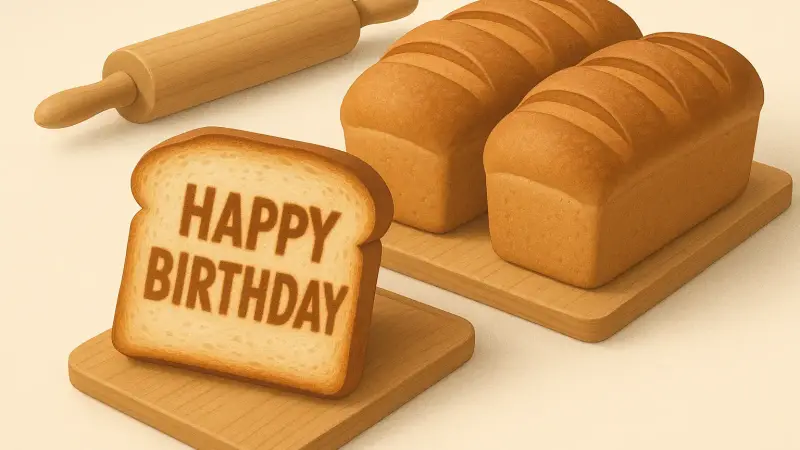
You don’t expect bread to have a second layer of meaning, but toast changes the rules. This idea isn’t tied to one famous bakery or a single city. Versions of “hidden message” foods pop up in places like Japan (where food design culture is strong), the U.S. (where custom bakery orders are common), and the U.K. (where novelty bakes get shared fast). The basic trick is consistent, though: a loaf looks normal when sliced, but a birthday message appears when the slice is toasted. Heat darkens some parts faster than others, so letters show up as if they were printed inside the crumb.
How letters can be “inside” a loaf
The cleanest way to get readable letters is to build them before baking. Dough can be colored slightly, or made denser, and then shaped into letter forms. Those letter shapes are placed inside a larger mass of plain dough and proofed together. When the loaf bakes, the letters become part of the interior structure, not a filling. When you slice it, you may only see faint outlines because the crumb is pale and evenly lit. The message is physically there, but it doesn’t contrast much yet.
Another method uses a stencil-like insert made from baked bread or a very dry dough. That insert has a different moisture content and toasts differently. Some bakers also rely on controlled sugar content in the letter dough. Sugar accelerates browning, but too much changes fermentation and makes the crumb gummy. That balance is why these loaves tend to be special-order items rather than everyday sandwich bread.
Why the message waits for the toaster
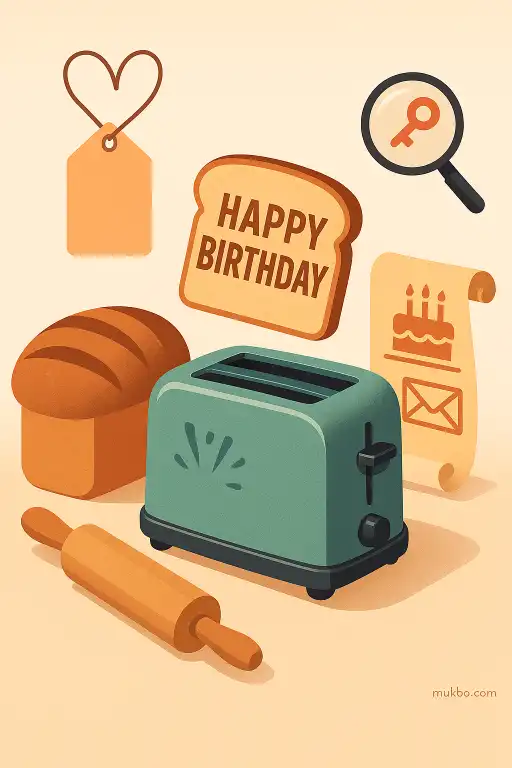
Toasting is mostly about heat moving water around and triggering browning on the surface. The message appears because different parts of the slice reach “brown” at different times. Letter sections might contain a bit more sugar or milk, which brown faster. Or they might be slightly denser, which changes how quickly heat penetrates and dries them. The slice can look blank at first, then suddenly the letters jump out after another half-minute. It feels like a reveal, but it’s just timing.
A detail people usually overlook is that the slice has to be cut in the right direction. If the message runs along the length of the loaf, a diagonal cut can stretch or break letters into unreadable pieces. Thickness matters too. A thin slice browns uniformly and can wash out the contrast. A slightly thicker slice keeps the outer layer browning while the interior stays lighter, which makes the letters easier to read.
What a real order tends to look like
A typical request is a short phrase like “HAPPY BDAY” or a name plus an age, because long sentences distort during proofing. Dough expands in every direction. Curves puff. Sharp corners soften. That’s why block letters show up more often than script. If someone wants “MIA 10,” the baker can build chunky shapes that survive fermentation without turning into blobs.
On the day it’s served, the loaf behaves like normal bread until heat is applied. Picture a breakfast table: slices go into a toaster, and the first one comes out looking ordinary. Then someone flips it back in for a little longer, and the letters appear on the face that was closest to the heating element. People sometimes miss that the message can be stronger on one side than the other, because toasters don’t heat evenly. The reveal depends on the appliance as much as the bake.
The constraints bakers have to work around
These loaves are harder than they look because bread is a moving target. Proofing time varies with room temperature and yeast activity. A letter that’s perfectly centered before fermentation can drift as the dough relaxes. If the outer dough proofs faster than the letter dough, the message can warp. Bakers compensate by chilling components, adjusting hydration, or proofing in molds to keep the geometry stable.
There’s also a flavor constraint. If the letter dough is engineered only to brown fast, it can taste noticeably different. Some bakeries aim for subtle contrast so the slice still tastes like one loaf. That means the message may only be readable at a narrow window of toastiness. Too light and nothing shows. Too dark and the whole surface browns, flattening the contrast again.
Why it feels so convincing
The effect lands because it uses a familiar ritual. Toasting is repetitive and predictable, so the brain expects a simple “light to dark” change. A letter-shaped change breaks that expectation without looking like a trick. The crumb still has pores. The crust still smells right. Nothing oozes out. It reads like the bread had a private layer the whole time, and heat is the only thing that can make it speak.
And because the message shows up on a slice-by-slice basis, it can feel personal in a way a frosted cake message doesn’t. One person might see the first letter and call everyone over. Another might get a slice from the middle and see the whole phrase at once. The loaf doesn’t announce itself until it’s already part of the table.
Related reads
- Why pupils widen when someone catches your eye
- Why you cannot tickle yourself
- What happens to memories overnight when sleep seals them in
- A landlord who quietly reunites tenants with umbrellas left years ago
- A stretch of road where every car alarm triggers at the same milepost
- How decision fatigue makes small choices unravel by dinner time