

That moment you can’t place the name
It isn’t one single “place” where this happens. It shows up everywhere, from a crowded office elevator in New York to a school pickup line in London to a neighbor’s party in Sydney. You spot someone and your brain clicks: you know that face. Then the name refuses to appear. The core reason is simple: faces and names are handled by different memory systems, and they don’t have equal support. A face comes with built-in structure and meaning. A name is often just a sound tag that has to be attached on purpose, in a specific moment, while attention is already split.
Faces get dedicated brain hardware
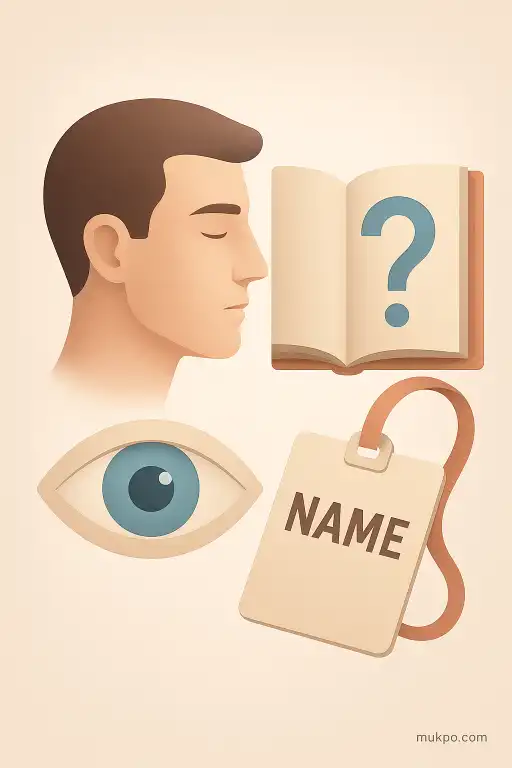
Humans are unusually good at processing faces. There are brain regions that respond strongly to faces, including the fusiform face area in the temporal lobe. A face is also a rich bundle of cues. Shape, spacing, expression, age, and even grooming can be processed in parallel. That makes recognition fast and resilient. It can work even when conditions are bad, like dim lighting or an awkward angle, because the brain can fill in missing information from partial patterns.
A name doesn’t get that same kind of built-in scaffold. “Maria” or “Kevin” doesn’t visually resemble the person. It usually doesn’t carry a dependable clue about their job, your relationship, or where you met. So the brain can recognize the person while failing to retrieve the arbitrary label connected to them.
Names are arbitrary, and that makes them fragile
Memory retrieval likes multiple hooks. A face naturally provides them. A name often provides only one. If the link between the face and the sound was made during a distracted moment, the connection can be thin. Think of a quick introduction at a conference reception. There’s background noise. You’re shaking hands. You’re also trying to read a badge and make eye contact. That short window can be enough for recognition later, but not enough for a stable name trace.
One detail people overlook is that names compete with each other. Lots of people share the same few common names within a community or age group. That creates interference. When a face feels familiar, several candidate names can become partially active at once, and none crosses the threshold into confident recall.
Recognition and recall are not the same task
Recognizing a face is often a “matching” problem. The brain compares what it sees to stored patterns and decides it’s the same person. Recalling a name is more like searching for a specific file without a clear filename. The cue “that person” is broad, so the search can stall. That’s why the name can pop up later, when the pressure is off and the search keeps running in the background.
This split also explains a common experience: someone can remember where they met the person, or what they talked about, while the name stays missing. Context and conversation details are linked to episodes and meaning. A name is often stored as a separate verbal item that has to be pulled out by a narrower route.
Stress and social stakes change what gets retrieved
The exact same memory can be easier or harder depending on the moment. Social pressure tends to narrow attention. That can help with reading a face—because faces are central to the situation—while making word retrieval worse. Name recall is a kind of precise verbal access, and it’s sensitive to stress, divided attention, and fatigue. Even small factors matter: a loud room, a rushed greeting, or trying to multitask while walking can weaken the later ability to pull the name on demand.
There’s also a timing issue. Faces are processed almost immediately when someone enters view. Names usually aren’t. A name often arrives after the face is already recognized, so the brain has to bind the two across a short delay. If attention drifts in that gap, the face can be saved without the label sticking to it.

Related reads
- Why your throat tightens before you speak in public
- A statue that slowly accumulates extra coats of paint overnight from visitors’ tributes
- How your stomach keeps time without a clock
- A parking meter that once spooled out free bakery coupons during a heatwave
- Why a single compliment can change the way you walk
- An unused stairwell that opens into a hidden rooftop garden full of mailboxes