

A tiny leak of sweat at the worst time
Someone pauses over “accept” on a job offer email, or hesitates at a red light deciding whether to make a risky turn. Suddenly the palms feel damp. This isn’t one single event with one single cause. It shows up during exams in the U.S., negotiations in Japan, and penalty kicks in football stadiums across Europe. The core mechanism is a fast stress response that shifts the body into a higher-alert setting. That shift includes a special kind of sweating that is strongest on hands and feet. The moisture is real, but it’s also part of a larger package: heart rate changes, breathing changes, and muscles getting ready.
The “go” system flips on fast
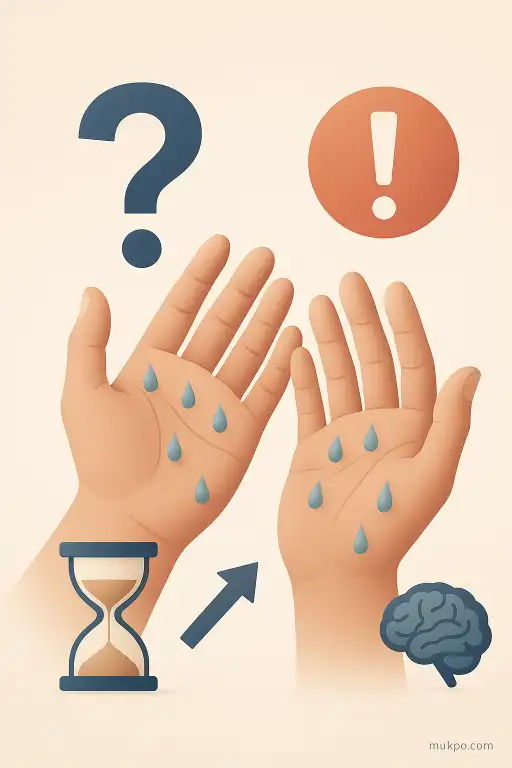
Tense decisions often trigger the sympathetic nervous system. It’s the branch that ramps the body up for action when the brain predicts consequences and uncertainty. Signals run from the brain to the spinal cord and out to the skin. Palms get special attention because they’re useful tools for action. If a moment might require grabbing, bracing, writing, or holding on, hands are part of the plan.
This can happen even when the person is sitting still. The trigger isn’t movement. It’s appraisal: the brain treating the situation as high-stakes or hard to reverse. A tense decision has both. You can’t fully know the outcome, and you feel responsible for choosing anyway.
Palms sweat differently than the rest of the body
Palms, soles, and parts of the face are packed with eccrine sweat glands. These are the watery glands people usually associate with cooling. But on the palms they’re heavily tied to emotion and attention, not temperature. That’s why hands can get sweaty in an air-conditioned room, while the rest of the skin stays dry.
A specific detail people overlook is that this kind of sweating is often patchy. It can show up in the fingertips first, or only on one hand if that hand is more engaged. It can also come in quick bursts. The timing can be seconds, not minutes, which is why it feels like it “appears” right when the decision hits.
Moisture changes grip, touch, and feedback
There’s a practical side to wet palms. A slight film of moisture can increase friction between skin and some surfaces, especially smooth ones. That can improve grip and fine control in certain conditions. The nervous system doesn’t “think” this through consciously. It’s an old pattern: prepare the hands for contact.
At the same time, sweat changes how touch signals feel. Damp skin interacts differently with paper, phone screens, steering wheels, or someone’s hand. Those tiny changes get fed back to the brain and can make the moment feel even more intense. It’s not just that the person notices sweating. The hands literally feel different, and that sensation becomes part of the decision atmosphere.
Why decisions trigger it more than fear alone
Pure fear is one thing. A tense decision adds another layer: conflict and prediction. The brain is weighing outcomes, tracking social consequences, and trying to pick a path with incomplete information. That combination tends to recruit attention systems that are tightly linked to palmar sweating. Researchers even use changes in skin conductance (how well the skin carries a tiny electrical signal) as a lab marker for arousal during choice and uncertainty.
Not everyone sweats the same amount, and it can vary with medication, hydration, caffeine, hormones, and baseline anxiety. But the pattern is consistent: when the brain treats a choice as urgent and meaningful, the hands often give it away first.

Related reads
- Why you remember someone’s face but not their name
- Why your throat tightens before you speak in public
- A statue that slowly accumulates extra coats of paint overnight from visitors’ tributes
- How your stomach keeps time without a clock
- A parking meter that once spooled out free bakery coupons during a heatwave
- Why a single compliment can change the way you walk