
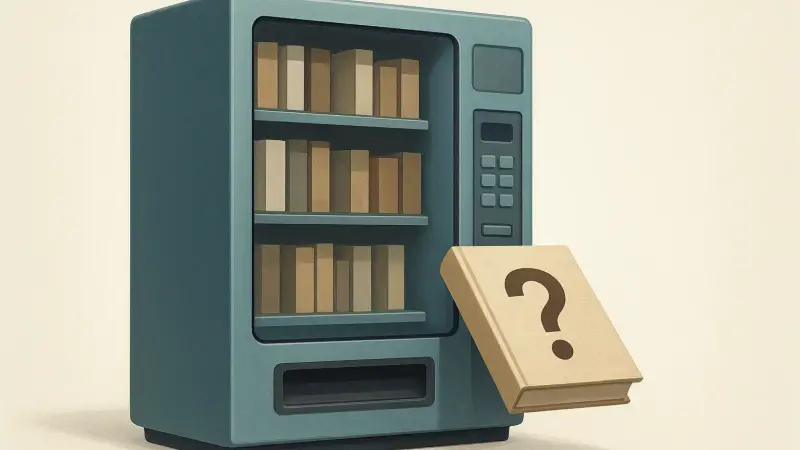
What these machines are, in plain terms
You walk up to a vending machine expecting chips and soda, and the buttons are still there, but the “product” is a book you can’t fully choose. It’s not one single famous machine in one town. It shows up in different forms in different places. Austin, Texas has had book vending machines through the Austin Public Library, and Singapore’s National Library Board has run book dispensers as well. The core mechanism stays simple: you pay (or scan a library card), the machine releases a wrapped book, and the wrapping keeps the title a surprise until you open it.
The “mystery” part varies. Sometimes it’s literally mystery novels. Other times it’s any genre, but you don’t know which you’re getting. That uncertainty is the point. It turns selecting a book into a small moment of chance.
How the surprise is created
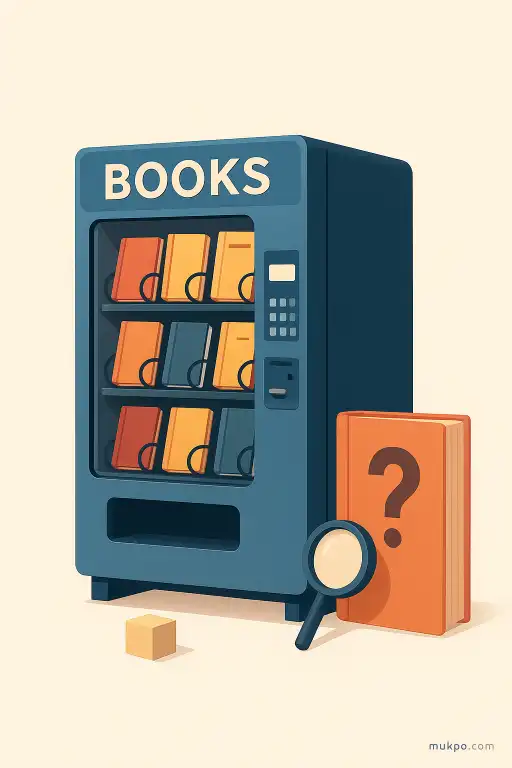
Most setups rely on blind packaging. Staff or volunteers wrap books in plain paper, or they seal them in opaque sleeves. The machine then treats each bundle as an identical item, even though the contents differ. Some versions add a short clue on the wrapping, like “slow-burn detective story” or “set on a ship,” but those clues can be inconsistent because they depend on whoever did the wrapping that week.
A detail people often overlook is how much the physical size matters. Vending spirals and drop-chutes are built for predictable dimensions. A thick hardcover or an odd-shaped paperback can jam the mechanism, so these machines usually work best with standard paperbacks or carefully chosen formats. That practical constraint quietly shapes what kinds of “mystery books” people end up receiving.
Why libraries and bookstores bother
For a library, a dispenser can act like a tiny branch in a place that’s already busy: a transit hub, a government building, a community center, or a university hallway. It can also sidestep limited hours. You can borrow a book when the main building is closed, as long as the machine is accessible. With public library systems, the “payment” might be a library card scan rather than money, and the inventory might be rotated from regular collections.
For bookstores and pop-ups, the appeal is different. A surprise book bundle is an easy way to move stock without relying on a customer to recognize a title. It also changes the decision fatigue problem. People stall in front of shelves because there are too many options. A blind pick collapses the choice into a single action.
What the experience feels like for the reader
The machine makes the transaction feel quick and slightly formal, like buying a ticket. You don’t browse. You don’t flip to the first page. You get a sealed object. That’s why these machines often work best in places where people are already waiting: near elevators, in lobbies, by train platforms, inside airports. The time pressure matches the format.
It also changes how “good” a book feels. When someone picks a book off a shelf, they tend to credit their own judgment if they like it and blame themselves if they don’t. With a surprise book, the satisfaction or disappointment attaches to the system instead. That’s why the tiny printed clue, when it exists, matters more than it seems. It gives people something to agree with or argue with after the reveal.
The logistics nobody sees
These machines only feel magical if they’re maintained. Someone has to restock them, track what’s inside, and remove items that don’t vend reliably. If it’s a library machine, someone also has to manage returns, because a dispenser that only pushes books outward still needs a path for books to come back. Some deployments handle this with normal return bins nearby, while others treat the dispensed books as giveaways rather than loans, depending on the program.
There’s also the quiet question of curation. A “mystery” selection still has boundaries set by humans: what conditions the books are in, what genres are acceptable for the location, what age ranges are included, and how often repeats happen. When inventory is limited, the surprise can shrink fast. People notice if the machine keeps offering the same few kinds of stories, even if the covers are hidden.
Related reads
- A hidden room behind wallpaper stuffed with decades of lost letters
- Why your palms sweat during a tense decision
- Why you remember someone’s face but not their name
- Why your throat tightens before you speak in public
- A statue that slowly accumulates extra coats of paint overnight from visitors’ tributes
- How your stomach keeps time without a clock