
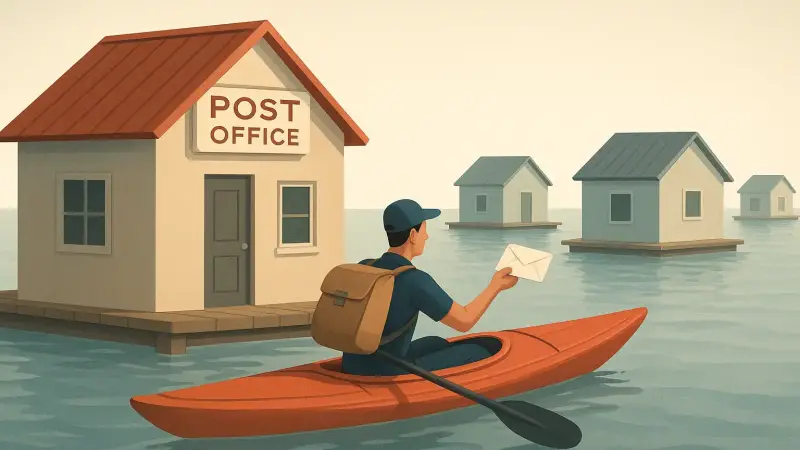
How a kayak becomes a mail route
It feels like mail should arrive on wheels, not through a rippling canal. But in a few places, the most reliable “street” is water, so the post office adapts. One well-known example is the floating village of Ganvié in Benin, where homes sit on stilts and daily movement happens by canoe. In setups like that, the route is basically a short paddle instead of a drive. Letters, small parcels, and official notices travel in a waterproof bag, and the mailbox might be nailed to a wooden post near a landing rather than mounted beside a front door.
This isn’t one single system that works the same everywhere. It varies with the waterway, the housing, and how the postal service is organized. Sometimes it’s a dedicated delivery run. Sometimes it’s more like a scheduled drop tied to when boats are already moving.
Floating neighborhoods change the basic logistics
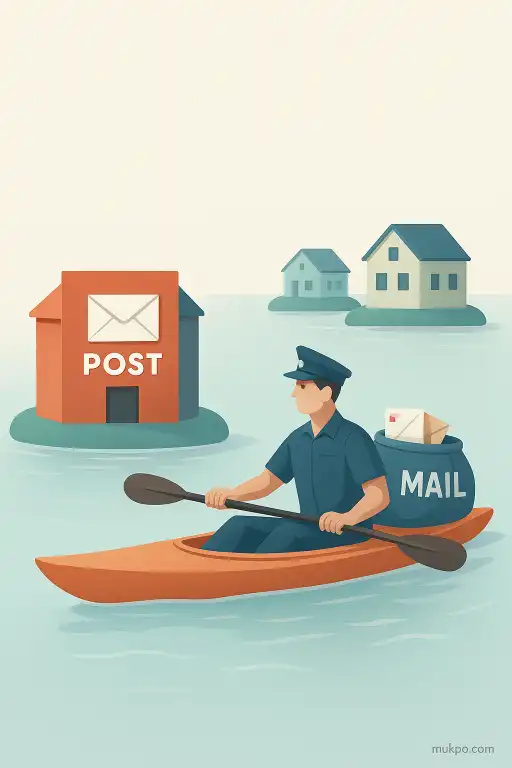
A floating or stilt-house neighborhood scrambles the normal assumptions of delivery. Addresses can be fuzzy. A “street” might be a channel with no name. Homes can shift slightly with current or season, or access points can move when water levels change. Even when houses don’t move, the path to them does. A delivery worker on a kayak is working with tides, wind, weeds, and wake from motorboats the way a driver works with traffic.
The overlooked detail is how much time goes into simply making the handoff safe. A kayak (or canoe) has to come alongside without damaging the boat or the structure. That can mean using a specific post or a small landing platform, or timing deliveries for calmer water. A quick “step onto the porch” often isn’t possible, so the exchange happens at the edge, where the boat can be steadied.
What gets delivered, and what doesn’t
When delivery happens by small boat, the mail mix tends to shift. Letters and official documents are the easiest. Lightweight parcels can work too, but volume is limited by balance and storage. Bigger items often get handled through pickup points on land, or by larger boats when they’re available. Even if a postal service tries to offer the same products everywhere, the real constraint is physical: a kayak’s cargo space, the need to keep items dry, and the need to keep the boat stable.
Weather can quietly decide what counts as “deliverable.” Rain is obvious, but wind can be worse. A strong crosswind makes it hard to control a loaded kayak, especially in open stretches. That’s why some routes lean on protected canals, hugging shorelines and structures rather than taking the shortest line across.
The postal worker’s toolkit looks different
The work still depends on the same basics: sorting, timing, and proof that something arrived. But the gear changes. Dry bags and watertight containers matter as much as the mail itself. So do tie-off lines, because you can’t just set a kayak in “park.” Even the order of delivery can change. A carrier might group stops by how sheltered they are, saving more exposed areas for calmer moments.
Another small thing people miss is how the route can be limited by simple human needs. There’s no easy place to take a break or step inside to sort for five minutes. The boat is the desk. That pushes sorting and bundling decisions earlier, before launching, because once you’re on the water, every extra pause makes you drift.
Why a kayak can be the most practical option
A kayak is cheap compared to building and maintaining roads, bridges, or frequent motorboat service for short distances. It’s also quieter and can reach narrow channels that a larger boat can’t. In places where the waterway is the neighborhood’s main corridor, a small craft is simply the right size for the “streets.” That’s especially true where homes cluster tightly, with short gaps between landings and lots of turns.
It also avoids a common problem with motorboats: wake. A fast, heavy boat can slam waves into stilt structures and tiny docks. A paddle-powered delivery run can slip through without shaking the whole edge of the neighborhood. If you watch a delivery done this way, it can look slow from shore, but it’s often the most predictable way to reach the same set of doorsteps, day after day.
Related reads
- The Victorian spectacle of Barnum’s mermaid hoax that fooled museumgoers and ministers
- A vending machine that gives mystery books instead of snacks
- A hidden room behind wallpaper stuffed with decades of lost letters
- Why your palms sweat during a tense decision
- Why you remember someone’s face but not their name
- Why your throat tightens before you speak in public