
Why a loose outfit can change your choices
Think about the last time you wore something roomy on purpose. A big hoodie. Wide-leg pants. A coat that hangs past your hands. This isn’t one single “place” story, and the details vary across cultures and dress norms. You can see versions of it in U.S. streetwear, in Japan’s oversized silhouettes, and in Middle Eastern thobes and abayas. The basic mechanism is simple: clothing changes how the body feels in space, and that shifts attention, self-consciousness, and the sense of control. Those shifts can nudge mood and risk taking, sometimes in opposite directions.
Loose clothing changes how the body maps the world
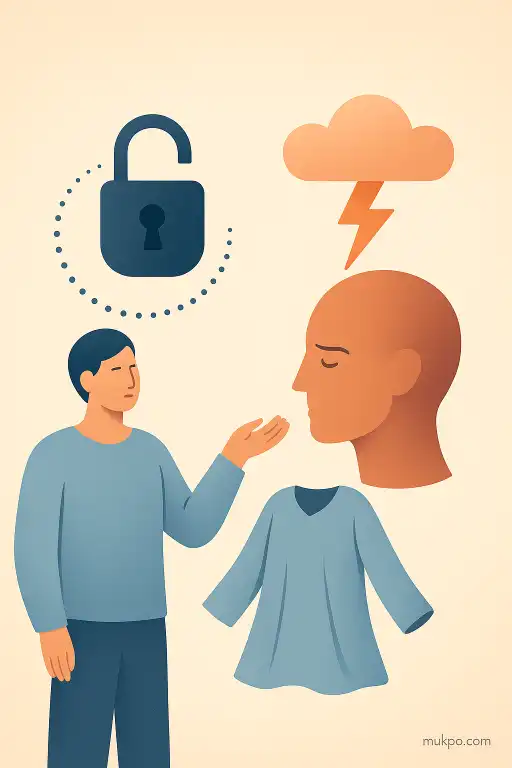
Clothes are part of the body’s “boundary” system. Tight clothing gives constant feedback: pressure at the waist, a seam pulling at the shoulder, a collar that reminds you to hold your posture. Loose clothing reduces that steady stream of signals. With fewer reminders, people often feel less “contained,” which can read as freedom for one person and as slightly unmoored for another. The same physical looseness can translate into either calm or restlessness, depending on context and personality.
A small overlooked detail is hem weight and fabric swing. A heavy, draping fabric moves a beat behind the body. A light, airy one moves ahead and flutters. That timing difference changes gait and arm movement without anyone deciding to. The result is subtle: a person may take longer steps, turn more broadly, or gesture more. Those changes feed back into emotion because posture and movement are tied to arousal and confidence.
Attention shifts from “How do I look?” to “What’s happening?”
Loose clothing tends to reduce constant micro-monitoring. If fabric isn’t pulling, riding up, or emphasizing a specific body area, there is less need to check and adjust. That can lower self-focused attention. Lower self-focus often tracks with lighter mood, especially in social settings where appearance feels evaluative. It can also increase willingness to act quickly because there’s less internal pause to manage how the action will look.
The flip side is that some people rely on structured clothing as a cue for “being on.” When the cue disappears, attention can drift. That can look like risk taking, but it can also be plain distraction. In a meeting, someone in a soft, oversized sweater might speak more freely because they feel less scrutinized. In a lab task that requires careful timing, the same person might make more impulsive choices because their usual “tighten up” signal isn’t there.
Risk taking depends on what kind of risk you mean
“Risk” isn’t one behavior. Social risk (speaking up, approaching someone, cracking a joke) often goes up when people feel less exposed. Physical risk (moving fast, climbing, taking sharp turns) can also go up, but for a different reason: loose clothing can make movement feel easier while also masking small body warnings. If you can’t feel a waistband tightening or a sleeve resisting, you may not notice you’re overreaching until later.
There’s also a practical dimension that gets ignored. Loose clothing can snag, drag, or reduce peripheral awareness of where fabric ends. That changes real safety risk, not just psychological risk. Someone running for a train in a long coat may take bolder steps partly because the coat hides leg position and makes the stride feel smooth, while also increasing the chance of catching a hem on a stair edge.
Mood shifts through comfort, temperature, and “permission”
Comfort is the obvious part, but temperature is often the driver. Loose garments trap or release air differently, changing skin temperature and sweat. Warmth can make people feel safe and sleepy. Too much warmth can make them irritable and impatient. The mood change can then alter decisions: impatience makes quick choices feel attractive; sleepiness makes effortful caution less likely.
Loose clothing also carries social meaning. In many workplaces, a blazer or fitted shirt signals formality and restraint. A looser outfit signals downtime. Those signals don’t just affect how others respond; they affect the wearer’s expectations about how they’ll behave. People often take bigger conversational swings, tolerate more ambiguity, or accept more uncertainty when their clothes match a “relaxed” script, even if the setting hasn’t changed.
A concrete scene where it shows up
Picture two people heading into the same crowded café. One is in fitted jeans and a structured jacket. The other is in wide pants and an oversized sweatshirt. The second person is more likely to slip into a seat without fussing with their outfit, lean back, and take up a little more space. That can make them seem more at ease, and they may speak more readily to the barista. The first person might sit more upright and be quicker to adjust their sleeves or jacket hem, staying in a slightly more self-aware mode.
The overlooked part is how those choices ripple into timing. Taking up more space changes how you navigate between chairs, how close you stand to strangers, and how quickly you move when someone brushes past. Those tiny spatial negotiations affect stress, and stress affects risk. A person who feels buffered by loose fabric may tolerate closer contact and make faster decisions. A person who feels “outlined” by tight clothing may slow down, not from fear, but from constant precision.
Related reads
- A library that lends power tools, seeds, and sewing machines
- A post office that delivers mail by kayak to floating neighborhoods
- The Victorian spectacle of Barnum’s mermaid hoax that fooled museumgoers and ministers
- A vending machine that gives mystery books instead of snacks
- A hidden room behind wallpaper stuffed with decades of lost letters
- Why your palms sweat during a tense decision