
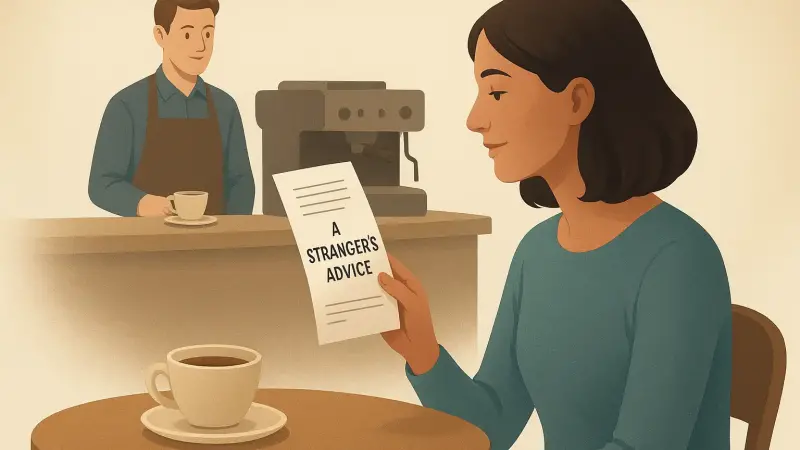
What people mean when they talk about this kind of cafe
You hear the story as if it’s one place, one counter, one little printer that knows too much. It usually isn’t. It’s a format that pops up in different cities, then vanishes. A cafe swaps the normal receipt footer for a line of “advice” that feels like it came from another customer. Sometimes it’s sweet. Sometimes it’s blunt. The mechanism is simple: you pay, the receipt prints, and there’s an extra sentence that wasn’t meant for you. In real life, it tends to show up as limited-time promotions or art projects, the same way some shops print jokes or quotes on the bottom of receipts.
A concrete version is easy to picture because it borrows from things that already exist. Some restaurants have printed fortunes in place of receipts. Some cafes run “pay it forward” boards. And some museums set up participatory installations that output slips of paper with text contributed by strangers. The details vary, and a lot of retellings leave out whether the “advice” was actually written by customers, selected by staff, or generated from a preset list.
How the advice actually gets onto the paper
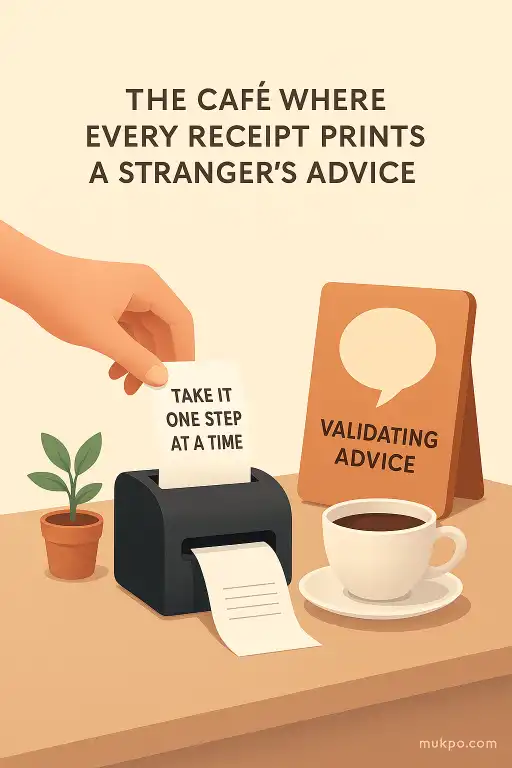
Most receipt printers can only print what the point-of-sale system sends them. So the “stranger’s advice” is usually just an extra line stored in the POS software. There are a few common ways to do it. Staff can choose one from a menu. A script can rotate through a list. Or a manager can paste in a daily batch, like a “quote of the day,” except the quotes are written in the voice of a customer. If there’s a web-connected POS, it can pull text from a shared document or a database.
The overlooked detail is how little space there is. Thermal receipts have narrow widths, hard line breaks, and no forgiveness for long sentences. That constraint shapes the advice. It comes out short because it has to. It’s also why the lines often look oddly formatted, with a forced wrap or a word split in a way nobody would choose in a handwritten note.
Why it feels like it was written for you anyway
Receipts arrive at a weird moment. You’re done choosing. You’re waiting. Your brain is idle enough to read whatever is there. If the line is generic but emotionally pointed, it can feel personal. A sentence like “Call your sister” or “Drink water before you spiral” doesn’t need to be accurate to land. It just has to touch something common. People also tend to remember the lines that hit and forget the ones that didn’t.
There’s also a social ingredient that doesn’t get mentioned much: the receipt is “official.” It’s printed by a machine that usually deals in totals and taxes, not feelings. That changes how it’s received. The same words on a chalkboard can feel like decor. The same words on a receipt can feel like they arrived from outside the room, like the system decided you needed to see it.
What a typical interaction looks like at the counter
A situational example: a customer taps their card, takes the receipt without looking, then notices the extra line while waiting for a latte. They show the person next to them. The other person checks their own receipt to compare. That comparison is a big part of why the gimmick spreads. If two receipts print different lines, it feels like messages are being “assigned.” If everyone gets the same line that day, it feels more like an announcement. Either way, the receipt becomes a small object people keep, at least for the walk home.
Staff behavior often gives away the setup. If the cashier tears off the receipt and hesitates for a half-second before handing it over, it suggests they know what’s printed there. If they act surprised or ask, “Did you get a good one?” it suggests it’s randomized. In some setups, staff get asked for reprints, which is funny until it becomes a bottleneck during a rush.
Where the “strangers” part comes from, and why it can get messy
When a cafe claims the lines are from other customers, there has to be a collection step. That could be a jar of handwritten slips, a QR code to a submission form, or a notebook by the sugar packets. Each method changes what gets submitted. Anonymous forms produce more extreme text. Notebooks produce longer, messier entries that don’t fit the printer. If the cafe curates, it stops being pure “stranger” advice and becomes edited advice, even if the source lines were real.
And there are practical limits. Receipts are not a safe place for anything that sounds like medical, legal, or relationship instruction, so real implementations tend to steer toward neutral prompts, reminders, or simple kindness. It also has to avoid looking like a coupon or a policy notice, because then customers stop reading it as a message. The whole effect relies on the line sitting in that narrow space between official and intimate, right above the return policy and the line that says “Thank you.”
Related reads
- The calming effect of repetitive tapping and what it does to your brain
- How loose clothing alters risk taking and mood
- A library that lends power tools, seeds, and sewing machines
- A post office that delivers mail by kayak to floating neighborhoods
- The Victorian spectacle of Barnum’s mermaid hoax that fooled museumgoers and ministers
- A vending machine that gives mystery books instead of snacks