

A crowded moment, and one face wins
You’re at a busy place and a familiar face appears for half a second. Think of Times Square in New York, a packed Tokyo train platform, or a school pickup line. Somehow your attention snaps to one person and stays there, even while everyone is moving. There isn’t one single “crowded scene” this happens in. It varies by setting and by what you already know. But the core mechanism is pretty stable: the visual system doesn’t take in everything equally. It builds a rough map fast, then commits attention to one candidate face and keeps updating that choice as new information arrives.
Your eyes don’t scan like a camera
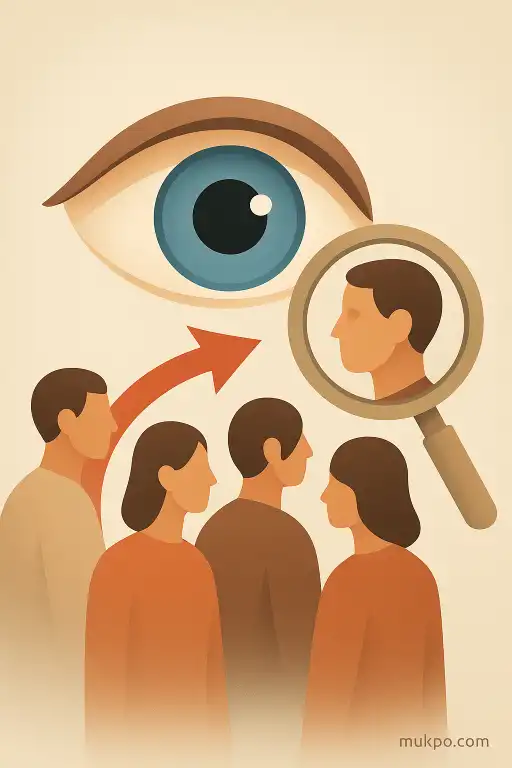
The first thing that happens is a quick sweep for structure: where heads are, where bodies are, which direction people are facing, where motion is. That broad picture mostly comes from peripheral vision, which is good at detecting movement and general shapes, not fine identity details. Fine detail comes later, and only for a tiny patch at the center of gaze. That patch is small enough that you could be “looking at the crowd” while only truly sampling one face at a time.
That’s why the eyes make fast jumps called saccades. Between jumps, perception is not a smooth video feed. It’s closer to snapshots stitched together. In a crowd, the system uses those jumps to test candidates: that hairline, that spacing of eyes, that walking style. The rest is filled in by expectation and context, which is usually good enough until it isn’t.
Attention locks on before you feel it
Once a face becomes a good candidate, attention starts to “stick” to it. That stickiness is partly bottom-up, like a bright shirt, a sudden head turn, or strong contrast. It’s also top-down, like searching for your friend’s glasses or your coworker’s haircut. The top-down part matters because it can bias what counts as a “match” before the face is fully resolved.
A specific detail people overlook is that gaze and attention can split. You can be looking at one face while attention is slightly ahead, checking the next likely face in your path. In a moving crowd, that offset helps the brain predict where the chosen person will be a moment later. It also explains why you can feel like you “lost them” even though your eyes were pointed the right way. Attention had already drifted to a different candidate.
Identity is pieced together from partial cues
When the scene is crowded, the brain leans on whatever cues survive clutter. A full, front-facing face is rare. People are in profile, half occluded by shoulders, or briefly blocked by a passing bag. So the system uses fragments: the outline of hair, brow shape, the distance between features, and especially the “config” of the face as a whole. It also uses non-face cues that ride along with identity, like posture, gait, and the way someone turns their head when they talk.
That’s why two similar-looking people can cause a quick false lock-on. If the hair and build match, attention can commit before the eyes have enough time on the face to verify. The correction often happens only after a second glance when the central, high-detail part of vision gets a clean sample. In a dense crowd, those clean samples are intermittent, not continuous.
Why the chosen face stays chosen
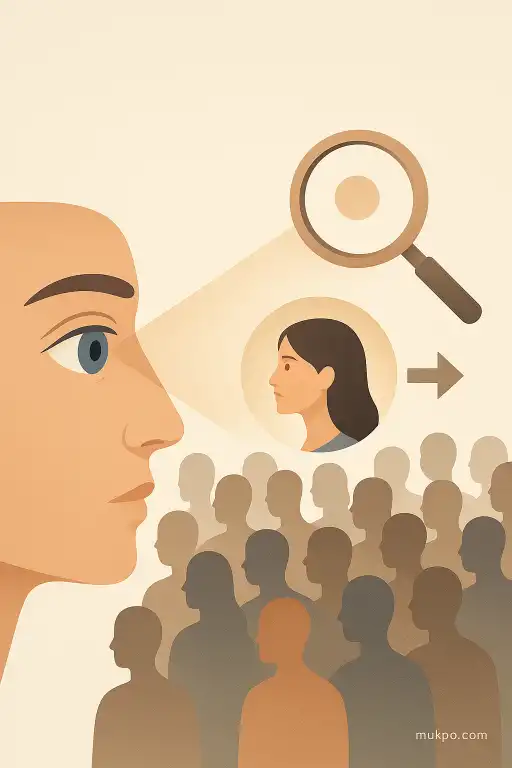
After selection, the system behaves like it’s tracking an object, not repeatedly re-identifying a person from scratch. It predicts where that face will go next and discounts competing faces that pop up nearby. This helps because crowds constantly generate distractions: a closer person crossing the line of sight, a sudden laugh, a bright sign, a phone screen flashing. Prediction keeps the target stable through brief occlusions.
But stability has a cost. If the target disappears for long enough, or if several similar faces cluster together, the prediction can “hand off” to the wrong person without it feeling like a decision. The handoff can be triggered by something as small as a head turn that hides the face for a beat, or a moment of glare that wipes out fine detail. Then attention updates its best guess and carries on, still feeling continuous from the observer’s point of view.
Related reads
- Why your hands fidget when you’re trying to think
- A museum that displays thousands of anonymous lost keys
- When London went blind: the January 1952 smog that stopped Parliament and remade urban life
- The forgotten subway station turned secret mushroom garden
- Why people smile more in photos than in person
- Why brief eye contact can feel thrilling or threatening