
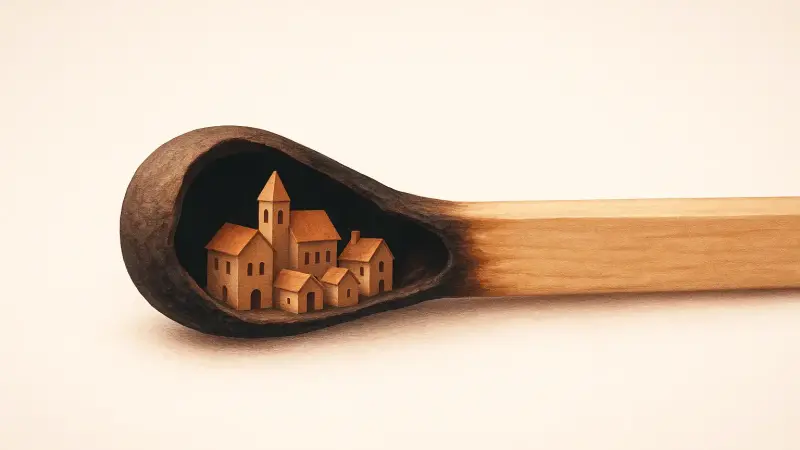
How matchsticks turn into buildings
People rarely ask what you can build from something meant to be burned. Yet matchsticks are basically tiny, uniform pieces of wood, and that’s the whole mechanism. A maker cuts, splits, sands, and glues them into beams, trim, shingles, stairs, and street rails. The “abandoned loft” part isn’t one fixed place with one confirmed origin. It’s a kind of recurring discovery story, like miniatures found in attics in London, New York, or old mill towns where storage spaces get forgotten for decades. When someone goes up to clear boxes, they find a town no bigger than a suitcase lid, still sitting on a dusty plank.
Why a loft is where these towns end up
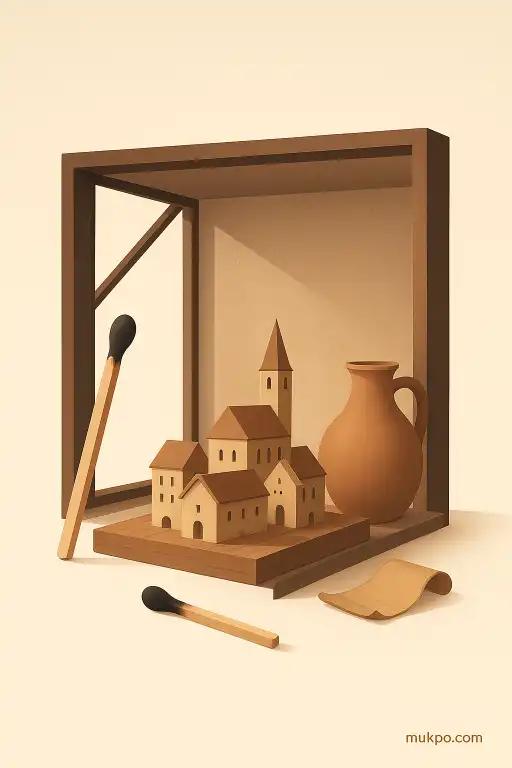
Lofts collect projects that were never meant to be permanent. Miniatures often start as “I’ll keep working on it later,” and later doesn’t come. The maker moves, downsizes, or loses workspace. The model is fragile, so it gets put somewhere safe. That “safe” place becomes a quiet trap: away from daily life, but also away from care. A loft has stable surfaces and low traffic, which is perfect for something that can be ruined by one careless sleeve or a curious pet.
There’s also the social side. A tiny town can look childish to visitors, even when it’s painstaking craft. So it gets packed away when the house needs to look “normal.” Years later, the person who knows what it is may not be the person who owns the building. That’s how an elaborate streetscape becomes an object with no label and no story attached.
What a matchstick town usually looks like up close
These towns tend to borrow familiar shapes: row houses, a church-like roofline, a little bridge, a main street with storefront windows scratched in. The scale varies, and it’s often inconsistent. A door might be too tall for a figure that doesn’t exist. That’s because the builder is working by eye and by the stick, not by architectural plans. The matchstick head may be cut off, left on for color, or sanded down to disappear. Some makers stain the wood or smoke it slightly so everything looks aged.
A detail people usually overlook is the glue. Old models often have visible beads at corners, or a glossy seam that catches light like a wet line. That can tell you more than the buildings do. Different eras and different builders used different adhesives, and many glues darken over time. In a loft, dust sticks to those shiny lines first, so the structure ends up outlined by dirt, as if someone drew it in pencil.
How they survive years without falling apart
It feels like these should collapse, but wood is stubborn when it stays dry. A loft can be harsh, though. Heat cycles expand and shrink the sticks. Humidity can warp long spans like fences and roof ridges. The real danger is not slow aging. It’s one sudden event. A leak from a roof tile, a burst pipe in winter, or pest activity can take out a whole block in a night. The models that get “found” are the ones that avoided that single bad moment.
When a town is built on a solid base, it lasts longer. Makers often use a board, a drawer bottom, or thick cardboard. If the base bows even slightly, it pulls the glued joints sideways. That’s when you see a street start to ripple, like the buildings are leaning into each other. And because matchsticks are light, a model can also shift from vibration. Footsteps, a closing attic hatch, or renovations downstairs can slowly walk it toward a shelf edge.
Why people read a story into it
Finding a miniature town in a forgotten space pushes a specific button. It’s clearly deliberate work, but it arrives without context. No signature. No date. No notes. That blank spot makes observers fill in a narrative: a solitary maker, a secret hobby, a life paused mid-project. Sometimes there really are clues, but they’re small. A matchbook strip used as roofing. A scrap of newspaper under the base. A particular brand of matches. Even then, it can be unclear whether those materials point to a time period or just whatever was within reach.
And the town format matters. A single matchstick ship or a bridge reads like a craft. A whole town reads like a place. Streets create implied movement. A town square suggests events. Empty windows invite you to imagine occupants. That’s why a dusty loft discovery can feel like more than an object on a board. It looks like a settlement that’s waiting, even if it was only ever a careful arrangement of sticks and glue.
Related reads
- How your eyes pick one face to follow in a crowded scene
- Why your hands fidget when you’re trying to think
- A museum that displays thousands of anonymous lost keys
- When London went blind: the January 1952 smog that stopped Parliament and remade urban life
- The forgotten subway station turned secret mushroom garden
- Why people smile more in photos than in person