
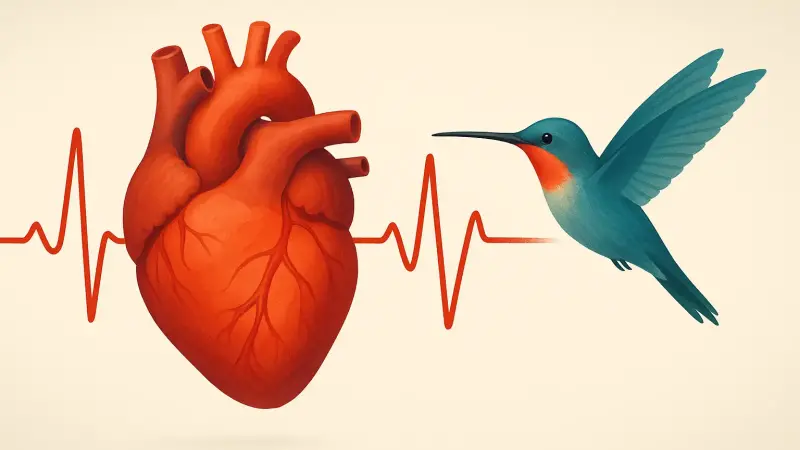
A jump that happens before you’ve decided anything
You’re in a quiet kitchen and a pan slips, or you’re on a New York City subway platform when a metal door bangs. For a split second, your pulse feels like it “kicks” harder than it should. It’s not one single event that causes this. People notice it after a car horn, a dog bark, a dropped phone, a sudden laugh in a silent room. The core mechanism is simple: an unexpected sound is treated as a possible threat, and your nervous system sends a fast signal that changes your heart’s timing and force before your conscious brain has even sorted out what the sound was.
The startle pathway is built for speed
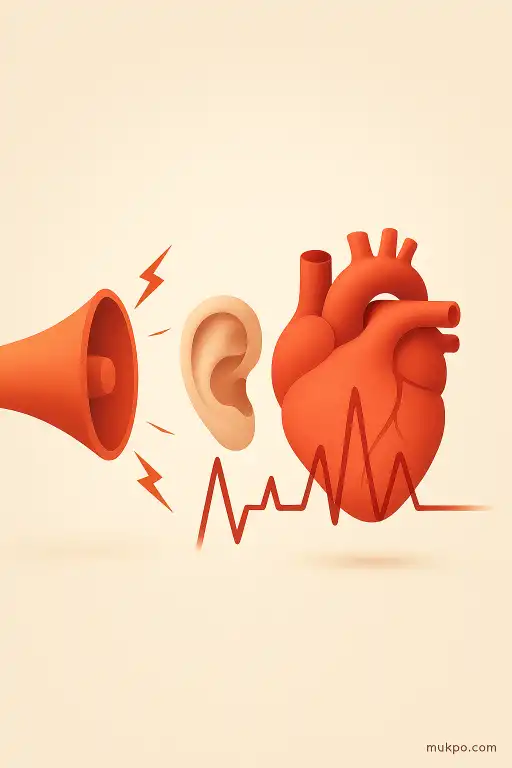
Unexpected sound has a privileged route into the brain. The auditory signal can trigger a startle response through fast circuits in the brainstem, without waiting for slower, detailed interpretation in the cortex. That’s why the reaction can feel “too quick” to be you. The body assumes it may need to move, brace, or scan the environment, so it flips into a high-alert setting immediately.
This is also why surprise matters more than loudness. A moderately loud sound that arrives out of nowhere often produces a bigger jolt than a very loud sound you’re already expecting, like music at a concert. Predictability changes the baseline. When your brain has a model of what’s next, the same stimulus doesn’t carry the same urgency.
Why it feels like one “extra” heartbeat
The sensation usually comes from a brief change in the balance between the sympathetic and parasympathetic nervous systems. The sympathetic side can rapidly increase heart rate and the strength of contraction. The parasympathetic side (largely via the vagus nerve) can brake the heart just as quickly. A sudden sound can cause a quick brake-then-release pattern, or a quick surge, depending on the person and the moment.
That little timing shift can create a beat that lands slightly early or late, followed by a stronger beat. People often describe the stronger one as the “jump,” even if the real change started one beat earlier. The overlooked detail is that you don’t directly feel most heartbeats. You mostly notice the ones that change in force or spacing enough to push blood more noticeably against vessels you can sense in your chest, neck, or wrist.
Breathing and posture quietly amplify it
Startle almost always changes breathing. A sharp inhale, a brief breath-hold, or a quick tightening of the chest wall can all happen automatically. Those shifts change pressure inside the chest, which changes how much blood returns to the heart for the next beat or two. That affects stroke volume, so one beat can feel unusually strong even if the heart rate barely changes.
Small muscle actions matter too. People often tense their abdomen, shoulders, or jaw without realizing it. That can change venous return and blood pressure for a moment, which the body monitors constantly. Your awareness of the pulse is also higher when you’re still, seated, or lying down, because there’s less competing sensation from movement and your attention has fewer other signals to latch onto.
Why some sounds trigger it more than others
The brain is tuned to certain acoustic features. Fast rise times, sharp onsets, and sounds that are hard to place in space tend to produce stronger startle. A balloon pop or a dropped metal object is often more jarring than a longer, smoother noise at the same volume. Your history matters too. If a sound resembles something previously linked to danger or stress, the system can react more strongly, even if you “know” you’re safe.
Context can also prime the response. In a dark hallway, a sudden click can feel bigger than the same click at noon in a busy café. Fatigue, caffeine, illness, and general stress can shift the threshold as well. So the same person can have a noticeable pulse jump one day and barely react the next, with nothing “wrong” in either case.
What you’re sensing in the wrist isn’t just the heart
When people notice this while checking their pulse, they often assume the heart did something dramatic. Sometimes it did, briefly. But the pulse in the wrist is a pressure wave shaped by the arteries too. A sudden sympathetic surge can tighten peripheral blood vessels and change how that wave reflects back through the arterial tree. That can make a single beat feel sharper or more forceful at the wrist than it would have felt in the chest.
There’s also the attention effect. The moment a sound grabs you, your monitoring of internal signals jumps up. That makes small, normal variations in beat-to-beat timing or strength feel more obvious. It’s the same basic reason a quiet room can make a clock seem louder: nothing else is competing for the same slice of awareness.
Related reads
- The tiny automatic acts people do before a stressful phone call
- Why some alarms leave you groggy while others snap you awake
- Matchstick miniatures an abandoned loft hiding a tiny carved town
- How your eyes pick one face to follow in a crowded scene
- Why your hands fidget when you’re trying to think
- A museum that displays thousands of anonymous lost keys