
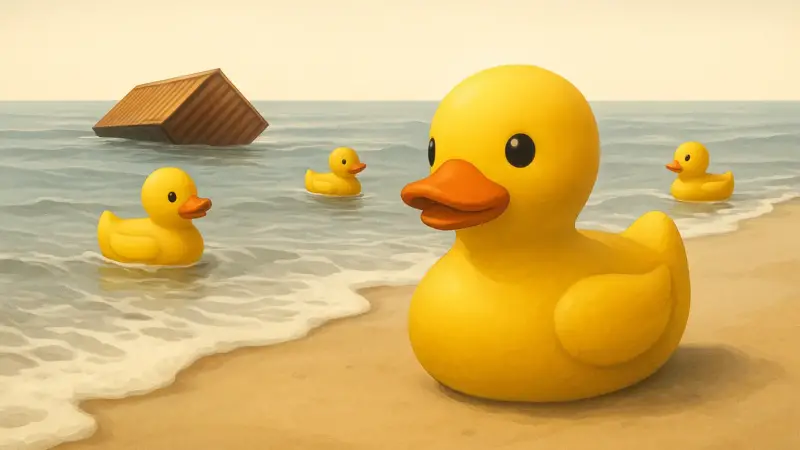
A rubber duck on a beach looks like a joke someone left behind. Sometimes it isn’t. In 1992, a container ship lost a load of plastic bath toys in the North Pacific, and people kept finding them years later on shorelines as far apart as Alaska and the U.K. The basic mechanism is simple and stubborn: light plastic floats, currents keep moving it, and beaches act like collection nets. What surprises people is the time scale. Some of these toys didn’t just drift for a season. They kept circulating, getting stranded, getting freed, and showing up again decades after they fell off a ship.
The spill people point to
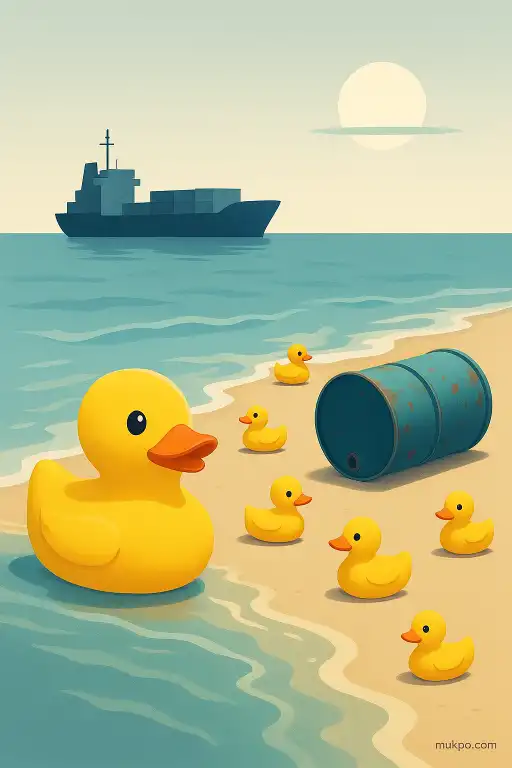
The best-known case is the 1992 loss of roughly 28,800 bath toys from a container in the Pacific, a shipment often described as including yellow ducks along with turtles, frogs, and beavers. Reports of finds popped up on the west coast of North America and then farther afield. The details vary depending on who’s telling it, and not every “duck” photo online is verified. But the broad outline is solid: a single container’s worth of small, buoyant plastic became trackable debris because the items were distinctive and easy for beachcombers to notice.
It also happened at a moment when modern container shipping was already moving enormous volumes, but public attention to marine debris was smaller. A lost container wasn’t unusual. What was unusual was that the cargo looked like toys you might have in your own bathroom, and it stayed visible in the environment long enough for people to connect distant sightings to one origin story.
How a duck can travel for years

Once something floats into the open ocean, it doesn’t move in a straight line. It gets caught in large rotating current systems called gyres. In the North Pacific, surface currents can carry floating objects toward North America, up toward Alaska, across toward Asia, or into loops that keep them offshore for long periods. Storms and seasonal wind shifts matter too. A toy can spend years mostly at sea, then get pushed toward land in a few days when conditions line up.
The overlooked detail is windage. A rubber duck isn’t just “floating.” Part of it sits above the water, so wind can push it differently than currents push the water below. Two objects in the same patch of ocean can diverge because one catches more wind. That makes beaching patterns messy, even when the spill location is known.
Why beaches keep seeing the same kind of item
Shorelines don’t just receive debris. They sort it. Beaches with certain slopes, sand grain sizes, and wave patterns tend to trap floating plastic in the wrack line, where seaweed and small debris collect. Once stranded, an object can sit above the waterline for a long time. Then a storm surge can pull it back out, basically resetting its journey. That’s one reason “decades later” can be literally true without requiring the same duck to drift continuously for 30 years.
Cold regions can preserve floating toys longer too. Less sunlight can mean slower UV degradation, and cooler temperatures can slow some kinds of material fatigue. But abrasion still happens. Sand, rocks, and ice can scuff away paint, round off edges, and erase markings that might have tied an item to a specific manufacturer or shipment.
Not every duck comes from that one container
It’s tempting to treat any beach duck as evidence of the famous spill, but there are many routes to the sea. Cargo losses happen repeatedly worldwide, and records aren’t always public or complete. Consumer plastics also enter the ocean through rivers and storm drains. Even within shipping incidents, the same object type can appear in multiple shipments. So when someone finds a duck on a beach in, say, Scotland or British Columbia, it may fit the story, but it isn’t automatically “one of the 1992 ducks.”
That uncertainty is part of why the story persists. It’s a rare case where marine debris feels individually recognizable, but the ocean doesn’t attach a label. Without a serial number or distinctive manufacturing mark, most identifications are based on timing, design features, and where the item washed up—useful clues, but not a guarantee.
What scientists learned from toy sightings
These finds ended up functioning like accidental drift experiments. Oceanographers already used purpose-built drifters and tagged buoys, but a mass of identical floating objects creates a different kind of dataset: lots of observers, lots of coastlines, and a long time window. Sightings can support or challenge models of surface transport, especially when they show up in places that seem “too far” or “too late” based on simple current maps.
The catch is that beachcomber reports are uneven. Popular beaches get checked more often. Remote coastlines might collect debris for years with no one recording it. And a toy’s condition changes how noticeable it is. A bright, intact duck is more likely to be reported than a sun-bleached, cracked one half-buried in kelp.
Related reads
- How your feet decide the fastest route without conscious thought
- How the Amber Room vanished from a royal palace and became WWII’s enduring mystery
- The Kentucky hamlet that keeps electing a dog as mayor
- Century old jam on a supermarket shelf that still passed safety tests
- Why doodling can help you pay attention during long talks
- The 1976 Korean DMZ tree-cutting standoff that escalated into a military spectacle