
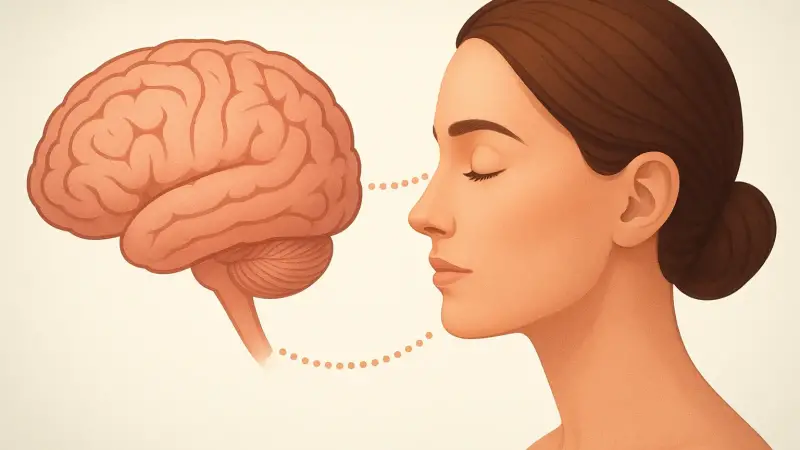
A moment you’ve probably had
You look up from your phone and spot a friend across a café. It can happen in London, Seoul, or São Paulo, and it doesn’t depend on the lighting being perfect. The recognition lands fast, often before you’ve really “checked” the details. Under the surface, the brain is running a rapid match between what your eyes are feeding it and a stored face pattern built from years of views. That match starts with rough, global structure and only later pulls in fine features. It’s quick because the system is built for speed first, certainty second.
The fast route from eyes to a “known” signal

When a face hits the retina, the early visual system doesn’t start by identifying a person. It starts by extracting edges, contrast, and broad layout. Very quickly, areas in the ventral visual stream become sensitive to “face-like” configurations. A key hub often discussed in this is the fusiform face area, which responds strongly to faces as a category. The speed comes from using shortcuts: low spatial frequencies first (big shapes, hairline, spacing), then higher spatial frequencies (eyelashes, skin texture, fine contours) if the first pass doesn’t settle it.
That first pass can be enough when the match is strong. If the input resembles a stable template—your coworker’s typical hairstyle, the way their eyes sit in their face, their head shape—the system can trigger familiarity before you’ve consciously noticed the specifics. Conscious awareness can lag behind the earlier neural decision by a beat. That’s why people sometimes recognize someone and only a moment later think, “Wait, where do I know them from?”
Why familiar faces get priority
Familiarity changes the problem. For strangers, the brain is mostly encoding a new pattern and comparing it to a general “face” norm. For familiar people, it has a well-trained model that predicts what that face tends to look like across angles, expressions, and years. Those predictions narrow the search space. The brain doesn’t have to test every possibility. It tests a smaller set of strong candidates, and one of them can win quickly.
This is also where emotion and meaning creep in. Familiar faces are tied to memories, names, voices, and social context. Recognition isn’t only visual. Once the visual system throws a “known” flag, other networks can start filling in associated information. Sometimes that extra information arrives late or partially. You can get a strong sense of familiarity without retrieving a name, because those pieces are handled by different processes that don’t always sync perfectly.
The detail people overlook: timing and the “gist” of a face
People often assume recognition depends on noticing the eyes or mouth first. A lot of fast recognition depends on something less obvious: the coarse arrangement and overall silhouette, including hair and head shape. Hair can be a surprisingly heavy cue, even though it feels “not part of the face.” Another overlooked piece is timing. The brain doesn’t wait for a complete, high-resolution picture. It commits early based on the gist, then corrects if later detail conflicts.
This is why you can misfire when a familiar cue is copied. A similar haircut, the same glasses, or the same posture at a distance can trigger that early “known” signal. The correction can come a fraction later when fine features fail to match. The experience feels odd because it exposes the order of operations: fast guess first, verification second.
When it breaks: masks, angles, and look-alikes
Change the input, and the speed advantage can shrink. During COVID-era masking, many people noticed how much recognition slowed when the lower half of the face disappeared. It wasn’t only about missing features like the mouth. It also disrupted familiar ratios and contours the brain expects. Odd angles can do the same thing. A face tilted down under a hat brim may not match the stored pattern well enough for an instant hit, so the system has to rely on slower accumulation of clues.
Look-alikes exploit the same mechanics. If two faces share the broad geometry and a few high-weight cues, the early pass can’t easily separate them. The later pass can, but only if there’s enough clean detail—lighting, distance, and motion all matter. That’s why recognition can snap into place the moment someone turns their head or smiles. A single familiar movement can provide the missing information the brain was waiting for.
Related reads
- A startup that bottles Himalayan mountain air and sells it by the can
- How a 16th-century Ottoman gardener sparked a palace scandal
- Why your hands go numb when you sleep on them
- Why your hands warm up when you remember a pleasant moment
- Rubber ducks from a cargo spill that still wash up decades later around the world
- How your feet decide the fastest route without conscious thought