
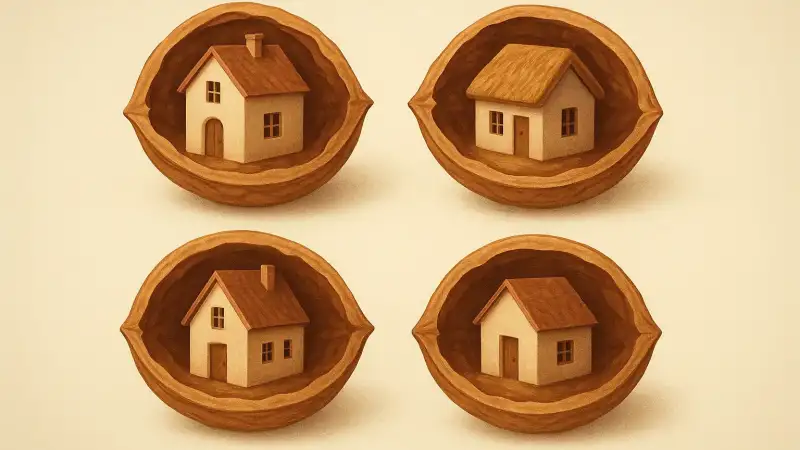
How a walnut becomes a room
People pick up a walnut and assume the only surprise inside is the nut. But some collectors open one and find a whole interior scene: a tiny room carved into the shell itself, with beams, stairs, and a door that fits the curve like it was always meant to be there. This isn’t one single local tradition. You’ll see it connected to European “nut carving” work (often described around Germany and France), and you’ll also see modern miniature artists selling similar pieces online through platforms like Etsy and at craft fairs. The mechanism is simple to describe and hard to do: the shell becomes the walls, and everything else is built to the shell’s scale.
The shell is the hardest material decision

A walnut shell is thin, uneven, and full of weak points. It can split along natural seams, and the inside surface is rough in a way that fights detail. Makers usually have to stabilize it before anything “architectural” happens. That might mean sealing the interior, reinforcing edges, or carefully controlling humidity while the piece is worked. If the shell is opened, the hinge line matters. Some pieces are built so the two halves close cleanly without crushing the interior, which forces everything inside to stay below a very specific height.
One overlooked detail is the shell’s lip. That narrow rim is what determines whether the walnut closes without a visible gap. It’s also where glue squeeze-out and tool marks show first. Collectors notice it because it’s the part you can’t hide behind furniture or shadows.
What actually goes inside these tiny houses
The most convincing “houses” aren’t packed with objects. They’re built around a readable layout. A single staircase, a loft platform, or a doorway that implies an unseen next room does a lot of work. Miniature builders often use thin wood veneer, paper, and fabric because they cut cleanly and don’t add bulk. Metal shows up too, but usually as wire for rails, nails, or hooks. Light-colored materials tend to photograph better, which matters because many buyers first meet the piece through a listing photo.
A concrete example of how small this gets: hinges and ladders are sometimes made from bent wire and slivers of wood that are only a few millimeters wide. At that scale, “straight” lines are a challenge. Even a tiny warp looks like a structural mistake. That’s why many interiors lean into curves that match the walnut’s shape instead of fighting it with rigid rectangles.
Why collectors pay more than people expect
The surprising prices come from labor and scarcity, not raw materials. A walnut shell is cheap. Time isn’t. The work is slow because each step limits the next one: once a wall is glued in, access becomes awkward, and one slip can crack the whole shell. There’s also a strong “singularity” effect. Even if an artist makes a series, each shell’s interior volume is different. That forces the layout to change, so the pieces don’t feel mass-produced.
Provenance matters more than people think. A piece tied to a known miniature artist, a documented series, or a clear sales history can jump in value compared with an equally pretty walnut house with no background. The market varies a lot by platform and region, and specific price ranges are hard to pin down because listings and private sales aren’t consistent. But the pattern is stable: buyers pay for the illusion of a complete place in a space that should not allow it.
How authenticity gets judged up close
Collectors tend to look for signs that the interior was built for that specific shell, not dropped in as a generic insert. Fit is the giveaway. If the floor follows the walnut’s curve and the corners meet the shell without big filler blobs, it reads as intentional. If everything sits flat like a tiny box inside a hollow, it can feel less special. Tool marks also tell a story. Clean cuts where they should be clean, and roughness where roughness makes sense, can look more honest than an interior that’s sanded into bland perfection.
Another detail people overlook is how the piece behaves when opened and closed. A well-made walnut house doesn’t snag. The interior doesn’t scrape. The closure feels aligned, not forced. That single motion—opening it and hearing almost nothing—often separates a delicate sculpture from a fragile craft experiment.

Related reads
- How a stolen bucket set two medieval Italian city-states on a year-long bloody feud
- Why your stomach knots before speaking and what that sensation signals
- How your brain recognizes a familiar face in under a blink
- A startup that bottles Himalayan mountain air and sells it by the can
- How a 16th-century Ottoman gardener sparked a palace scandal
- Why your hands go numb when you sleep on them