
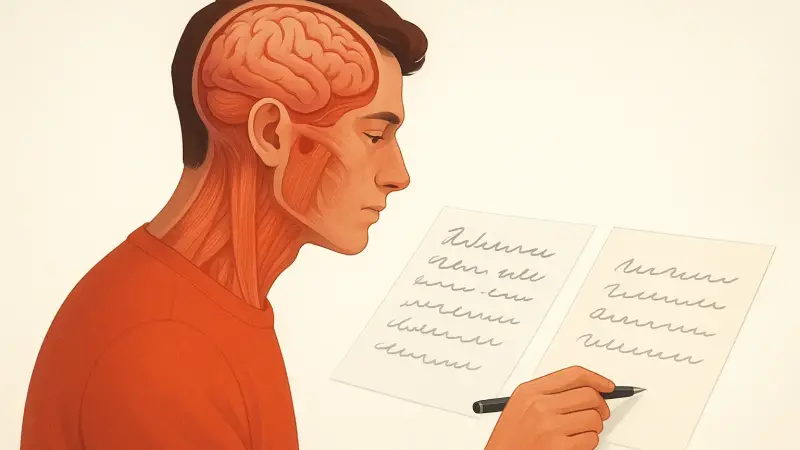
Why the same hand can look messy one day and tidy the next
Someone can jot a quick note that looks like a scramble, then sign a form in neat, controlled letters five minutes later. This isn’t one single “place” or “case.” You see it in classrooms in the U.S., on office forms in the U.K., and in Japan where neat penmanship is often practiced early. The difference is not usually about knowing how letters “should” look. It’s about how much of the movement is being run by automatic motor routines versus slow, attention-heavy control. Handwriting sits on top of muscle memory, even though the “memory” is in the nervous system, not the muscles.
A concrete example is filling out a paper form at a clinic: the name line is often clear, but the address line turns sloppy when the pen angle changes and the clipboard shifts on someone’s knee. A small detail people overlook is how much that surface and grip change the movement. Even a few degrees of wrist extension can alter which joints do most of the work.
Handwriting is a stored movement sequence, not a stored picture
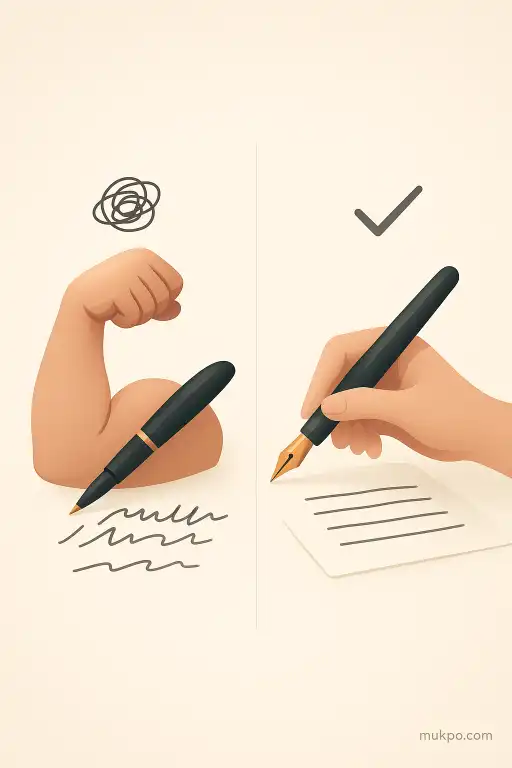
Neat handwriting tends to come from stable, well-rehearsed movement programs. The brain is not redrawing each letter from scratch like a tiny artist. It’s calling up sequences: how far to move, when to slow down, when to lift, and how to link one stroke to the next. Those sequences are trained over years and get tied to very specific conditions. Change the pen, the paper friction, the speed, or the posture, and the old sequence doesn’t fit as cleanly.
That’s why some people’s printing looks better than their cursive, or their cursive looks better than their printing. Those are separate “packages” of motion. Even within one style, capital letters and lowercase can behave differently because capitals are used less often and may be less automated.
Speed and attention decide which control system is in charge
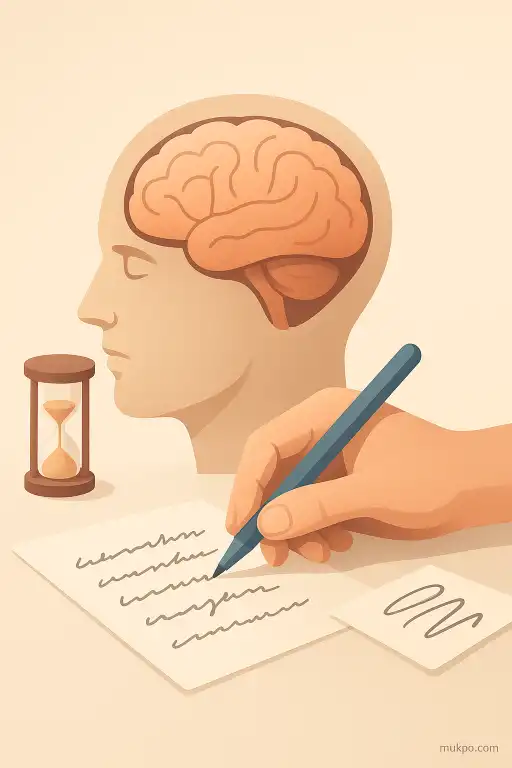
When writing is slow, attention can babysit the strokes. It can correct mid-letter. It can adjust spacing. When writing is fast, control shifts toward predictive movement. The system relies on what it expects the hand to do next. That prediction is efficient, but it’s also how small errors get amplified into mess. A rushed loop becomes a wrong-sized loop, which changes where the next stroke lands, which changes the spacing, and suddenly the whole word collapses.
This is also why “sloppy” often shows up in the middle of a sentence rather than the start. At the start, attention is fresh and the first few letters get extra care. After a few seconds, the hand is running on autopilot and the eyes are already thinking about the next word.
Neatness depends on stable anchors: posture, friction, and where the motion comes from
The hand doesn’t write alone. The shoulder, elbow, wrist, and fingers share the job, and people unconsciously pick a “division of labor.” Neater writing often comes with a consistent division, like using the forearm to glide and the fingers for small shapes. Sloppier writing often shows up when the division shifts midstream. The person starts with finger control, then the wrist takes over when they tire, or the shoulder starts steering when the surface is awkward.
One overlooked detail is friction management. On smooth paper with a gel pen, the hand can overshoot because there’s less resistance. On rough paper, the pen drags and the hand compensates by pressing harder, which reduces fine control and makes lines wobble. The writing looks “messy,” but the real change is in pressure and micro-tremor, not letter knowledge.
Why stress, fatigue, and context leak into the letters
Handwriting is sensitive to arousal. Under stress, muscles tend to co-contract: opposing muscles tighten at the same time. That stabilizes the limb but reduces fluidity. The pen pressure often goes up, the strokes get more angular, and spacing becomes less consistent. Fatigue pushes in a different direction. The hand may lighten pressure to conserve effort, then lose contact stability and start skipping or drifting.
Context matters because the nervous system learns context with the skill. A person may have “meeting notes” handwriting and “signature” handwriting as two different motor habits. The first is optimized for speed and capture. The second is optimized for repeatability and social display. Both can be genuine muscle memory, just tuned to different situations, and the switch can happen without the writer noticing.
Related reads
- How tiny rituals like tapping or checking unlock a sense of control
- The town that paid families to move in and brought its main street back to life
- Why yawns spread across a room even when people are strangers
- The sudden phantom smell that isn’t there and how memory conjures scent
- Why rehearsing arguments feels more satisfying than actually apologizing
- The house that legally owns itself in Athens, Georgia