

Noticing the blink match your steps
You’re walking under a row of streetlights and one of them seems to “listen” to you. It blinks, and the blink lands right on your footsteps. People report this in lots of places rather than one famous incident. You’ll see versions of it in the UK, the US, and Australia, usually on quiet residential streets where you can hear your own pace. The core mechanism is ordinary. A lamp or its control gear is unstable, so it flickers. Your brain is great at locking onto patterns, so the flicker starts to feel timed to your movement, especially when you’re moving at a steady cadence.
Why the light is blinking at all
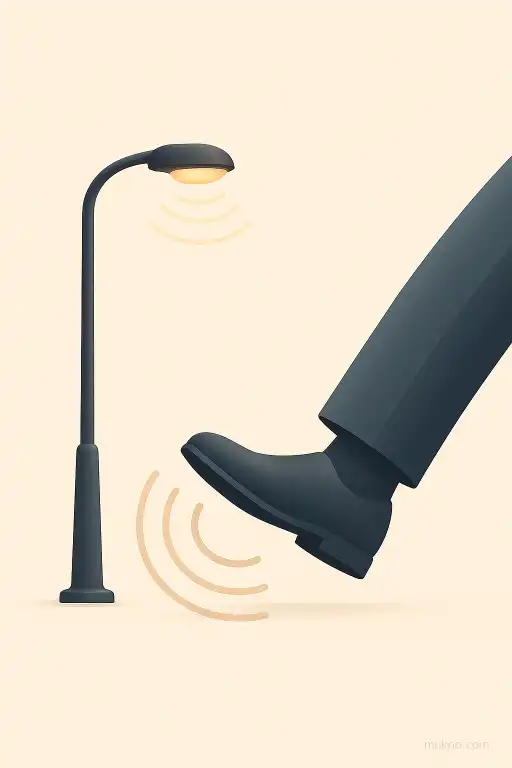
Streetlights don’t just “turn on.” They have drivers, ballasts, photocells, and sometimes smart controllers. If any of that is failing, you can get a rhythm: brighten, dim, recover, repeat. With older sodium lamps, end-of-life cycling is common. The lamp warms up, draws more current, a safety circuit cuts it, it cools, it restarts. LEDs can do a different version when a driver capacitor degrades or a connector is loose. That can create a steady pulse that looks intentional when you’re the only person out there.
A detail people overlook is that many streetlights are on a shared circuit. One failing driver can inject noise that makes a nearby light stutter too, so it looks like the “one above you” is reacting, even if the cause is a few poles away. Another overlooked piece is the photocell. If it’s partially shaded by a branch or dirty lens, it can hunt around dusk. It isn’t fast, but the back-and-forth can line up with a walk down the block and feel personal.
How your walking turns it into a sync
Most people walk with a fairly regular tempo. Many kinds of electrical flicker also repeat at a regular tempo. When two rhythms are close, your perception tends to “snap” them together. It’s the same reason two nearby turn signals can look like they’re coordinating, or why a dripping tap can feel like it speeds up when you pay attention. You don’t need perfect timing. If the blink lands on every second or third step for a few seconds, that’s often enough for the feeling to stick.
The effect gets stronger because you’re moving through changing light. Under a pole, glare is high. Between poles, it’s low. Your eyes adapt constantly, and that adaptation can make minor brightness changes feel bigger right when you step into or out of the brightest patch. If your footfalls are audible, they also create a second rhythm. The brain likes to line up sound and vision. So a mild flicker that you might ignore while standing still can feel “responsive” once your steps provide a beat.
A concrete street-level example
Picture a single LED streetlight on a calm suburban road. You approach from a darker stretch, and the first thing you notice is a slight shimmer in the pool of light on the pavement. As you pass directly underneath, the shimmer seems to become a crisp blink. Two or three steps later it happens again. You slow down, and it still happens, just less convincingly. You speed up, and for a moment it feels like it “tries” to keep up before drifting out of phase.
That drifting is a clue that it isn’t sensing you. A motion sensor streetlight usually changes in a big, obvious way, and it does it with a delay. The “synced blink” people describe is often subtle and quick. It’s closer to a driver or lamp cycling than a designed response. If there’s wind, the story gets more convincing. Tree branches can move shadows across the photocell or across the lamp itself, turning a small fluctuation into something that looks like a deliberate signal.
Why it feels directed at you
At night, your attention narrows. There are fewer moving parts in view, and the brightest object wins. A streetlight is also positioned like a “presence.” It’s above you, it changes state, and it’s tied to the exact spot you’re occupying. That’s a strong setup for agency detection, even in people who don’t usually think that way. If you’re walking alone, there’s no competing rhythm from another person. Your pace becomes the reference clock for everything you notice.
It also helps that many outdoor lights have a faint buzz or tick when they’re unstable. People rarely register that sound until they’re already alert, and then the sound becomes part of the timing. The blink seems sharper because the noise and the visual change land close together. When you’re a few meters past the pole, both the light and the sound fall off quickly, and the “conversation” ends as abruptly as it started.
Related reads
- A supermarket that redirected abandoned carts into a hidden community garden
- The town that numbered its stray cats and issued them identity cards
- The statue swallowed by a sinkhole that reappeared intact days later
- The coastal town where hundreds of lost dentures wash ashore every year
- Why your face flushes before you realize you’re embarrassed
- The Georgian scandal where doctors believed a woman gave birth to rabbits