

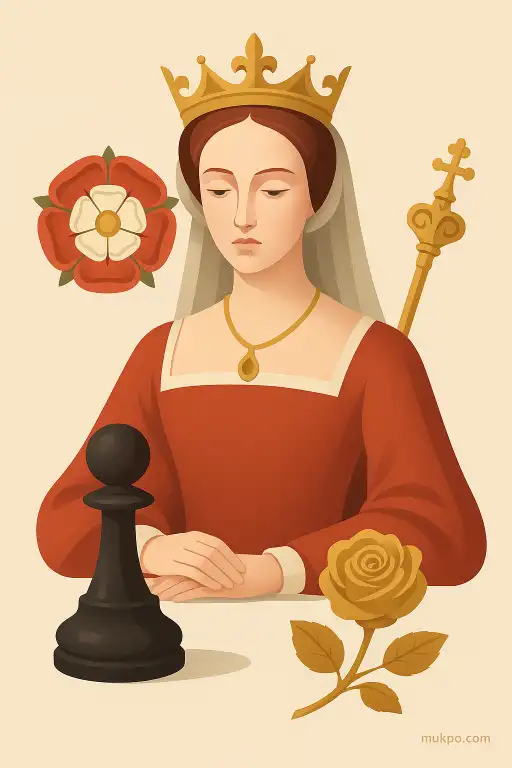
It feels like a crown should settle an argument. In July 1553, it did the opposite. Lady Jane Grey was proclaimed queen in London, then removed nine days later when Mary Tudor took power. The strange part is how little Jane’s own wishes mattered. The mechanism was paper and procedure: a dying king’s signature, a council’s proclamation, judges and lawyers arguing over what counted as lawful succession, and a rush to get key towns and weapons on side. Jane didn’t create the crisis. She was placed into it, right where competing claims could use her.
A succession that wouldn’t stay settled
Henry VIII tried to make the Tudor future neat with statute. The Third Succession Act of 1543 put Edward, then Mary, then Elizabeth in line, even while it still treated Mary and Elizabeth as legally illegitimate in other ways. It also gave Henry power to shape the order by will. That choice mattered later, because it encouraged people at court to treat succession like something that could be “managed” with documents rather than accepted as custom.
By the time Edward VI was dying in 1553, the problem wasn’t just that there were rival candidates. It was that the country had lived through sharp religious change under a child king. Mary was openly Catholic. Elizabeth was Protestant-leaning but politically careful. Jane was firmly Protestant and came with a set of relatives and patrons who were ready to move quickly. The succession crisis was also about what kind of church the next monarch would protect.
Why Jane Grey was the convenient choice

Jane’s claim ran through Mary Tudor’s younger sister, Mary Brandon, Duchess of Suffolk. That made Jane a Tudor great-niece, not a direct heir. Under Henry VIII’s settlement, Mary and Elizabeth were ahead of her. But Jane was young, educated, and surrounded by committed Protestants. She could be presented as a “clean” Protestant alternative to Mary without the awkwardness of elevating Elizabeth, who still carried the shadow of Anne Boleyn’s fall and was not as easy for others to control.
One overlooked detail is how much this depended on speed and visibility. A queen is not only a person with a bloodline. A queen is a person other powerful people publicly agree to obey. Proclamation mattered. So did access to the Tower of London, which was both a fortress and the place where monarchs traditionally prepared for coronation. Getting Jane into that setting helped make her look inevitable, even when the legal basis was shaky.
The paperwork that tried to outrun the law
Edward VI produced a document often called his “Devise for the Succession.” Its wording changed as his health worsened. Early versions aimed at “male heirs” of certain relatives, which didn’t exist in the right places. Later versions moved toward naming Jane directly. That evolution is one reason the intent looks improvised rather than settled. It also created a practical problem: Henry VIII’s statute was still on the books, and a king’s personal plan did not automatically cancel an act of Parliament.
Getting the plan to stick meant dragging institutions along. Senior figures on the privy council were pushed to sign. Lawyers and judges were leaned on to recognize Edward’s device. But the closer you look, the more it becomes a question of authority under pressure: a dying minor king, a powerful council, and legal professionals asked to bless something that could later be treated as treason if it failed. That fear wasn’t abstract. Everyone involved knew the penalty for backing the wrong monarch.
Nine days of fragile power
Jane’s “reign” lasted because a small circle in London could control messaging for a moment. Coins, seals, and formal announcements were the tools of reality. But outside the capital, people watched for signs of who had the stronger claim and the stronger support. Mary acted quickly from East Anglia, gathering allies and presenting herself as Henry VIII’s lawful heir. That argument was simple to understand, and it mattered that it could be repeated without getting tangled in Edward’s last-minute paperwork.
Military and logistical details tipped the balance. Control of ports, roads, and armories mattered as much as courtroom reasoning. The council also had to worry about public disorder in London and the risk of foreign involvement. Even if foreign plans were unclear, the possibility of outside pressure hovered over every decision. Jane, meanwhile, was kept in a position where others could speak for her, and where changing sides could happen around her without her having real leverage to stop it.
Pawn is not the same as innocent
Calling Jane a pawn doesn’t mean she was unaware of politics. Contemporary accounts suggest she resisted the idea at first, though the exact words and scenes vary depending on the source, and some were written with clear agendas after the fact. What is clearer is that her marriage to Guildford Dudley tied her to John Dudley, Duke of Northumberland, the dominant figure in Edward’s final months. That link made her useful and also made her dangerous once the tide turned.
When Mary won, the same mechanisms that had tried to manufacture Jane’s legitimacy were reversed. Proclamations were rewritten. Allegiances were re-declared. The label “traitor” replaced “queen” almost overnight. The harshness that followed wasn’t only personal vengeance. It was the state trying to make an example that would discourage the next faction from attempting a paper coup in a moment of weakness.
Related reads
- When a streetlight began syncing its blink to residents footsteps
- A supermarket that redirected abandoned carts into a hidden community garden
- The town that numbered its stray cats and issued them identity cards
- The statue swallowed by a sinkhole that reappeared intact days later
- The coastal town where hundreds of lost dentures wash ashore every year
- Why your face flushes before you realize you’re embarrassed