
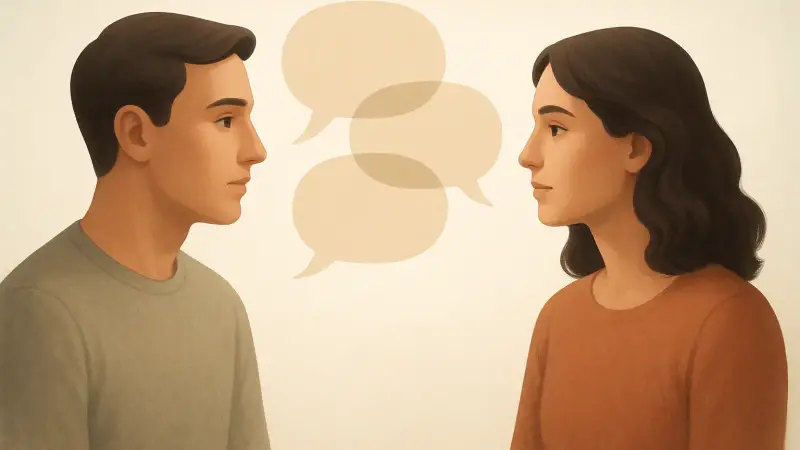
A pause can change the whole room
It isn’t one single cultural rule. It varies a lot. In Finland, in Japan, and in many Quaker meetings in the United States, longer silences are often treated as normal rather than awkward. In a small talky kitchen, the same gap can feel like something went wrong. Silent pauses tend to make conversations feel deeper because they interrupt the usual reflex to fill space. A pause gives everyone a moment to notice what was just said and decide whether it deserves a real response or just another line to keep things moving.
There’s also a basic timing detail people overlook: a pause doesn’t have to be long to register. A beat that’s only a second or two can feel huge if it lands right after something personal. The “depth” feeling often comes from the placement, not the duration.
Silence breaks the autopilot script
Most everyday conversation runs on prediction. Someone asks a question, the other person answers, and both keep an eye on what comes next. That makes talk efficient. It also makes it shallow by default, because the mind is already preparing the next turn. A silent pause interrupts that. With no words arriving, the brain can’t keep riding the same groove, so attention shifts back to meaning, tone, and what might be underneath the sentence.
This is why pauses often follow moments that would otherwise get smoothed over. A person says, “I’m not doing great,” and if the other person rushes in with “Oh no, why?” the exchange stays on rails. If there’s a pause, even a short one, it changes the social demand. Something real has been put on the table, and now there’s time for it to be felt.
It signals that a response is being chosen, not triggered
People read a pause as a sign of internal work. Not always correctly, but reliably. Silence can look like thinking, weighing, or holding back something careless. That perception alone adds gravity. A quick reply can sound like reflex, even when it isn’t. A measured delay often sounds intentional, as if the speaker is selecting the right level of honesty or the right amount of detail.
A concrete example is a job interview question like, “Tell me about a mistake you made.” If the candidate answers instantly, it can feel rehearsed. If they pause, look away for a moment, then answer, it often reads as more personal, even if the content is similar. The pause creates the impression of search and self-editing, which people associate with depth.
Silence raises the stakes, so people listen differently
Conversation usually includes small noises that keep it floating: “yeah,” “right,” laughter, quick agreement. When those disappear, the interaction feels more exposed. That exposure makes listeners more alert. They watch faces more. They notice breathing, posture shifts, and tiny changes in expression. Those signals are always there, but talk covers them up. Silence makes them loud.
It can also change what people think the conversation is for. A fast back-and-forth often feels like social bonding or information exchange. A pause can make the same topic feel like it’s about judgment, confession, or meaning. The room hasn’t actually changed, but the conversational “mode” has.
It can invite more honesty, or create pressure
Silent pauses don’t always feel good. Sometimes they feel deep because they feel risky. If one person stops talking, the other person may feel responsible for moving things forward, and that can pull out thoughts they didn’t plan to say. In close relationships, a pause after “Can we talk about something?” often leads to more direct language, because filler suddenly feels inappropriate.
But the same mechanism can create discomfort or even shutdown. In groups where quick responses are valued, silence can be read as disapproval. In a tense conversation, a long pause can feel like punishment. The “depth” people sense is partly the awareness that something important could happen next, and no one knows which way it will go.
Related reads
- The airport carousel that reliably ejected one lone shoe from every flight
- Why memories from a morning often feel sharper than those from late night
- A pedestrian crossing that erupted into spontaneous disco lights after midnight
- When kings shaved silver from coins and markets exploded: medieval coin debasement
- How splitting attention makes ordinary tasks feel strangely harder
- How Victorian salons turned arsenic into beauty and scandal