
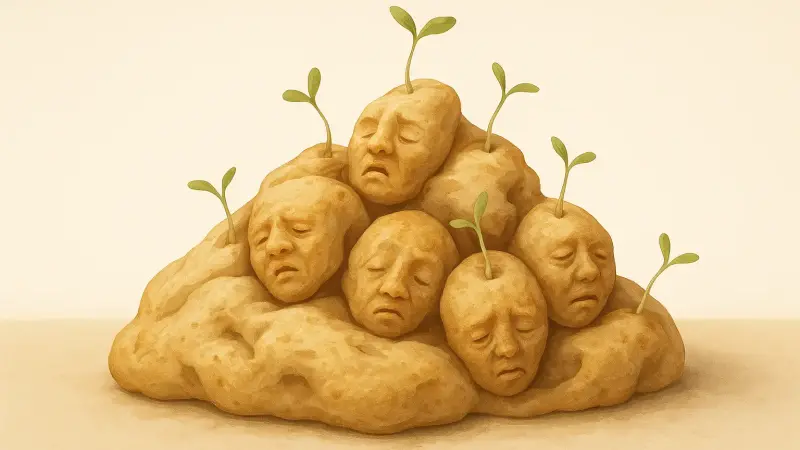
Not one famous bakery, but a common bakery moment
It isn’t one documented “face dough” bakery with a clear address and date. It’s a thing that shows up wherever bread dough gets left to dry out or ferment in odd corners. People report it in small neighborhood bakeries and in home kitchens, from the UK to the US to Japan, because the setup is the same: a scrap of dough is tossed aside, it skins over, it cracks, and the cracks can look like tiny crusty faces. If you’ve ever seen a lump of old starter dried onto the rim of a jar, you’ve already seen the basic mechanism. It just usually doesn’t get interpreted as a face.
How “discarded dough” turns into a crust
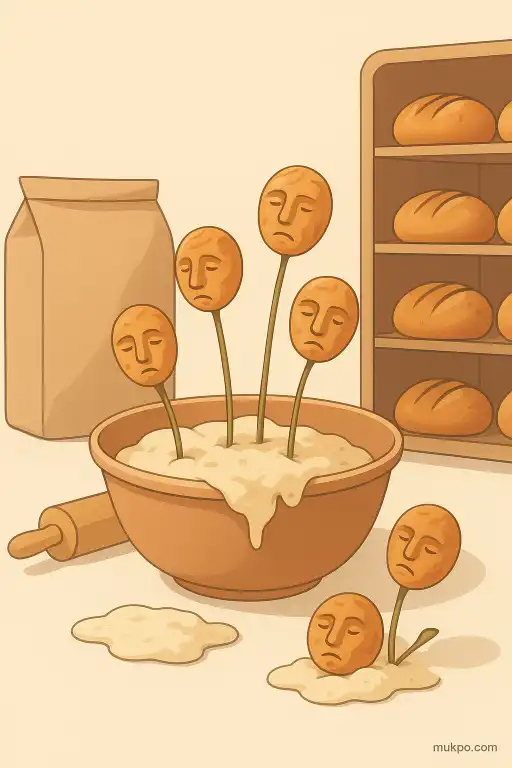
Dough changes fastest at the surface. Water evaporates, especially near a warm oven, a proofing box vent, or a drafty back door. That outer layer stiffens first and becomes a thin shell. Underneath, the dough can still be soft and still expanding. Yeast and bacteria keep producing gas for a while, and the dough can also puff just from heat.
When the inside swells against a drying shell, the shell can’t stretch evenly. It splits. Those splits often form a few deep lines and a couple of smaller pits where bubbles collapsed. Human brains are tuned to read two marks and a line as eyes and a mouth, even when it’s random. The “sprouting” part is usually the moment the crust lifts and breaks, not new growth.
Why the cracks cluster into “eyes” and “mouths”
The cracking isn’t completely random. Dough tends to tear where it’s thinnest, where the surface dried fastest, or where something tugged it. A dough scrap that was pinched off has weak points from the pinch. If it was folded or rolled, there are seams. Seams become the first fracture lines. Two nearby gas bubbles can leave two shallow dents when they deflate, which reads as eye sockets.
One overlooked detail is flour dusting. A lightly floured surface dries into a different skin than a wet one. Flour can create a slightly rigid layer that cracks in clearer, higher-contrast patterns. That contrast is what makes “expressions” pop in a photo. The same scrap, brushed with water, often just slumps and wrinkles instead of forming bold lines.
A concrete scene where it happens
Picture a working bench at the end of a shift. There’s a small pile of trimmings from shaping rolls, pushed to the side. The baker is moving fast. The bench is warm from trays that just came off the oven. The scrap pile sits in that warm air stream for an hour, then longer. It forms a skin, then the inside expands a bit, and the skin splits into a few bold cracks.
It can look especially face-like if the scrap is about palm-sized and slightly domed. Flat scraps tend to make flatter crack patterns. Very wet scraps often just spread. And scraps stuck to something—like dried starter on a jar shoulder, or dough smeared on a plastic tub—can “lift” at the edges as they dry, which makes the shape feel more like a little head than a pancake.
What else can add to the “tiny face” effect
Heat doesn’t just dry dough. It also browns it. Even without baking, a scrap near an oven mouth can get a little toasted on the outside, which sharpens shadows in the cracks. If the scrap is later baked accidentally—say it’s stuck to the bottom of a tray, or it’s swept onto a peel and goes into the oven—the crust can harden and keep its “features” longer. That’s when people start showing it to coworkers.
Mold can also confuse the story, because it appears later and adds speckles that resemble freckles or pupils. But the face-like structure usually happens first, during drying and cracking. The timing matters. If someone only notices the scrap days later, it’s unclear which parts came from cracking and which came from contamination. In a busy bakery, a lot of these little transformations happen off to the side, and the only reason one gets remembered is because, for a moment, it looks like it’s looking back.
Related reads
- Why silent pauses make conversations feel deeper
- The airport carousel that reliably ejected one lone shoe from every flight
- Why memories from a morning often feel sharper than those from late night
- A pedestrian crossing that erupted into spontaneous disco lights after midnight
- When kings shaved silver from coins and markets exploded: medieval coin debasement
- How splitting attention makes ordinary tasks feel strangely harder