
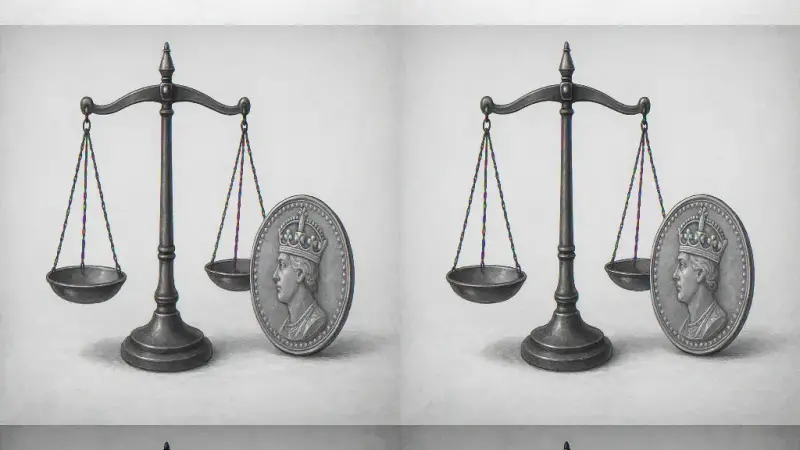
When people in Tudor England handed over a coin, they were trusting more than the king’s face stamped on it. They were trusting the metal inside. So the Crown ran a quiet test with a blunt, practical mechanism: take a sample of newly minted coins, seal them up, and later have independent experts weigh and assay them against a legal standard. In London, at the Royal Mint and the Exchequer, this became the Trial of the Pyx. Under Henry VIII and Elizabeth I, it mattered because silver content could slide for all sorts of reasons—bad refining, worn tools, or deliberate “light” money—and ordinary trading would feel it first.
Why coin honesty needed a ritual
Tudor government ran on coin. Taxes, wages, rents, customs duties, and army pay all came down to how much reliable silver or gold people believed they were receiving. If the money was underweight or underfined, prices could jump without anyone changing a single law. Merchants would demand more coins for the same goods. Workers would notice their pay buying less. That kind of distrust could spread faster than any proclamation.
There was also an uncomfortable fact: the same authority that benefited from tinkering with coinage was the one promising it was fair. England did see repeated changes to standards in the 16th century, especially in the 1540s and early 1550s. When the Crown altered fineness by policy, it could insist it was legitimate. When something went wrong in practice, it needed a way to show the fault was not being hidden.
The Pyx: a locked sample of the year’s money
The “pyx” was a locked chest used to hold selected coins from Mint production. As coins were struck, officials were supposed to pull out pieces at intervals and set them aside as a record of what was actually being made, not what was promised on paper. Those sampled coins were kept sealed under controlled custody so they could not be swapped later without leaving a trail.
A small detail people tend to overlook is that the test did not depend on one perfect coin. It depended on a batch. Coins wear down in circulation and individual blanks vary slightly. The Trial’s strength was statistical before anyone used that word: a controlled sample, stored away from everyday handling, that could be weighed and assayed as a group against the official “remedy,” the permitted margin of error.
Who judged it, and what “assay” meant
The Trial was not just Mint staff checking their own work. A jury was involved, drawn from skilled goldsmiths—people with a professional stake in accurate metal and the practical knowledge to catch tricks. The setting was formal and legalistic, tied to the Exchequer, because a failed result could become an accusation, not merely a technical problem.
Assaying meant testing the precious-metal content, not just the look. For silver coins, that usually meant melting and refining a measured amount of the sample, then separating precious metal from base metal to see the true fineness. Weight mattered too. A coin could be properly fine but too light, or properly heavy but underfined. Either way, the public lost value, and either way, it would show up when the numbers were taken seriously.
A concrete moment: the Great Debasement hanging over the process
It is hard to understand the Trial’s political edge without the memory of the Great Debasement under Henry VIII and Edward VI. In those years, the silver content of English coinage was reduced by policy and then later repaired under Mary I and Elizabeth I. The exact way any one Trial session landed in public conversation is not always clear from surviving records, but the broader context is: people had lived through official change, so they watched for unofficial cheating.
Picture a cloth merchant in London paid in fresh shillings. If those coins were subtly off—light enough that scales noticed, or base enough that a goldsmith’s tests raised eyebrows—the harm was immediate. The Trial of the Pyx was a delayed mechanism, not a market-day inspection, but it created a credible threat. Mint officers and moneyers knew that a sealed sample could come back months later and be turned into evidence, in front of people who understood metal for a living.
What could go wrong, and why the delay still worked
The odd thing about the Trial is its timing. It was not constant surveillance. Coins could circulate for a long while before the official sample was tested. That lag sounds like weakness, but it served a purpose. Mints were complex workshops. Metal quality depended on refining, alloying, and repeated melting. Weight depended on cutting blanks and striking. A periodic, high-stakes review pushed the whole system toward consistency without stopping production every day.
Failures, when they happened, could point in different directions. Some problems were deliberate, like skimming metal in the workshop. Others were procedural, like poor quality control in alloying. The Trial also had a quiet administrative value: it forced the Mint to keep standards written down and measurable—weights, fineness targets, allowed remedies—so arguments could be settled with numbers instead of loyalties. That mattered in a Tudor state where loyalty was often the first explanation offered for everything.
Related reads
- A bridge that hummed a different tune as the temperature dropped
- A bakery where discarded dough sprouted into tiny crusty faces
- Why silent pauses make conversations feel deeper
- The airport carousel that reliably ejected one lone shoe from every flight
- Why memories from a morning often feel sharper than those from late night
- A pedestrian crossing that erupted into spontaneous disco lights after midnight