
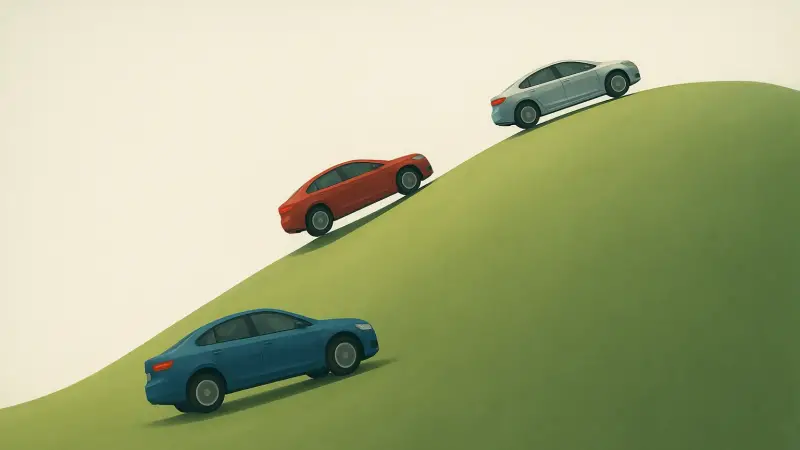
A car in neutral should roll downhill. So when it creeps the other way, the scene feels like a broken rule. That “uphill” roll has been reported in a lot of places, not just one: the Gravity Hill road segment near Bedford, Pennsylvania, the so‑called Spook Hill in Lake Wales, Florida, and a well-known slope in Jeongdongjin, South Korea are all cited by visitors. The mechanism is simple, even if it doesn’t feel that way. The road is usually sloping down. The surroundings trick the eye into reading it as up, so the car follows gravity while the brain swears it’s watching the opposite.
What people usually see on the road
The setup tends to be similar. A short stretch of pavement looks like it rises away from where people stop. A car is put in neutral, or a bottle is placed on the ground, and it “rolls uphill” toward the apparent high point. The effect is often strongest when the road bends slightly, because the curve hides reference points that would otherwise give the slope away.
One situational detail that gets overlooked: the horizon is often blocked. Trees, embankments, and nearby hills erase the one reference the visual system trusts most. Without a clear horizon line, the brain leans harder on whatever straight edges it can find, like a treeline or a fence, even when those edges are tilted.
Why the “uphill” direction looks like up
Humans don’t read slope the way a level does. The brain estimates “up” by combining several cues: the angle of the road, the angle of surrounding terrain, the way objects sit on the landscape, and learned expectations like “roads usually climb toward that hill.” If most of the scene is pitched one way, a smaller pitch in the opposite direction can be misread.
That’s why these spots often sit in shallow bowls or on uneven ground. If the broader landscape slopes down behind the viewer, the road ahead can feel like it’s rising, even when it’s dropping. A distant line of trees that’s slightly tilted can act like a fake horizon and pull the whole sense of level with it.
What gravity is actually doing
Nothing exotic needs to happen for a car to roll. If the road falls even a small amount—sometimes too small to notice by eye—gravity provides a component of force along the pavement. With a car in neutral, that’s enough. With a bottle, it’s even easier, because there’s no drivetrain friction or parking brake drag to complicate things.
Wind can confuse the moment, but it rarely explains the whole effect. A gust might change the speed or make a light object drift, yet cars roll consistently in one direction at these sites, which matches the actual grade. People often focus on the car, but the key is the ground it’s on, not what’s moving.
How the setting is designed to mislead you
Many of these places became attractions because the illusion holds up on camera. A slight telephoto zoom flattens depth, making the rise look steeper than it is. If the camera is also a little off-level, the viewer gets an even stronger “that’s uphill” signal. Even when a person is standing there, it’s easy to carry the camera’s mistake back into what they remember seeing.
Road features add to it. A shoulder that slopes the opposite way from the main lane can make the lane feel canted “up.” Painted lines, guardrails, and drainage ditches can be subtly angled. The brain treats those as trustworthy geometry. It usually doesn’t occur to people that the “straight” line they’re relying on might not be level at all.
Why the illusion survives arguments
What keeps these hills famous is how firm the perception feels. The car moves. The engine is off. The road ahead looks higher. That’s enough to lock in a story. And because the slope is gentle, it doesn’t trigger the body’s balance system the way a real hill does, so there’s no internal “this is downhill” sensation to override the visual guess.
At places like Spook Hill in Lake Wales, the folklore is part of the experience, so people arrive primed to notice the wrong details and ignore the right ones. They watch the car, not the landscape. They remember the direction, not the missing horizon. The hill doesn’t have to do anything special after that.
Related reads
- The secret assay that kept monarchs honest: the Trial of the Pyx in Tudor England
- A bridge that hummed a different tune as the temperature dropped
- A bakery where discarded dough sprouted into tiny crusty faces
- Why silent pauses make conversations feel deeper
- The airport carousel that reliably ejected one lone shoe from every flight
- Why memories from a morning often feel sharper than those from late night