
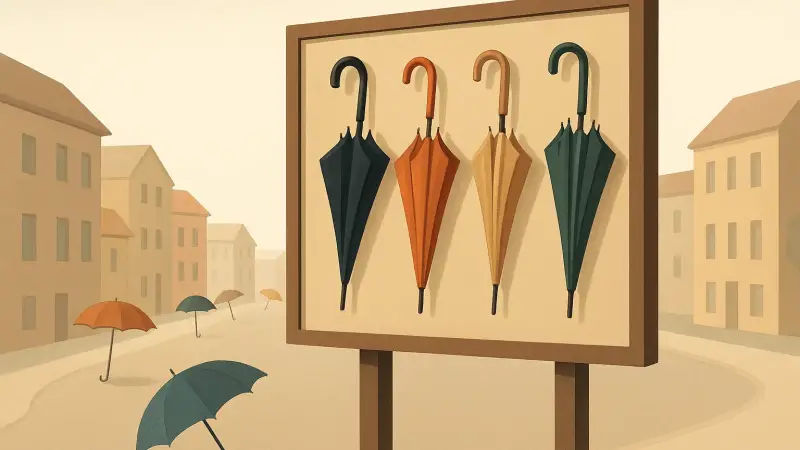
It’s easy to assume a lost umbrella is gone for good. But there are places where the next step isn’t a “lost and found” desk. It’s a public board, with the umbrella physically attached and a short note beside it. There isn’t one single, famous town where this always happens, and reports vary. But the basic idea shows up in a few very real settings. In Japan, for example, you’ll sometimes see umbrellas left in neat rows or by a sign at a train station or shop entrance, waiting for the owner to spot them. In parts of Switzerland and Germany, small communities also rely on informal return systems posted in shared spaces.
How the “pinned umbrella” setup usually works
The mechanism is surprisingly physical. Someone finds an umbrella on a bus, outside a café, or near a school gate. Instead of taking it home, they bring it to a spot that already functions as a community bulletin board: outside the town hall, beside a grocery store entrance, near a train platform, or in the lobby of a community center. The umbrella gets clipped, tied, or hooked onto the board’s frame. Then a note goes up next to it with just enough information to identify it.
The note is rarely dramatic. It tends to say where it was found and roughly when. People often skip the obvious details and include one small identifier instead: “black handle with a silver button,” “wooden J-shaped grip,” “broken tip on one rib.” That tiny detail is what stops the system turning into free umbrellas for anyone walking past. Most umbrellas look the same at a glance. Owners recognize the specific annoyance they’ve been living with.
Why a noticeboard beats a formal lost-and-found

A formal lost-and-found works well in one building with staff. A town’s everyday losses don’t happen in one building. They happen at the edge of a sidewalk, in a park, at a bus stop, in front of a bakery. A public noticeboard is a central point that’s already part of daily routes. People pass it on the way to work, school pickup, or groceries. That visibility matters more than organization.
It also reduces the cost of “handling.” An umbrella is bulky, wet, and slightly grimy. Keeping it behind a counter means storing a dripping object until someone claims it. Hanging it on a board outside lets it dry. It also keeps it out of a back room where it might be forgotten. The overlooked detail here is moisture: a closed umbrella can stay damp for hours, and anything stored near it ends up smelling like rain and fabric dye.
What the notes reveal about trust and proof
The notes are doing two jobs at once. They’re an invitation to the owner, and they’re a soft barrier against opportunists. Some communities keep the description vague on purpose and ask the claimant to provide a matching detail. You’ll see notes that read like: “Found near the post office. Tell me the pattern to claim.” Other places do the opposite and describe the umbrella in full, betting that most people won’t take something that clearly isn’t theirs.
There’s also a social layer. Posting a note is a tiny public act of being the kind of place that returns things. That becomes self-reinforcing. If you’ve seen a few returned items on the board, you’re more likely to add to it the next time you find something. Umbrellas sit in a sweet spot for this. They’re common enough that the board doesn’t feel like a big event, and low-value enough that nobody needs paperwork.
What makes umbrellas especially likely to come back
Umbrellas are easy to lose and awkward to steal. They’re often left behind because rain stops, people enter a warm building, and the umbrella becomes dead weight. Many are interchangeable, so taking one on purpose doesn’t feel worth the guilt. But for the owner, the loss is still annoying. They remember it the next time it rains. That creates a steady stream of people looking for their exact umbrella a day or two later.
They’re also easy to display. A phone or wallet can’t be pinned in public without inviting trouble. An umbrella can be shown openly with relatively low risk. Even if someone did take it, the harm is limited, which makes it easier for a community to tolerate a system built on visibility instead of control. That’s one reason you see public return methods for umbrellas more than for keys, jewelry, or cash.
Where the system breaks down
These boards work best where lots of people share the same paths and recognize the same shared spaces. They tend to struggle in places with heavy tourist flow or high turnover, where the owner may already be gone. Weather can also ruin the whole arrangement. A board placed in an exposed spot turns into a sail rack in strong wind. Notes peel. Ink runs. Umbrellas fall and get stepped on, which makes them even harder to identify later.
Even in towns that do this, it isn’t always consistent. Some umbrellas end up in a conventional lost-and-found, especially if they’re found indoors. Some get left propped against a wall with no note at all. The public board method depends on someone having the time and the mild confidence that it’s normal to touch another person’s forgotten object, carry it a short distance, and attach a message for a stranger.

Related reads
- Victorian London’s parties where guests paid to unwrap real mummies
- The odd comfort of rewatching movies you already know
- A Victorian suitcase that kept an entire tiny garden growing for a century
- The frontier uprising against whiskey taxes that tested the early American republic
- Why your name grabs attention in a crowded room
- How brief goodbye routines steady anxious minds