
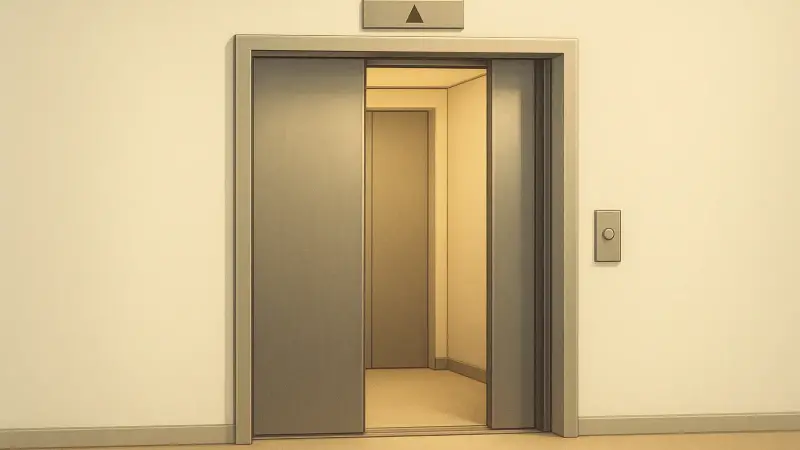
A familiar ride that keeps feeling personal
Most office elevators feel boring until one starts behaving like it’s listening. Someone stands alone in the lobby, thinks “seventh floor,” and the doors open to seven—before they touch a button. It isn’t one documented incident in one building, either. You see versions of this story attached to offices in London, New York, and Tokyo, and the details vary depending on who’s telling it. The core mechanism is always the same: the cab appears to “choose” a floor based on the last person’s thought, not the last button press. It’s the kind of thing people only notice when it happens twice in the same week.
What a modern elevator is actually doing
Most elevators in office buildings are not simple up-and-down machines waiting for a single request. They’re part of a group control system. Multiple cars share a “brain” that tries to reduce wait time and energy use by staging cars near likely demand and chaining stops efficiently. Some buildings also use destination dispatch, where you select a floor on a keypad or badge reader before entering, and the system assigns you a car. Even without destination dispatch, the controller is constantly guessing what to do next based on recent calls, time of day, and where cars already are.
That’s how you can get a spooky-looking coincidence without anything supernatural. If a car is being held at (or sent toward) a floor because it’s statistically likely, the next person can walk up, think of that same floor, and feel “seen” when the doors open there. The building isn’t reading minds. It’s just being predictable in a way people don’t expect from a metal box.
How the “last person” part gets built into the story
The “last person” detail usually comes from how we reconstruct the moment. People remember the thought because it feels private, and they remember the doors opening because it feels like a response. The missing middle is everything the elevator did a minute earlier. Someone could have called the elevator from the seventh floor and then walked away. A cleaner could have used a service key. A delivery person could have hit a hall call and gotten distracted. Those actions still count as requests to the controller, but they’re invisible to the next person standing in the lobby.
There’s also a small timing trick. If you approach just as the car is completing a run and returning to a “home” floor, it can look like it opened to the floor you imagined, when it was simply finishing its last scheduled stop. The story compresses time, and the elevator seems to jump directly from your thought to the result.
The overlooked detail: door timing and “nudges”
One specific thing people usually overlook is how much door behavior is controlled by sensors and timers, not by a clean “stop at floor” command. Modern doors will reopen, hesitate, or close early depending on infrared curtains, weight sensors, and even how long the door has been held. If someone on a floor blocks the door with a cart, the car may register a stop there longer than normal. That can ripple into where it goes next, because the controller is rescheduling while the car is still physically sitting at that floor.
This is also where the mind-reading feeling gets stronger. A person thinks of a floor, steps in, and the doors close quickly as if the elevator is “decisive.” But that quick close can be the system trying to catch up after a door hold or a sensor-triggered reopen. The rider experiences it as intention. It’s just housekeeping logic and timing.
A concrete way it plays out in an office day
Picture a Tuesday morning: the seventh floor has a recurring meeting at 9:00, and several people badge in around 8:55. The controller learns that pattern over weeks and tends to keep a car hovering near the lower floors, then sends one upward with a bias toward the floors that generate morning traffic. A person arrives at 8:58, alone, thinking about a file they need on seven. The car that was already scheduled to service a recent call up there finishes its run, and the doors open at seven just as they arrive.
Later, when the story is told, the elevator “always opens to the floor the last person thought of.” The “always” comes from the handful of memorable hits, not the dozens of misses. The rest of the day, when it opens to a random floor or waits in the lobby like normal, nobody builds a story around it.

Related reads
- A statue that oozes coffee instead of rain after storms
- Why imagined arguments seem more satisfying than real ones
- A town where lost umbrellas reappear pinned to public noticeboards with notes
- Victorian London’s parties where guests paid to unwrap real mummies
- The odd comfort of rewatching movies you already know
- A Victorian suitcase that kept an entire tiny garden growing for a century