

What people mean by “still connects”
Sometimes you pass a phone booth that looks like it should be dead: cloudy glass, missing coin return, keypad worn flat. And yet the receiver still gives a dial tone. The story usually hinges on one odd behavior. Most numbers fail or return an error, but one specific number still rings through. This isn’t one single place or one single verified case. Variants show up in different countries and decades, tied to whatever payphone network existed there. The mechanism is always the same idea, even when the details vary: a payphone line that was never fully disconnected, paired with routing rules that still allow one destination.
A concrete example people recognize is Japan’s “Phone of the Wind” in Otsuchi, Iwate Prefecture. It looks like a phone booth and people use it, but it is not connected to the telephone network at all. It matters because it shows how easily the “one number works” claim gets mixed with unrelated booths that are meaningful for other reasons. When a booth genuinely connects to a number, it’s typically because there is still a live line, not because the booth is somehow special.
The overlooked detail: payphones don’t dial like house phones
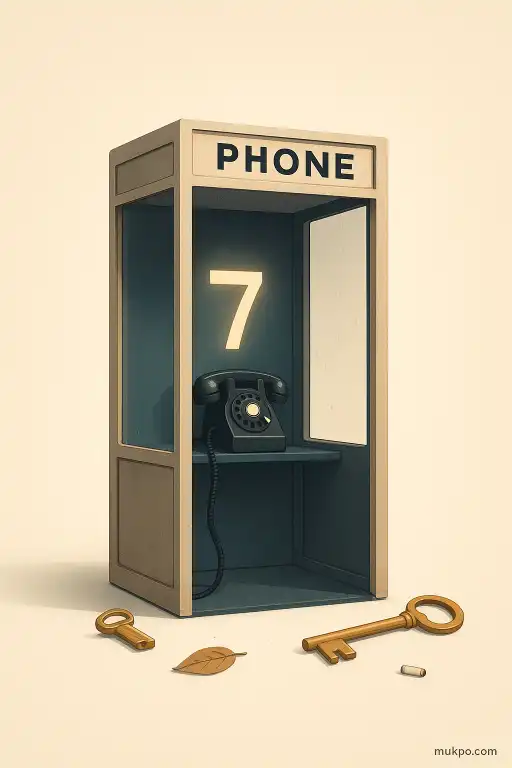
Older payphones were often configured with restrictions that regular phones didn’t have. They could be set to allow only certain calls: emergency services, the operator, a maintenance test line, or collect calling access numbers. That is why “only one number works” can be real without being supernatural. The number might not be a personal line at all. It could be a service code, a carrier platform, or a legacy destination that the switch still recognizes.
The overlooked piece is the difference between what the keypad sends and what the network accepts. A payphone may appear to “dial” any digits, but the local exchange can intercept the call based on class-of-service rules. Some systems also treat short codes and special prefixes differently. If a single destination is whitelisted, everything else can be blocked upstream, long before it reaches the wider network.
How a dead-looking booth can still have a live line
Payphones were part of regulated infrastructure for a long time. Even after a booth is abandoned physically, the copper pair feeding it can remain energized. Disconnection is an administrative action, and those records are not always perfect. If the owner changes, if the site is redeveloped halfway, or if billing was bundled into a larger account, a line can sit there in limbo. The booth looks forgotten, but the exchange still thinks something is attached.
There’s also a simple reason a line might be left active: it was used as a known location for emergencies. In some jurisdictions, payphones had requirements around providing access to emergency numbers even without coins. That doesn’t mean the booth can call one “mysterious” number, but it sets up the same feel. You pick up, you get tone, you try numbers, and only one call behaves differently. The rest can fail silently, especially if the phone is misconfigured or partially damaged.
Why the “single number” often feels personal
People expect a phone to be neutral: dial any number, reach anyone. When only one call goes through, the brain supplies a story. It also helps that the destination is rarely explained by a sign. If the number reaches a recording, rings without answer, or forwards somewhere unexpected, it feels like intent. A maintenance line that plays tones, a carrier recording, or a voicemail box can easily be interpreted as “someone is there.”
One situational pattern shows up again and again in retellings. Someone tries the obvious things first: their own mobile, a friend, a random local business. Those fail. Then they try a number they “found” associated with the booth, scribbled nearby, shared online, or remembered from a rumor. That call rings. The key detail people tend to miss is that they have shifted from ordinary dialing to a number that might already be in a routing exception list, like an operator service, a carrier access platform, or a test destination kept alive for network checks.
What can make the number hard to trace
Even when a call completes, it can be difficult to identify where it lands. Numbers can be forwarded, ported, or mapped to services that don’t show a public listing. Some destinations are not “lines” in the everyday sense. They are interactive voice response systems, paging gateways, or legacy carrier services that exist mostly for internal use. A caller hears ringing or a recording and assumes a person is behind it, but the network could be bouncing the call through layers of automation.
And there’s the physical side. A booth can be vandalized in a way that selectively affects dialing. A stuck key, water in the keypad membrane, a broken hook switch, or a damaged coin relay can change what digits are reliably transmitted. That can make it seem like “only one number works” because that one sequence happens to get through intact. The receiver lifts, the tone is there, and the rest of the experience depends on small, unglamorous parts that nobody notices until they fail.

Related reads
- The office elevator that always opens to the floor the last person thought of
- A statue that oozes coffee instead of rain after storms
- Why imagined arguments seem more satisfying than real ones
- A town where lost umbrellas reappear pinned to public noticeboards with notes
- Victorian London’s parties where guests paid to unwrap real mummies
- The odd comfort of rewatching movies you already know