
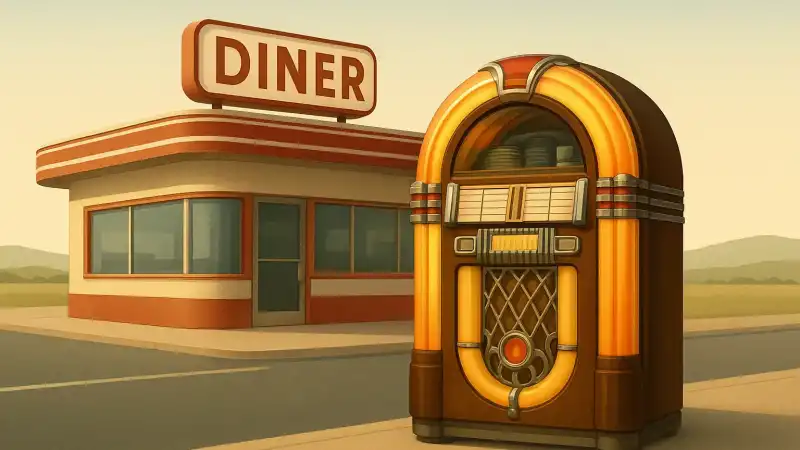
Most diners have a jukebox that’s basically a time capsule. You hit a button and you get the same catalog you’d hear in any bar off Interstate 40 or on a late night in Queens. This idea flips it. The machine still looks familiar, but the songs inside it are recorded by the people eating there, earlier that day. A couple orders fries, steps into a little booth, sings something messy and sweet, and by the time the coffee is topped off, that track is in the jukebox queue. It isn’t one famous place with a known address. It’s more like a format you could imagine anywhere a diner can spare a corner.
How the same-day jukebox works
The core mechanism is simple: a recording station on site, a fast way to process files, and a playlist system that behaves like a jukebox. People record in a booth, or sometimes at a table if the setup is looser and noisier. The staff (or an automated system) tags the track with a name, a time stamp, and basic info so it can be found and queued. Then it’s published to the jukebox interface, usually the same interface people already understand: search, select, pay, play.
The overlooked detail is what has to happen between “recorded” and “playable.” Raw audio is rarely ready. Levels jump, consonants spike, room hum sits under everything. Even a quick pass of noise reduction and compression matters, because a diner is loud. If you don’t even things out, one song disappears under the grill sizzle and the next one blasts the whole counter. The difference between a charming gimmick and a usable jukebox is that invisible five minutes of audio cleanup.
What people actually record
Expect a lot of covers. They’re easy, and people already know the melody. Someone will do a shaky verse of “Stand by Me,” someone else will try a pop chorus, and a regular might do a country standard because that’s what they grew up singing in the car. Original songs happen too, but less predictably. They take more nerve, and they’re harder for strangers to latch onto when the hook isn’t familiar.
There’s a pattern to the recordings that has nothing to do with talent. Short wins. A full three-minute track is a commitment in a public place. People tend to record one verse and one chorus, or even just a chorus twice. That also makes the jukebox feel more alive. The room changes songs more often. You don’t get trapped listening to a long, awkward take while the server is trying to call out orders.
Why it feels different from karaoke
Live karaoke is about the moment. Everyone hears the same performance at the same time, and then it’s gone. A same-day jukebox turns those moments into objects that can circulate. A person can record at 9 a.m., leave, and still “be there” when their song plays at noon. That shifts the social dynamic. People start listening for who recorded what, not just what song is being sung.
It also changes how attention moves through the room. With karaoke, the singer has the spotlight and you look up. With a jukebox, the sound is ambient and you look around. People clock reactions in small ways: a cook pausing for a second, a booth of teenagers laughing at a friend’s bravado, an older couple smiling because the voice is someone they know. The performance is disembodied, so the room does more guessing.
The diner has to manage risk and consent
If customers are recording audio that will be played publicly, the place needs clear consent. That can be as basic as a checkbox on the screen that says the recording will play in-house. Without that, you get problems fast. People record other people without permission. Someone tries a joke that isn’t funny when it’s heard by strangers. A bad recording can become the thing the room remembers, and not in a good way.
Then there’s copyright. A diner can’t assume it’s fine because the singer is “just a customer.” Covers are still covers. If the system is strictly in-house and ephemeral, some operators might treat it like a kind of performance. But the line gets blurry the second recordings are saved, shared, or monetized. Even if the legal details vary by place and licensing setup, the practical reality is the same: the diner has to decide whether it’s running a playful novelty or a tiny recording platform.
What it does to the room over a day
In the morning, the playlist is thin. A few tracks, a few brave early recordings, and a lot of silence between the classics. By lunch, it starts to feel like a bulletin board. People hear a name they recognize. They hear a voice they don’t. They start to ask the server who’s been in the booth. The jukebox becomes a way of tracking the day’s crowd without anyone posting anything online.
By late afternoon, there’s usually a strange intimacy. The regulars have heard the same handful of people more than once. Tourists add one-off songs that don’t match the local taste. The staff starts to have favorites, not because they’re the best singers, but because they’re the ones who recorded something that sits nicely under conversation. When a song recorded earlier comes on and a table suddenly goes quiet to listen, it’s not because it’s polished. It’s because the room realizes it’s hearing itself.
Related reads
- An abandoned phone booth that still connects callers to a single mysterious number
- The office elevator that always opens to the floor the last person thought of
- A statue that oozes coffee instead of rain after storms
- Why imagined arguments seem more satisfying than real ones
- A town where lost umbrellas reappear pinned to public noticeboards with notes
- Victorian London’s parties where guests paid to unwrap real mummies