
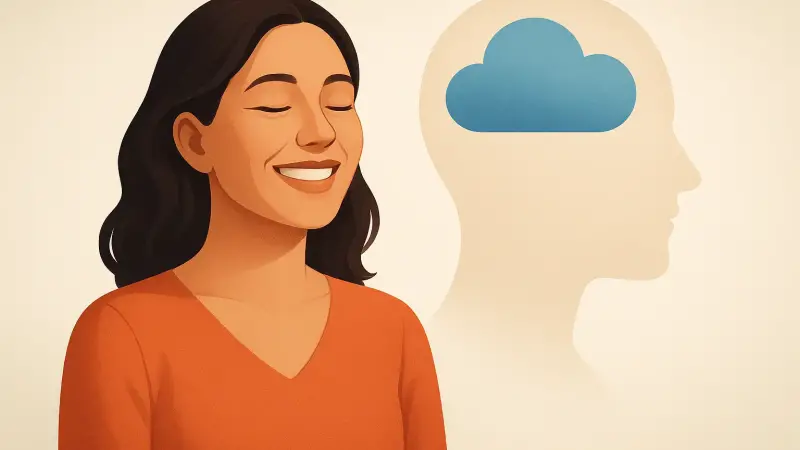
A small thing people notice but rarely question
You can walk into a tense place and feel it in your face first. A tight mouth in a crowded subway car. A clenched jaw in a waiting room. It isn’t one single “smile culture” that explains it either. It varies a lot between places like the United States, Japan, and Russia, and even between workplaces and families in the same city. Still, the basic mechanism is pretty consistent: moving the muscles used for a smile sends feedback into the nervous system. That feedback can nudge the body’s stress response, even when the situation hasn’t changed.
The facial feedback loop is more than a phrase

The face is not just an output device. It’s wired into systems that track threat, safety, and social contact. When the zygomatic muscles (the ones that lift the corners of the mouth) and the muscles around the eyes shift into a “smile-like” pattern, sensory nerves report that change back to the brain. That can slightly alter how the brain interprets what’s happening in the body, including how keyed-up it thinks it needs to be.
A detail people overlook is that not all smiles are the same signal to the body. A “social” smile that only uses the mouth can feel different than a Duchenne smile, which also recruits the muscles around the eyes. Those eye muscles are not just decoration. They change the overall pattern of facial tension, which can change what the nervous system reads as strain versus ease.
Stress physiology can shift from the outside in
Stress isn’t only a thought. It’s also heart rate, breathing, and hormone signaling. Smiling tends to be linked with parasympathetic activity, the “brake” side of the autonomic nervous system that supports recovery. Researchers have measured small differences in heart rate and perceived stress when people hold a smile-like expression during stressful tasks. The effects aren’t magical and they vary by person, but the direction is often the same: the body can downshift a notch.
Part of this may be mechanical. Facial tension changes breathing patterns, especially around the mouth and jaw. A clenched jaw is often paired with shallow breathing. A relaxed face makes it easier for breathing to lengthen. That matters because breathing and heart rate are tightly linked through vagal pathways, and those pathways are a big part of how stress ramps up and ramps down.
It also changes what other people do next
Stress levels are not only internal. They’re affected by feedback from other humans. A smile can change the next 10 seconds of an interaction, which can change the stress load in the body. Think of a customer-service desk where a line is building and one person is already upset. If the staff member’s face stays neutral and tight, the customer often escalates. If the staff member gives a small, genuine-looking smile, the customer may soften, speak more quietly, or shorten the complaint.
That shift matters because social threat is a major driver of stress physiology. Being judged, challenged, or rejected can trigger a strong response. A smile can signal “I’m not a threat,” which can reduce the other person’s defensiveness. Then the room gets calmer. The calmer room feeds back into the original person’s stress level, regardless of what they were trying to communicate with their face.
Why it doesn’t work the same way for everyone
The effect depends on context, culture, and how forced the expression feels. If a smile is used to cover fear or anger, the mismatch can create more tension in the body, not less. Some people also find smiling under pressure exhausting, especially in jobs that require constant friendliness. In those cases, the “smile” is paired with effort and monitoring, which are both stress-amplifiers.
It also depends on what the brain expects a smile to mean. In some settings, smiling at strangers is normal. In others, it can be read as odd, intrusive, or even suspicious. That interpretation changes the social feedback you get, which changes whether the nervous system gets a safety signal or a warning signal. The same facial movement can land very differently depending on where you are and who is watching.
Related reads
- Why some people prefer messy desks and others thrive on order
- How tiny annoyances hijack your focus all day
- A cliff that resonates a clear low note only at sunrise
- A roadside diner where the jukebox plays songs recorded by customers the same day
- An abandoned phone booth that still connects callers to a single mysterious number
- The office elevator that always opens to the floor the last person thought of