
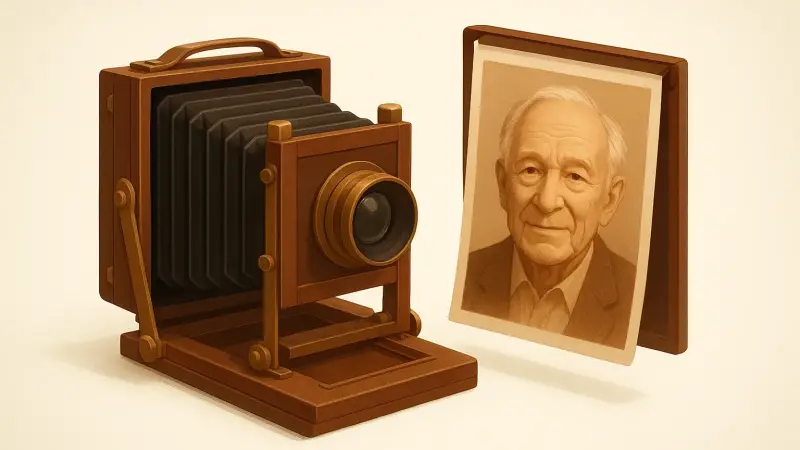
A camera that “developed” something years later
People expect film to be either exposed or not. Developed or not. So it’s jarring when an antique camera gets opened and there’s an image on the film that nobody remembers taking. This isn’t one single famous incident with one verified location. Similar stories show up around estate cleanouts and collector circles in lots of places, including the United States, the UK, and Japan. The core mechanism is usually mundane: old film can hold a latent image for a very long time, and a later chemical or environmental change can make that hidden exposure visible. It can feel like the camera “did it on its own,” but the film has been carrying the information.
What “decades old portrait” can mean on film
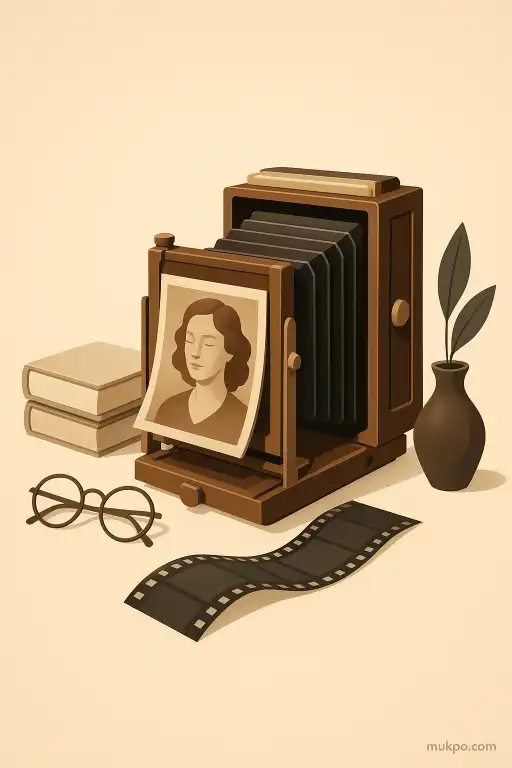
On traditional film, light doesn’t create a picture you can see right away. It changes tiny crystals of silver halide suspended in gelatin. Where light hit, a few silver ions get reduced into minuscule clusters of metallic silver. That invisible pattern is the latent image. It can sit there for years if nothing else happens. The portrait only becomes obvious when a developer turns those clusters into bigger silver grains, or when something else slowly darkens the same areas.
The overlooked detail is that “undeveloped” doesn’t mean “blank.” It means “not amplified yet.” If a camera was loaded and a face was exposed even once—maybe a quick test shot, maybe a shutter fired while it was being carried—the film can keep that faint blueprint far longer than people assume, especially if it stayed cool and dry.
How an image can appear without a proper darkroom
Film doesn’t need a formal developing tank to change. Heat, humidity, and time can push chemical reactions forward. With some black-and-white stocks, long storage can cause “latent image regression,” where the hidden image fades. But the opposite can also happen visually: general fog increases, and the densest parts of the latent image can become easier to see as contrast shifts. It’s not true development in the controlled sense, but to someone holding the strip it looks like an image emerged.
There’s also contamination. Developer residue, fixer fumes, or even certain cleaning chemicals can interact with the gelatin. Cameras stored in basements, attics, or near darkroom supplies are good candidates. A small leak from an old battery or a corroding metal part can also create localized staining that outlines shapes on the film. If that staining lines up with a faint exposure underneath, it can read as a coherent portrait.
Why portraits show up more often than landscapes
A portrait is a high-contrast subject. Faces tend to have clear midtones, dark hair or clothing, and catchlights in the eyes. That matters because long-stored film usually loses subtle differences first. Fine detail drops away. Shadows block up. Highlights fog. A landscape with delicate texture can turn into mush, but a head-and-shoulders frame can stay recognizable even when the negative is in poor shape.
There’s a situational pattern people miss: older cameras were often “tested” indoors at close range. Someone loads a roll, points it at whoever is nearby, and clicks once to make sure the shutter works. Then the camera goes back in a closet. Years later, that casual test exposure is the only frame with enough signal to survive aging, so it’s the one that seems to appear from nowhere.
What can make the timing feel impossible
Part of the confusion is that the camera and the film don’t necessarily match. Antique bodies often get reused with much newer film, and old film sometimes gets loaded into newer bodies. So “decades old” can refer to the camera’s age, the film’s expiration date, the time since the exposure, or just the owner’s memory. If the roll sat in the camera through moves, inherited storage, or long periods of disuse, nobody has a clean timeline.
Another wrinkle is printing and scanning. A negative that looks nearly blank to the eye can still contain an image that a scanner pulls out by stretching contrast and lifting shadows. The person discovering it experiences that as a sudden reveal. They opened the back and saw “nothing,” then later the portrait shows up on a screen. The film didn’t decide to develop itself at that moment. The information was there, just buried under fog and age.
Related reads
- How the brain invents reasons after we make a choice
- A library that stamps books with the weather they were read in
- How smiling can actually lower your stress levels
- Why some people prefer messy desks and others thrive on order
- How tiny annoyances hijack your focus all day
- A cliff that resonates a clear low note only at sunrise